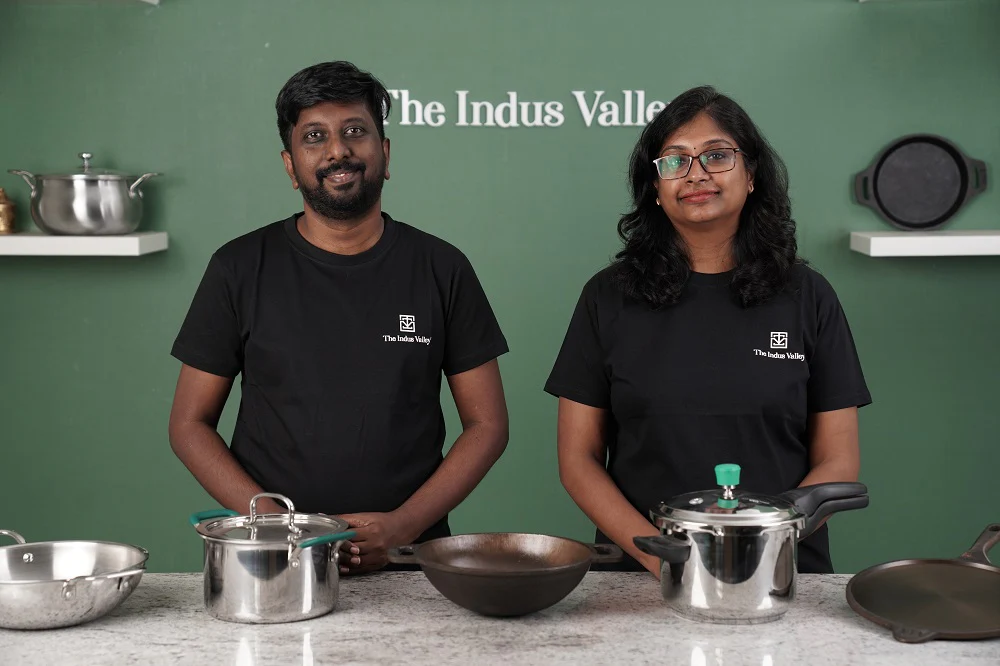
Co-founder Jagadeesh Kumar reveals how The Indus Valley scaled to ₹200 Cr ARR, championing traditional, toxin-free kitchenware for health-conscious Indians.
The Indus Valley, founded by Jagadeesh Kumar and Madhumitha Kumar in 2016, has successfully scaled to an Annual Recurring Revenue (ARR) of ₹200 crore (approximately $24 million) in the D2C cookware segment.
The brand champions toxin-free kitchenware, leveraging traditional materials such as cast iron, tri-ply stainless steel, and ceramic to cater to India's burgeoning health-conscious consumer base.
Jagadeesh Kumar's strategy focuses on robust product innovation, a direct-to-consumer engagement model, and capitalising on the increasing awareness surrounding healthy living and sustainable choices.
Operating within the highly competitive Home & Kitchen D2C sector, The Indus Valley distinguishes itself through its material science-backed product development and a clear, compelling health proposition.
The company is now strategically positioned for further expansion, aiming to diversify into new product categories and deepen its market penetration across key Indian metropolitan and Tier-2 cities.
In a significant stride for India's burgeoning direct-to-consumer (D2C) ecosystem, The Indus Valley, a Chennai-based toxin-free cookware brand, has announced its achievement of a ₹200 crore (approximately $24 million) Annual Recurring Revenue (ARR). Founded in 2016 by husband-wife duo Jagadeesh Kumar and Madhumitha Kumar, the company has carved a distinct niche by offering health-conscious consumers an alternative to conventional chemically-coated kitchenware, focusing on durable and natural materials. This milestone underscores the growing consumer shift towards wellness-oriented products and validates the brand's persistent commitment to quality and safety in the home and kitchen sector.
The Indus Valley's journey to this impressive revenue mark is rooted in its foundational philosophy: to bring back traditional, healthy cooking practices into modern Indian homes. The brand’s product portfolio prominently features pre-seasoned cast iron, premium tri-ply stainless steel, and ceramic cookware, all designed to be free from harmful chemicals like PFOA, lead, and cadmium, which are often found in non-stick coatings. This focus directly addresses a critical gap in the market, appealing to a demographic increasingly scrutinising ingredients and manufacturing processes across all consumption categories.
Jagadeesh Kumar, Co-founder of The Indus Valley, told Inc42, "Our vision was clear from day one: empower every Indian kitchen with safe, healthy, and durable cookware that stands the test of time. We observed a significant void where consumers were seeking alternatives to chemically-coated pans and pots, but options were limited or lacked quality assurance. Reaching ₹200 crore ARR is not just a financial milestone; it is a testament to the trust consumers place in our commitment to their health and the quality of our products."
The brand's D2C model has been instrumental in its rapid scaling. By controlling the entire value chain from manufacturing to customer delivery, The Indus Valley maintains stringent quality checks and fosters direct relationships with its consumer base. This approach allows for agile product development, quick feedback integration, and a consistent brand narrative that resonates with its target audience.
The Indus Valley Achieves ₹200 Cr ARR
The D2C toxin-free cookware brand has crossed an Annual Recurring Revenue of ₹200 crore, equivalent to approximately $24 million USD, marking a significant growth trajectory in India's home and kitchen segment.
The Recipe For Growth: Why Toxin-Free Matters
The surging demand for toxin-free products is not merely a trend but a fundamental shift in consumer behaviour, driven by increased health awareness and access to information. Historically, Indian kitchens have relied on traditional materials like iron, brass, and clay. However, the advent of modern non-stick cookware, promising convenience and ease of use, led to a temporary departure from these roots. The health implications associated with conventional non-stick coatings, particularly regarding per- and polyfluoroalkyl substances (PFAS) like PFOA, have now brought the focus back to safer alternatives. The Indus Valley capitalised on this return to tradition, marrying it with contemporary design and functionality.
"The pandemic further accelerated this awareness," Madhumitha Kumar told Inc42. "People spent more time cooking at home, becoming more conscious about what goes into their food and what tools they use. Our products are designed for longevity and health, reducing the need for excessive oil and ensuring that no harmful chemicals leach into meals. This educational aspect is crucial for us, and our customers appreciate the transparency and the long-term health benefits." The brand's emphasis on material science, from the superior heat retention of cast iron to the non-reactive properties of tri-ply stainless steel, provides a compelling reason for consumers to invest in their products, often at a premium compared to mass-market alternatives.
The brand's success is also a reflection of a broader trend within the Indian D2C ecosystem, where niche brands are finding significant traction by addressing specific consumer pain points and offering specialised, high-quality products. The competitive landscape for cookware in India includes both legacy players and a growing number of new-age D2C brands. The Indus Valley differentiates itself through its unwavering focus on the "toxin-free" promise, a clear and strong value proposition that cuts through the noise. This singular focus helps build a loyal customer base, transforming initial purchases into repeat business and brand advocacy.
What's Next: Scaling Beyond ₹200 Crore
With a robust foundation and significant market validation, The Indus Valley is now setting its sights on the next phase of growth. The immediate strategy involves expanding its product catalogue to encompass more categories within the kitchen and dining space, potentially exploring toxin-free bakeware, kitchen tools, and even small appliances that align with their health-centric philosophy. This expansion aims to capture a larger share of the household spending on kitchen essentials, leveraging the trust already established with its existing customer base.
"Our immediate goal is to deepen our penetration in Tier-1 and Tier-2 cities, where health consciousness is rapidly growing," Jagadeesh Kumar revealed to Inc42. "We are also actively looking at strategic partnerships for offline retail presence to complement our strong online footprint. While D2C remains our core, a hybrid approach will allow us to reach a broader audience who prefer to touch and feel products before purchase, especially for items like cookware. Furthermore, we are exploring opportunities for international expansion, particularly in markets with similar cultural values and a demand for healthy, traditional cooking solutions."
The path to scaling beyond ₹200 crore ARR will involve navigating challenges such as supply chain optimisation for heavy goods, managing increased competition, and continuously innovating while staying true to the brand's core values. The Indus Valley plans to invest further in R&D to introduce new materials and product designs that offer enhanced functionality and aesthetic appeal without compromising on health and safety. Potential funding rounds are also on the horizon to fuel this aggressive expansion, solidify market leadership, and invest in brand building and technology. The company's journey highlights a powerful playbook for D2C success in India: identify a critical consumer need, offer an uncompromising solution, and build a brand with authenticity and purpose.
Frequently asked questions
How did Jagadeesh Kumar build The Indus Valley into a ₹200 Cr brand?
Jagadeesh Kumar, with co-founder Madhumitha Kumar, scaled The Indus Valley to a ₹200 Cr ARR by focusing on toxin-free cookware made from traditional materials like cast iron, tri-ply stainless steel, and ceramic, catering to health-conscious Indian consumers.
What kind of products does The Indus Valley offer?
The Indus Valley specializes in toxin-free kitchenware, including products made from cast iron, tri-ply stainless steel, and ceramic, designed for healthy cooking.
Who founded The Indus Valley?
The Indus Valley was founded by Jagadeesh Kumar and Madhumitha Kumar in 2016.
What is The Indus Valley's Annual Recurring Revenue (ARR)?
The Indus Valley has successfully scaled to an Annual Recurring Revenue (ARR) of ₹200 crore, which is approximately $24 million.
What materials does The Indus Valley use for its cookware?
The brand leverages traditional materials such as cast iron, tri-ply stainless steel, and ceramic to create its toxin-free kitchenware.
When was The Indus Valley founded?
The Indus Valley was founded in 2016.