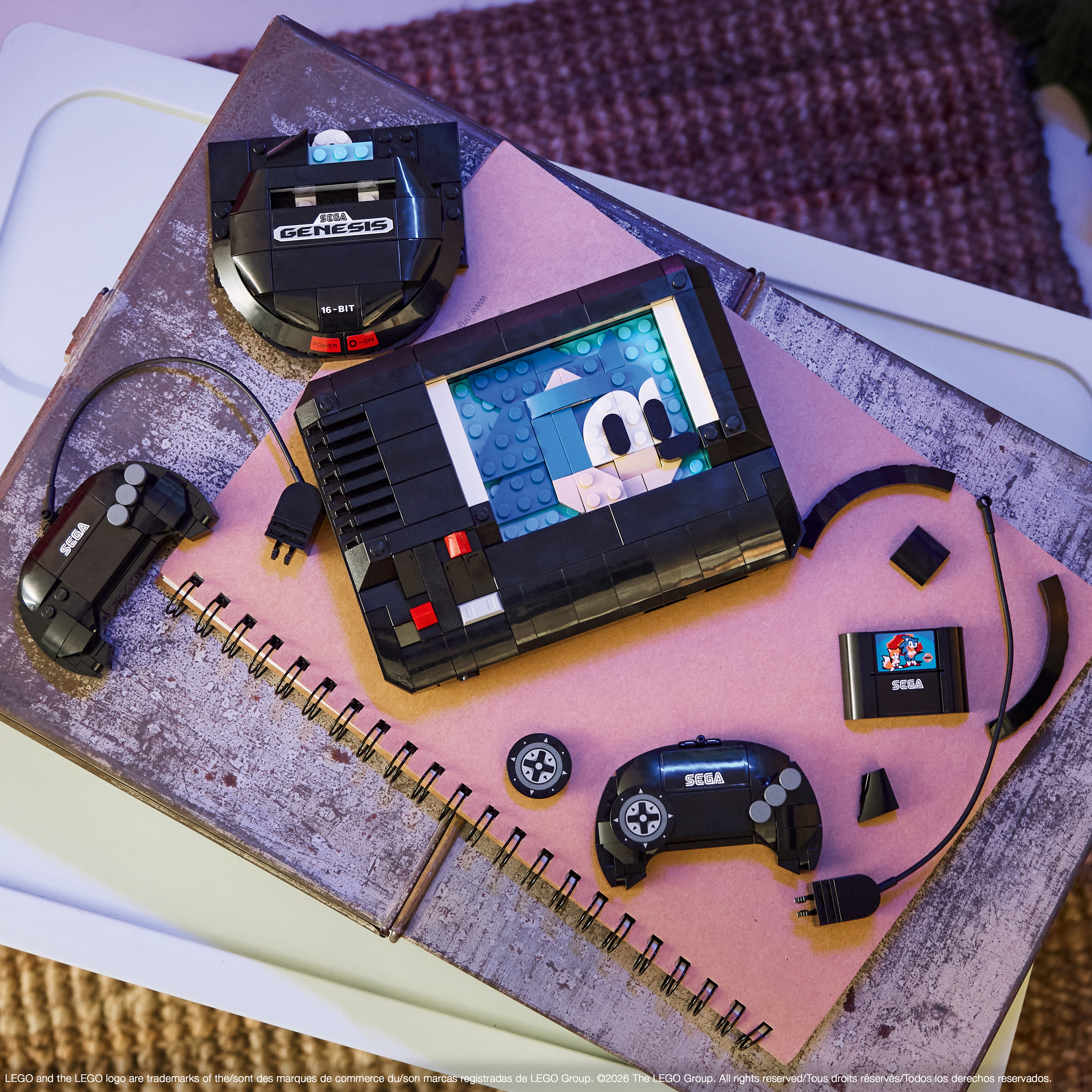
Silicon Valley spends billions trying to build the "next big thing," but Billund and Tokyo are proving there is more alpha in meticulously rebuilding the past. While the tech industry obsesses over the diminishing returns of 8K resolution and cloud-based latency, the news that Lego And Sega are partnering to release a functional-aesthetic, 1,125-piece Sega Genesis set signals a sophisticated pivot toward "Physical Permanence."
Most hardware dies twice: once when the software stops updating, and again when the capacitors leak. By turning the console that defined the 1990s into a high-end adult collectible, these two giants are creating a tangible archive that bypasses the planned obsolescence of the digital age. This is the "Product-as-Artifact" strategy—a lesson in brand durability that every founder building "smart" hardware should be studying with a degree of envy.
The Architecture of the Deal: Hardware as Art
The set is a 1:1 scale (in spirit, if not exact dimension) recreation of the 1989 "High Definition Graphics" model, complete with a buildable Sonic the Hedgehog cartridge that actually slots into the top. It follows in the footsteps of the LEGO NES and Atari 2600 sets, cementing a new category of "Adult Fan of Lego" (AFOL) products that prioritize mechanical accuracy over playability.
For Sega, this is a low-risk, high-margin maneuver to keep the Genesis brand alive in the physical world without the nightmare of manufacturing complex electronics or managing global supply chain volatility for semiconductors. For LEGO, it’s about maintaining its status as the world’s premier IP aggregator. When Lego And Sega collaborate, they aren't just making a toy; they are creating a physical trophy for the generation that now controls the majority of the world's discretionary income.
The Nostalgia Economy: Data Breakdown
Target Demographic: 30–45-year-olds (The "Kidult" segment).
Average MSRP for "Icon" Sets:$199–$269 USD.
The Secondary Market: Discontinued LEGO adult sets historically see an 11% annual return, frequently outperforming gold and the S&P 500 in localized cycles.
The "Easter Egg" Factor: 1,125 pieces, including a hidden mechanical diorama of the Green Hill Zone that reveals itself when the console shell is opened.
The Global Pivot: Why IP is the New Oil
This collaboration isn't happening in a vacuum; it is a response to a global tightening of the IP market. From the European Union’s Intellectual Property Office (EUIPO) to Japan’s recent amendments to copyright law, the protection and monetization of legacy "design language" has become a cornerstone of global trade.
In Tokyo, Sega Sammy Holdings has been aggressively pivoting toward "Transmedia" strategies, following the massive success of the Sonic cinematic universe. In Denmark, the LEGO Group reported a 13% increase in revenue specifically driven by its "Adults Welcome" campaign—a move that mirrors how luxury fashion houses like LVMH treat their heritage archives. For founders in the startup hubs of London, Singapore, or Berlin, the takeaway is clear: your software will eventually become a legacy burden, but your brand’s aesthetic—if physicalized—can live forever as a lifestyle asset.
"LEGO has successfully transitioned from a toy manufacturer to a luxury lifestyle curator. By partnering with Sega, they are tapping into a deeply emotional 'techno-nostalgia' that bypasses the rational brain. It’s no longer about what the machine does; it’s about how the machine made you feel in 1991." — Dr. Helen Edwards, Brand Strategist and Marketing Lead at Verve
Who Wins, Who Loses, and Who is Next?
The Winners: The "Collectors" and the IP Holders Sega wins by revitalizing a brand that hasn't seen new hardware in decades without the R&D risk. LEGO wins by diversifying its portfolio away from purely cinematic IP (like Disney or Marvel) and into "Tech-Heritage."
The Losers: The "Mini-Console" Market Remember the Sega Genesis Mini or the PlayStation Classic? Those were functional electronics that eventually ended up in junk drawers once the novelty of the pre-loaded games wore off. The LEGO version is different; it’s designed to be displayed on a bookshelf next to a Herman Miller chair. It’s furniture, not a gadget.
The Founder's Perspective: Building for the "Museum Era" "We spend so much time worrying about our API uptime and our churn rates," says a CTO of a London-based fintech unicorn. "Then I see what Lego And Sega are doing, and I realize that 30 years from now, nobody will care about my backend. They’ll care about the aesthetic of the era we built. We need to be building brands that people want to put on their shelves, not just their home screens."
Skeptic’s Corner: The Plastic Tech Paradox
Is there a limit to how many plastic recreations of dead tech the market can swallow? A contrarian take suggests that as the world moves toward the Circular Economy and stricter ESG mandates, the mass production of non-biodegradable "nostalgia" is a ticking reputational bomb. LEGO is currently investing billions in sustainable materials, but the irony of building a dead console out of petroleum-based bricks is a friction point that the climate-conscious operator shouldn't ignore.
Key Takeaways for Operators
Hardware as Content: Treat your physical product designs as a form of intellectual property that can be licensed out once the electronics are obsolete.
The Adult Premium: The "Kidult" market is growing faster than the traditional toy market. High-price-point, high-complexity builds are where the margins are shifting.
Tactile Engagement: In an AI-generated, digital-first world, the "Physicality" of a product is its most unique selling point.
Partnership over Competition: Sega couldn't build a new console, and LEGO couldn't invent Sonic. Together, they own the 90s.
What to Watch Next
The Nintendo GameCube Rumors: With the NES and SNES likely covered, insiders are watching for LEGO to move into the "early 3D" era of hardware.
Modular Integration: Watch for LEGO to introduce "Light and Sound" bricks that mimic the console’s original boot-up sequence, bridging the gap between plastic and electronics.
The "Web3" Physical Bridge: Expect more digital-native brands (think Pudgy Penguins or Bored Ape Yacht Club) to seek out LEGO-style physical partnerships to find "real world" legitimacy.
The Final Word
The news that Lego And Sega are bringing a buildable Genesis to market is more than a press release for retro-gamers; it’s a eulogy for the era of "disposable" tech. We are moving into a period where the history of computing is being curated by toy companies rather than computer scientists. For founders, the message is simple: build something that someone might want to recreate in bricks 30 years from now. If you can’t imagine your product as a LEGO set, maybe it isn't iconic enough yet.