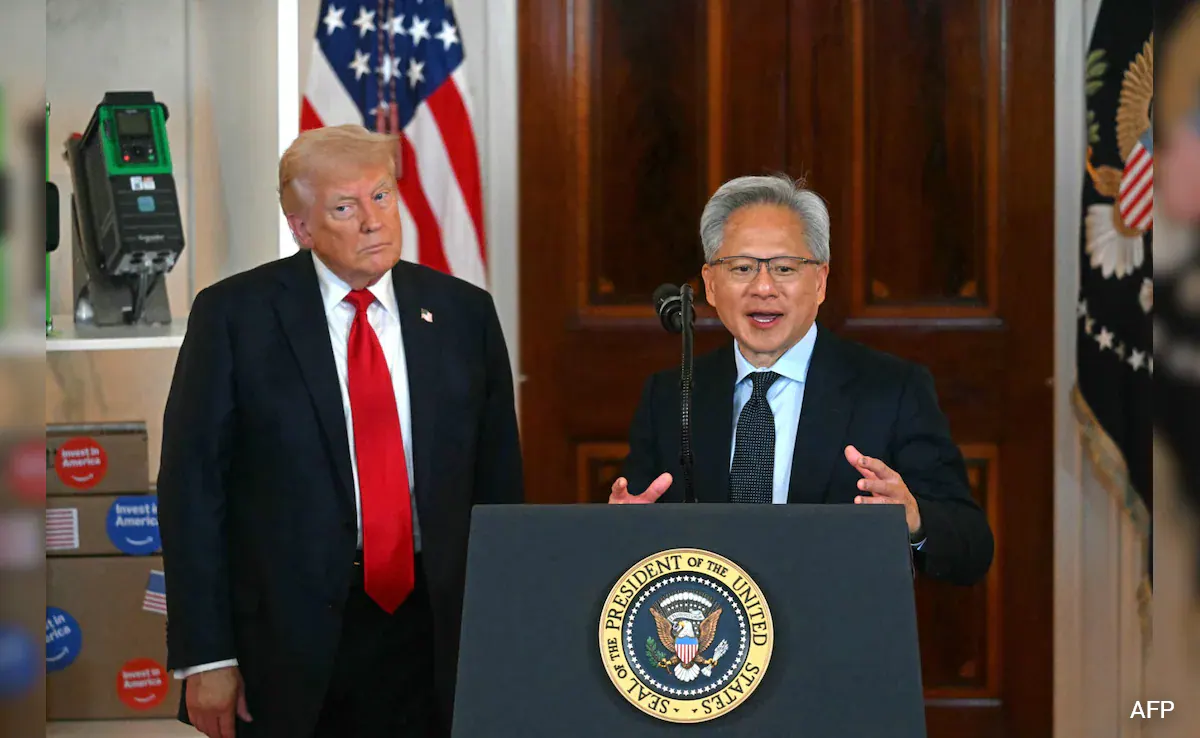
Jensen Huang's unexpected presence with Trump in Beijing signals a major shift in US-China tech policy, poised to reshape AI and global markets.
The tech world just got a wake-up call, and it arrived straight from Beijing. Nvidia CEO Jensen Huang, a figure synonymous with cutting-edge artificial intelligence, was spotted joining former President Trump's high-profile diplomatic visit to China this week. This isn't just a photo opportunity; it signals a potentially massive reversal in US-China tech relations that could reshape global markets and your investment portfolio.
Here's why it matters: The rumor mill, initially dismissed as wishful thinking by many, quickly escalated to credible reports suggesting the trip aims to finalize a deal for Nvidia to sell its advanced H200 AI chips to Chinese entities. This would represent a stunning pivot from the stringent export controls that have, for years, defined America's strategy to slow China's technological ascent, directly challenging the conventional wisdom of an inevitable tech decoupling.
For context, US policymakers have spent years erecting barriers to prevent China from accessing top-tier AI processors, fearing their use in military applications and surveillance. Nvidia, a leader in the AI chip space, has been at the forefront of these restrictions. The company was forced to design less powerful, China-specific chips, like the H800 and L20, to comply with export rules, effectively walking a tightrope between geopolitical mandates and a crucial market. Prior to the restrictions, China accounted for roughly 20-25% of Nvidia's data center revenue, a segment that has been significantly curtailed, costing the company billions in potential sales.
The H200 is Nvidia's latest and most powerful GPU for AI applications, offering significantly enhanced memory and performance over its predecessors. Allowing its sale to China would not just be a minor concession; it would be a substantial re-opening of the floodgates, granting Chinese tech giants access to the very tools Washington sought to withhold. It's a move that, if confirmed, will send shockwaves through Washington D.C., Silicon Valley, and financial markets worldwide, forcing a re-evaluation of what 'decoupling' truly means.
The potential deal comes as the global economy grapples with persistent inflation and a slowdown in key sectors. For many US corporations, particularly in tech, China remains an indispensable market for both sales and manufacturing. While political rhetoric often emphasizes national security over economic gain, the reality for public companies is quarterly earnings and shareholder value. This proposed H200 agreement could be seen as a pragmatic response to these economic pressures, prioritizing the bottom line for a major American tech powerhouse over the more hawkish geopolitical stance.
The Conventional Wisdom, Upended
For the better part of a decade, the conventional wisdom dictated a clear and accelerating trajectory: the United States and China were on an inexorable path toward technological decoupling. Analysts across the political spectrum, from think tanks to Wall Street strategists, consistently argued that Washington's commitment to stifling China's advanced computing capabilities—especially in AI—was unwavering. The rationale was simple: deny Beijing the most advanced semiconductors, and you slow its progress in critical areas like AI-powered military systems, surveillance, and next-generation economic competitiveness. This view held that any short-term economic pain for US companies was a necessary sacrifice for long-term national security and technological dominance.
This perspective was strongly reinforced by a series of increasingly stringent export controls, which not only targeted specific chips but also equipment and expertise necessary for their production. The idea was to create an insurmountable technological gap, forcing China to rely on its own nascent, less advanced chip industry. The prevailing narrative was that this strategy, while disruptive, was effectively working, albeit slowly, and that the US would only tighten these restrictions further, making any significant loosening unthinkable. Industry leaders, including Nvidia's Huang, had publicly acknowledged the challenging environment, adapting their product lines to fit within the ever-narrowing parameters.
However, the spectacle of Jensen Huang accompanying a US presidential envoy to Beijing, with the explicit aim of discussing an H200 chip deal, completely dismantles that deeply entrenched conventional wisdom. It signals a dramatic and unexpected shift from a purely confrontational stance to one that appears far more transactional and economically driven. This isn't a minor tweak to existing policy; it's a fundamental re-evaluation of the costs and benefits of the tech war, suggesting that the "national security at all costs" approach might be giving way to a more nuanced, or perhaps even opportunistic, engagement. The evidence, in this case, is the very presence of Huang and the nature of the rumored discussions, which directly contradict the long-held belief that advanced US chips were permanently off-limits to China.
This move implies that the pressure from US tech companies, facing billions in lost revenue and market share, has reached a critical point. It also suggests a potential strategic calculus within the US administration that allowing controlled access to certain advanced technologies might yield greater diplomatic or economic benefits than a total blockade. This could be a lifeline for Nvidia's China revenue, which, according to some estimates, had dipped from an estimated $12 billion annually before the most severe restrictions to under $4 billion in recent fiscal periods. A full return to the Chinese market with leading-edge products could add tens of billions to Nvidia's valuation, demonstrating the immense financial leverage at play.
What This Means for Your Money and the AI Race
For investors, the implications are immediate and potentially transformative, especially for shareholders of Nvidia. A deal allowing H200 sales into China could unlock a massive revenue stream that was previously written off. Nvidia's stock, already a market darling due to its dominance in AI, could see another significant surge, reflecting renewed access to the world's second-largest economy. But the ripple effects extend beyond Nvidia; it could signal a broader thawing of tech trade relations, potentially benefiting other American semiconductor firms, software companies, and even cloud service providers who have been eyeing the Chinese market with trepidation.
More broadly, this decision could significantly accelerate the global AI race. With access to top-tier chips, Chinese companies, which have already made substantial strides in AI research and application, could innovate even faster. While this might lead to faster global progress in areas like drug discovery, material science, and climate modeling, it also intensifies competition with US firms. Consumers worldwide could benefit from more rapid AI advancements, but it also raises questions about who controls these powerful technologies and how they are deployed, particularly concerning data privacy, algorithmic bias, and potential military applications.
The political fallout in Washington D.C. is likely to be intense. Hardline voices in Congress, who have advocated for an even tougher stance on China, will undoubtedly criticize the move as a concession that undermines national security. They will argue that providing China with advanced AI capabilities could eventually be turned against US interests. Conversely, industry lobbyists and more pragmatic policymakers might champion the deal as a necessary step to protect American corporate interests and maintain global economic leadership, arguing that complete isolation is neither feasible nor desirable in the long run. The debate will likely center on whether the economic benefits outweigh the perceived national security risks, a calculus that appears to have shifted dramatically.
From Beijing's perspective, this deal would represent a significant diplomatic and technological victory. It would alleviate immediate pressure on their domestic AI ambitions and potentially demonstrate that China's strategic importance can influence US policy, even under a hawkish administration. It might also lessen the urgency for China to fully indigenize its high-end chip production, though efforts in that direction will almost certainly continue, albeit perhaps with a slightly longer timeline.
Crucially, the exact terms of any H200 deal would be paramount. Would there be strict end-user verification? Limitations on volume or specific applications? Guarantees against military use? Without such caveats, the move would be seen as a near-total capitulation on tech export controls. However, even with stringent conditions, the mere fact that such a deal is on the table indicates a fundamental re-evaluation of what constitutes acceptable engagement in the US-China tech rivalry.
This unexpected development isn't just a blip on the geopolitical radar; it's a potential inflection point that demands a complete re-evaluation of US-China tech relations. It forces investors, policymakers, and consumers to reconsider long-held assumptions about the future of global supply chains, technological innovation, and the delicate balance between national security and economic prosperity. The ripples from this potential H200 deal will undoubtedly shape the contours of the AI era for years to come, illustrating just how quickly conventional wisdom can be shattered in the volatile world of international tech diplomacy.