In the Indian startup ecosystem, 2024 and 2025 were defined by the "quick-commerce-ification" of everything from groceries to electronics. Now, in May 2026, the instant-fulfillment playbook is officially breaching the walls of the highly lucrative, high-margin personal care and beauty industry.
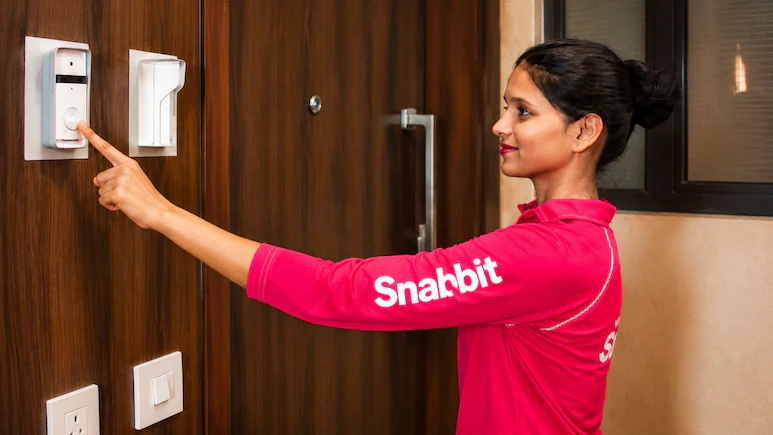
Hyperlocal home-services major Snabbit has announced its formal foray into the beauty services category. Moving away from the traditional industry standard of advance bookings and scheduled slots, Snabbit is introducing an instant, salon-at-home model designed to dispatch beauty professionals to a consumer’s doorstep within minutes.
The move follows a quietly executed six-week pilot in Bengaluru’s dense Sarjapur micromarket. The metrics from the pilot signal a significant consumer appetite for impulse-driven personal care: over 2,000 jobs completed in just 6 weeks, with an average fulfillment time clocks in at under 15 minutes.
The Antithesis of the Urban Company Model?
For nearly a decade, the salon-at-home narrative in India has been dominated by players like Urban Company, built entirely around structured, appointment-led logistics. Consumers typically plan these services hours, if not days, in advance due to heavy product kits and specialist availability.
Snabbit is deliberately attacking the high-frequency, low-friction end of this spectrum. Instead of complex, multi-hour hair coloring or intensive spa therapies, the platform is optimizing for rapid-turnaround use cases: threading, waxing, clean-ups, hair styling, head massages, and saree draping.
To pull this off without crushing operational unit economics, Snabbit is introducing three core innovations:
The "All-Rounder" Gig Worker: Instead of deploying multiple specialized technicians, Snabbit is retraining beauty professionals with 3 to 14 years of experience into multi-skilled operators capable of executing the entire low-complexity menu in a single visit.
Optimized, Lightweight Logistics: The massive, heavy roller-suitcases traditionally associated with salon-at-home services have been replaced with compact, lightweight kits and single-use, monodose packaging (partnering with premium brands like O3+ and Rica) to reduce wastage and maximize mobility on two-wheelers.
Zero Minimum Order Value: In a direct bid to capture the impulse market, Snabbit has stripped away minimum order thresholds, pricing basic services starting at just ₹49.
The Pync Connection & Hyperlocal Density
The operational backbone of this expansion is being spearheaded by Dev Priyam, VP of Business at Snabbit. Priyam, who previously co-founded beauty-tech startup Pync, joined the Snabbit leadership ranks following Pync's acquisition last year. This rollout is the first clear manifestation of that acquisition’s synergy.
"Consumers should not have to plan around basic beauty needs anymore," Priyam noted, indicating that the service is currently seeing heavy organic traction just before office hours or ahead of evening social events.
Operating strictly as a "salon by women, for women," the pilot currently utilizes a lean cohort of 25 active professionals averaging nearly 50 jobs daily. Snabbit plans to perfect the operational loop in Sarjapur before deeply integrating the vertical into the main Snabbit app and scaling it across its existing pan-India micromarkets.
StartupNews.fyi Analysis: The Founder’s Takeaway
For enterprise builders and investors watching this space, Snabbit’s move highlights a crucial thesis shift in Indian consumer tech:
The Margins Cushion the Speed: Quick delivery of groceries operates on razor-thin margins. Personal beauty services, however, enjoy some of the highest gross margins in the service sector. By applying instant-logistics to a high-margin category, Snabbit might find a much faster route to unit-economic profitability than standard quick-commerce.
The S&D (Skill & Delivery) Challenge: The ultimate bottleneck will not be demand; it will be supply retention and standardization. Maintaining a sub-15-minute SLA requires extreme neighborhood density of available workers. Retaining high-quality beauty professionals in an "on-demand" standby state without fixed-income guarantees is a structural hurdle Snabbit will have to clear as it scales beyond Sarjapur.