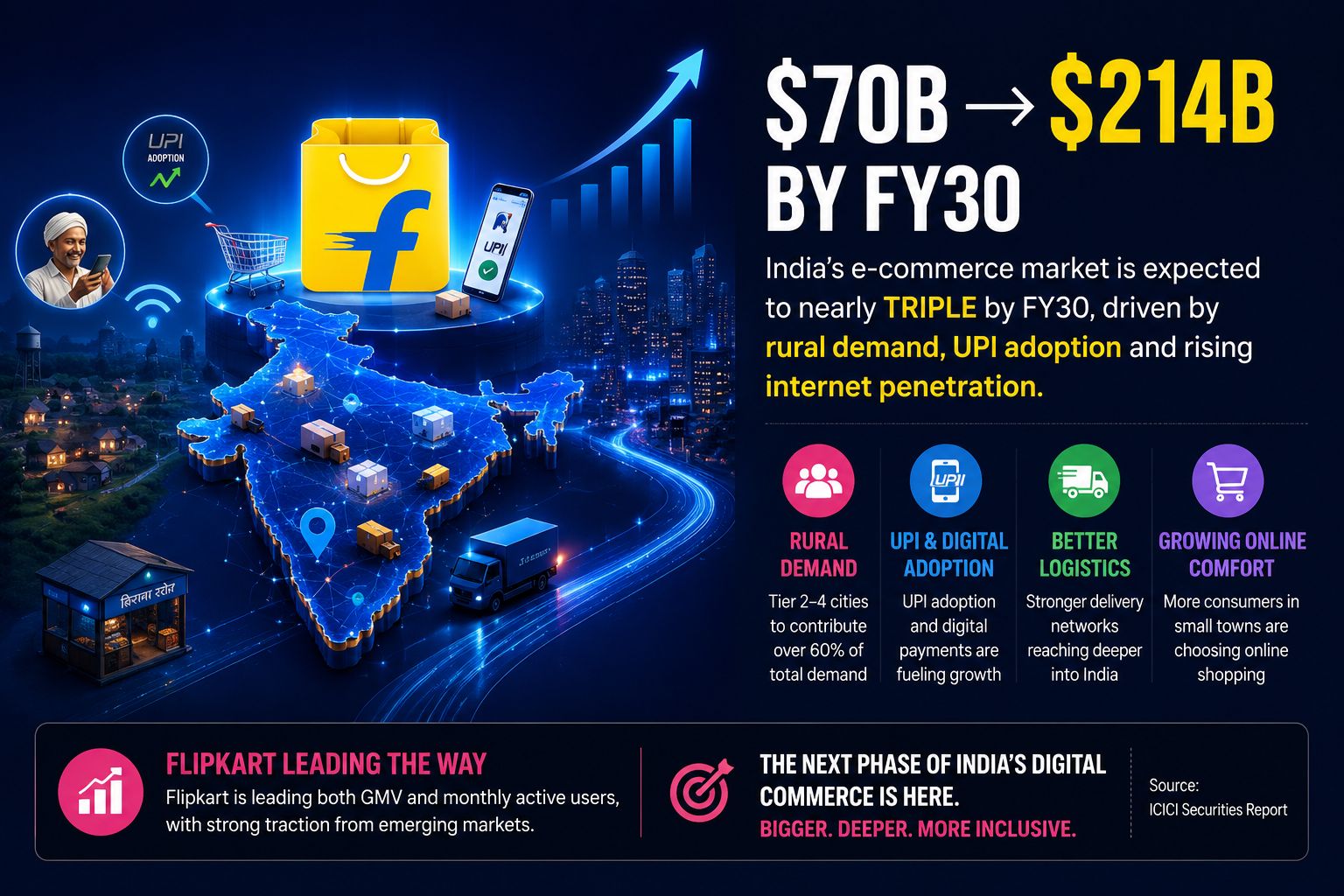
Flipkart secures 50-60% GMV share & 240 Mn MAUs as India's e-commerce market is projected to nearly triple by FY30.
India's e-commerce market is projected to reach $174-214 Bn (INR 14.5-17.8 Lakh Crore) by FY30, almost tripling from $70 Bn (INR 5.8 Lakh Crore) in FY25, driven by increasing internet penetration and rural demand.
Flipkart leads the market with an estimated 50-60% Gross Merchandise Value (GMV) share and 220-240 Mn monthly active users (MAUs), dominating high-value categories like electronics.
Amazon India secures the second spot with 25-30% GMV share and roughly 150 Mn MAUs, strong in metro markets and categories such as FMCG and beauty.
Meesho commands approximately 10% market share and 200 Mn MAUs, excelling in the value-commerce segment for price-sensitive consumers in Tier II and smaller cities.
E-commerce penetration within India's total retail market is expected to climb to 13% by FY30, up from 7% in FY25, indicating a significant shift from unorganised retail.
India’s digital commerce market is on a trajectory to nearly triple its current size, poised to hit an impressive $174-214 billion (INR 14.5-17.8 Lakh Crore) by FY30, a substantial leap from approximately $70 billion (INR 5.8 Lakh Crore) in FY25. This robust growth, detailed in a recent report by ICICI Securities, is primarily fuelled by expanding internet penetration, a burgeoning base of online shoppers, surging demand from non-metro markets, and a sophisticated digital payment infrastructure. The report underscores how India's e-commerce landscape has dynamically evolved over the past decade, transcending traditional online retail to embrace nuanced models like hyperlocal and quick commerce. The sector's momentum significantly accelerated post-2016, a period marked by the widespread adoption of smartphones, the revolutionary impact of UPI-led payments infrastructure, and the maturation of logistics networks. According to the ICICI Securities report, the COVID-19 pandemic further acted as a structural catalyst, rapidly embedding online shopping habits, particularly for groceries and essential goods, across diverse consumer segments. This confluence of technological advancement and shifting consumer behaviour has positioned e-commerce as an indispensable pillar of India's retail future. Among the leading players, Flipkart, the Walmart-owned giant, continues to assert its dominance, holding an estimated 50-60% share of the Gross Merchandise Value (GMV) market. The report estimates Flipkart’s monthly active user (MAU) base at a staggering 220-240 million, driven largely by its strength in high-value categories such as smartphones, appliances, and electronics, which collectively contribute 63-64% of its business. An investor told Inc42, "Flipkart's strategic advantage isn't just its product range, but its integrated ecosystem – Ekart for logistics, PhonePe for payments, and a robust network of 450,000 merchants. This creates significant entry barriers for competitors and ensures a sticky user base." Amazon India stands as the second-largest e-commerce player, commanding an estimated 25-30% GMV market share and serving around 150 million MAUs. The report highlights Amazon India's strong foothold in metro markets and its expansive presence in categories like beauty, personal care, FMCG, and general merchandise. With over 180 million products across 100+ categories and more than 100 fulfilment centres, Amazon’s operational scale is undeniable. A startup founder looking to scale told Inc42, "Amazon provides unparalleled reach, especially for D2C brands targeting urban consumers. Their entry into quick commerce with Amazon Now signals an aggressive play to capture every facet of urban consumer demand." Meesho, a disruptive force in the value-commerce segment, has carved out an estimated 10% market share, boasting approximately 200 million MAUs. The platform primarily caters to price-sensitive consumers in Tier II and smaller cities, a demographic that is increasingly vital for e-commerce growth. The ICICI Securities report indicates Meesho’s contribution to India’s e-retail GMV surged from around 5% in 2021 to over 10% in 2025. However, the brokerage points out that Meesho continues to grapple with profitability challenges, largely due to low-ticket order sizes and comparatively high delivery costs. For a founder in the value-commerce space, balancing hyper-growth with unit economics remains a constant tightrope walk.
India's total retail market is projected to expand from $978 Bn (INR 81.5 Lakh Crore) in FY25 to $1.4-1.6 Tn (INR 116.7-133.4 Lakh Crore) by FY30, with e-commerce's share rising from 7% to 13%.
Why It Matters
The projected tripling of India's e-commerce market is more than just a headline number; it represents a fundamental shift in the nation's economic fabric and consumer behaviour. This expansion is deeply intertwined with the digital empowerment of Bharat, particularly rural regions and Tier II-IV cities, which are expected to contribute over 60% of total e-commerce demand by 2026. With nearly 970 million internet subscribers and around 500 million online shoppers, India is witnessing a democratisation of access to goods and services previously confined to organised urban retail. The decline of unorganised retail's share from 79% in FY25 to a projected 66% by FY30 signals a formalisation of the retail sector, fostering greater efficiency, transparency, and potentially, better consumer pricing and choices. For investors, this robust growth trajectory signals a fertile ground for innovation and significant returns. Beyond the established giants, opportunities abound for niche players in logistics, payments, D2C brands, and specialised platforms catering to specific regional or product requirements. The report highlights that categories like smartphones continue to dominate, accounting for 30-40% of total GMV, followed by appliances and electronics (20-30%), and fashion (15-20%). A seasoned analyst shared, "The low household penetration in categories like home appliances presents immense room for online retail expansion. It's not just about selling existing products online; it's about creating new consumption patterns in underserved markets." This structural shift promises to fuel job creation, drive digital literacy, and integrate millions into the formal economy, making it a critical barometer for India's digital future.
What's Next
As the Indian e-commerce market surges forward, the next phase of growth will likely be defined by deeper penetration into untapped geographies and the continued evolution of fulfilment models. The emphasis will increasingly shift towards hyper-personalisation, leveraging AI and data analytics to cater to diverse linguistic and cultural nuances across the country. Quick commerce, already gaining traction in metros, is expected to expand its footprint, challenging traditional retail even further. Innovation in logistics, particularly for last-mile delivery in rural and semi-urban areas, will be paramount. Expect to see continued investment in supply chain technology, warehousing, and alternative delivery methods to reduce costs and improve efficiency. The ongoing battle for the next billion users, particularly those with lower digital literacy, will necessitate simpler interfaces, voice-enabled commerce, and greater integration with local languages. The market's dynamism suggests that while the established players will continue to dominate, agile startups focusing on specific pain points or unique consumer segments could still carve out substantial value.
Frequently asked questions
What is the projected size of India's e-commerce market by FY30?
India's e-commerce market is projected to reach $174-214 billion (INR 14.5-17.8 Lakh Crore) by FY30. This represents nearly a threefold increase from its estimated $70 billion value in FY25.
Which company currently leads India's e-commerce market?
Flipkart currently leads the Indian e-commerce market, holding a significant share of both Gross Merchandise Value and monthly active users.
What is Flipkart's estimated market share in terms of GMV and MAUs?
Flipkart holds an estimated 50-60% share of the Gross Merchandise Value (GMV) and boasts 220-240 million monthly active users (MAUs), making it a dominant player.
What are the key drivers of India's e-commerce market growth?
The primary drivers for India's e-commerce market growth include increasing internet penetration across the country and a significant rise in demand from rural areas, expanding the consumer base.
In which categories does Flipkart show strong dominance?
Flipkart exhibits strong dominance in high-value categories within the e-commerce sector, particularly electronics. This focus contributes significantly to its overall GMV leadership.
How much is India's e-commerce market expected to grow from FY25 to FY30?
India's e-commerce market is expected to almost triple, growing from an estimated $70 billion (INR 5.8 Lakh Crore) in FY25 to $174-214 billion (INR 14.5-17.8 Lakh Crore) by FY30.