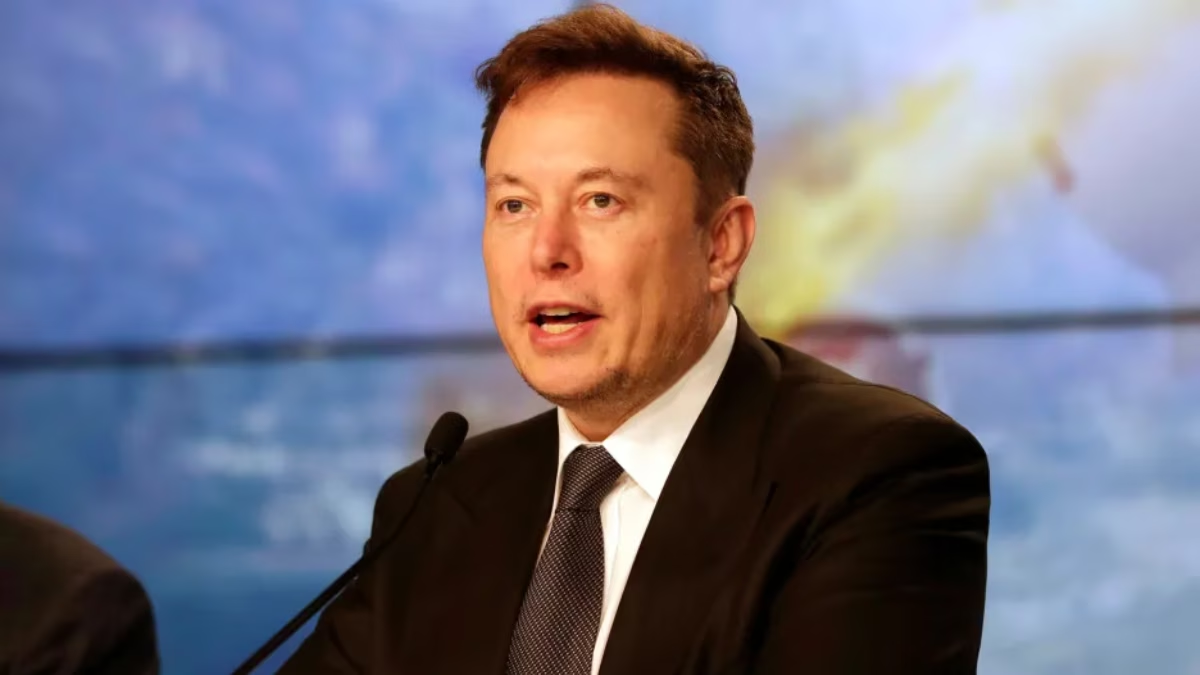
Eleven days, That's how long Elon Musk delayed disclosing his initial 5% stake in Twitter in early 2022 — a gap that, according to federal regulators, let him buy more than $500 million worth of shares at artificially low prices before the market caught on. On Monday, that saga came to a close: Elon Musk agreed to pay $1.5m to settle the Securities and Exchange Commission's lawsuit, closing a chapter that has defined the most combative relationship between a tech mogul and a federal regulator in recent memory.
The headline number — $1.5 million — is almost comically small. Forbes pegs Musk's net worth at $789.9 billion. The penalty amounts to roughly 0.00019% of that figure. For context, that's proportionally less than a $190 parking ticket for someone earning $100,000 a year. But reducing this settlement to a wealth-ratio calculation misses the more consequential story playing out in Washington, on global markets, and inside the SEC itself. Yahoo Finance
The Mechanics: How Elon Musk to Pay $1.5M Became Inevitable
The facts of the case, as laid out in the SEC's January 2025 complaint, are not complicated. On March 14, 2022, Musk crossed the 5% ownership threshold for Twitter's common stock, triggering a legal obligation under Section 13(d)(1) of the Securities Exchange Act of 1934 to file a beneficial ownership report within 10 days — by March 24, 2022. He didn't. He eventually disclosed a 9.2% position on April 4, 2022 — 21 days after he was legally required to do so.
What made this particularly damaging to other investors was the market reaction once the disclosure finally landed. Following Musk's eventual disclosure, Twitter's share price surged more than 27%, reflecting the market's expectation of significant strategic changes under his involvement. Investors who sold during the 21-day window — unaware that the world's richest man was quietly accumulating a controlling interest — did so at deflated prices. The SEC estimated they were collectively shortchanged by more than $150 million. Miami
The legal mechanism used against Musk matters here. Section 13(d) is a strict liability statute — regulators don't have to show intent, just that the rule was violated. Musk's team argued the delay was inadvertent. Under strict liability, that's largely irrelevant. Courts don't accept "I forgot to speed" as a defence either.
What's notable is where the settlement landed numerically. In December 2024, the SEC had initially asked Musk to pay more than $200 million to settle — a figure that included disgorgement of alleged gains. The final penalty: $1.5 million, paid through a Musk revocable trust, with no admission of wrongdoing. The SEC quietly dropped its disgorgement demand entirely. Business Standard
A Pattern, Not a One-Off
To understand why this settlement carries weight beyond the numbers, you need to look at Musk's history with the SEC — a story that stretches back further than most people remember.
The fraught battles between Musk and the regulator began in September 2018, when the SEC charged him with securities fraud for tweeting he had "secured" funding to potentially take Tesla private. He settled that case by paying a $20 million civil fine, letting Tesla lawyers review some of his tweets in advance, and giving up his role as Tesla's chairman. That settlement was later relitigated — Musk's lawyers challenged the tweet-review clause for years — before it was ultimately unwound. Yahoo Finance
The Twitter disclosure case followed a similarly contentious arc. The probe turned contentious when Musk refused to sit for another deposition, and the SEC asked a judge to compel him to testify. He called the investigation politically motivated and accused the agency of targeting him for his speech. His relationship with the Trump administration — Musk led the Department of Government Efficiency before departing — added a layer of political complexity that critics say shaped the final outcome. The Hill
The settlement follows the abrupt departure of SEC enforcement chief Margaret Ryan, who left her job in March after just over six months, one day before both sides disclosed they were in settlement talks. The timing was not lost on observers. Yahoo Finance
"It's an embarrassing day for the SEC," said Amanda Fischer, former chief of staff to SEC Chair Gary Gensler. The settlement, she argued, "should cause the public to question whether the SEC is protecting White House insiders at the expense of ordinary investors."
Robert Frenchman, a partner at Dynamis law firm in New York, offered a different read. The $1.5 million penalty, he said, is "a modest sum for the richest person on the planet" — but he argued it still carries deterrent value. "That is a statement to the market that the rules apply to everyone, even to Elon Musk."
The Global Regulatory Backdrop
This case doesn't land in isolation. Around the world, regulators are grappling with the same fundamental question: how do you apply disclosure rules designed for institutional investors to billionaires who can move markets with a single tweet?
In the European Union, the Market Abuse Regulation (MAR) mandates near-real-time disclosure of significant shareholding changes, with penalties that scale relative to the economic benefit derived from the violation — precisely the disgorgement framework the SEC abandoned here. The UK's Financial Conduct Authority operates similarly, with enforcement that regularly includes full disgorgement plus fines.
By that standard, a $1.5 million penalty for a $150 million-plus economic advantage is remarkably lenient. European regulators would almost certainly have pursued the full disgorgement amount — and then added a proportional penalty on top. The contrast matters not just for fairness, but for market integrity: global institutional investors making cross-border decisions need to trust that U.S. disclosure regimes are as rigorous as their home-market equivalents.
In Asia, the picture is more complex. India's SEBI has demonstrated willingness to pursue high-profile enforcement cases — the 2024 action against certain Adani Group entities being the most visible example. Meanwhile, Singapore's MAS has carved a reputation for swift, transparent enforcement on disclosure violations. The U.S. outcome here will be studied carefully in those markets as a signal of American regulatory appetite in the current political climate.
The civil penalty Musk will pay is, per the SEC, the largest ever imposed for this specific category of Section 13(d) violation. That's not a small footnote. It sets a precedent, even if the absolute dollar amount looks trivial next to the alleged windfall.
What the Settlement Actually Resolves — and What It Doesn't
Musk's lawyer Alex Spiro declared the outcome a clean sweep: "Mr. Musk has now been cleared of all issues related to the late filing of forms in the Twitter acquisition, as we said from the outset he would be." Yahoo Finance
That's technically accurate. But the Twitter-related legal exposure doesn't end here. A separate civil lawsuit saw a San Francisco jury hold Musk liable in March for having defrauded Twitter shareholders after announcing the buyout. Shareholders alleged that Musk's public questioning of Twitter's bot problem was an attempt to force a price renegotiation or exit the deal — causing the stock price to fall and costing sellers hundreds of millions. Estimated damages in that class action could total $2.5 billion. Musk's lawyers are seeking a dismissal or new trial. Yahoo Finance
The $1.5 million settlement, then, resolves the disclosure chapter. The acquisition chapter — and its far larger financial consequences — remains very much open.
Meanwhile, Musk has since folded Twitter into his artificial intelligence company xAI, and then folded xAI into SpaceX, creating one of the most complex private corporate structures in history. The xAI-X merger gave xAI an implied valuation of $80 billion while consolidating Musk's media and AI assets under the SpaceX umbrella — a structure that itself raises questions about disclosure obligations, related-party transactions, and shareholder rights that regulators globally have yet to fully address. Yahoo Finance
Key Takeaways
The penalty is record-setting in category, negligible in scale. The $1.5m fine is the largest ever for a Section 13(d) violation — but represents a fraction of a percent of the alleged $150m+ advantage Musk gained from the delayed disclosure.
The SEC dropped its disgorgement demand entirely. This is the significant concession that critics will focus on. Asking for $200m and settling for $1.5m isn't a negotiation — it's a retreat.
No admission of wrongdoing limits precedential impact. Standard in SEC settlements, but worth noting: Musk walks away without having acknowledged the violation, which constrains the value of this case as a template for future enforcement.
The broader Twitter legal exposure is unresolved. The class action with potential $2.5 billion in damages is actively contested, with Musk's team seeking to overturn the jury verdict.
Global regulators will read this as a U.S. signal. In jurisdictions with stricter disgorgement regimes — the EU, UK, Singapore — this outcome will be interpreted as evidence of softening U.S. enforcement posture under the current administration.
Disclosure compliance is still the lesson. Whatever the politics, strict liability under Section 13(d) remains. Every founder, operator, and activist investor accumulating a public stake needs legal counsel tracking the 10-day clock from the moment that 5% threshold is crossed. The cost of getting it wrong — even if you're not the world's richest person — just got expensively documented.
The outcome of the Elon Musk to pay $1.5m settlement is, in the end, a Rorschach test for what you believe the SEC is actually for. If you think it exists to deter violations through proportional consequences, this looks like failure. If you think it exists to close cases and move on, this is tidy resolution. The agency itself said nothing. Musk's lawyer took a victory lap. Former Gensler staffers called it embarrassing. And somewhere, every hedge fund compliance officer running a Schedule 13D clock just quietly double-checked their calendar.