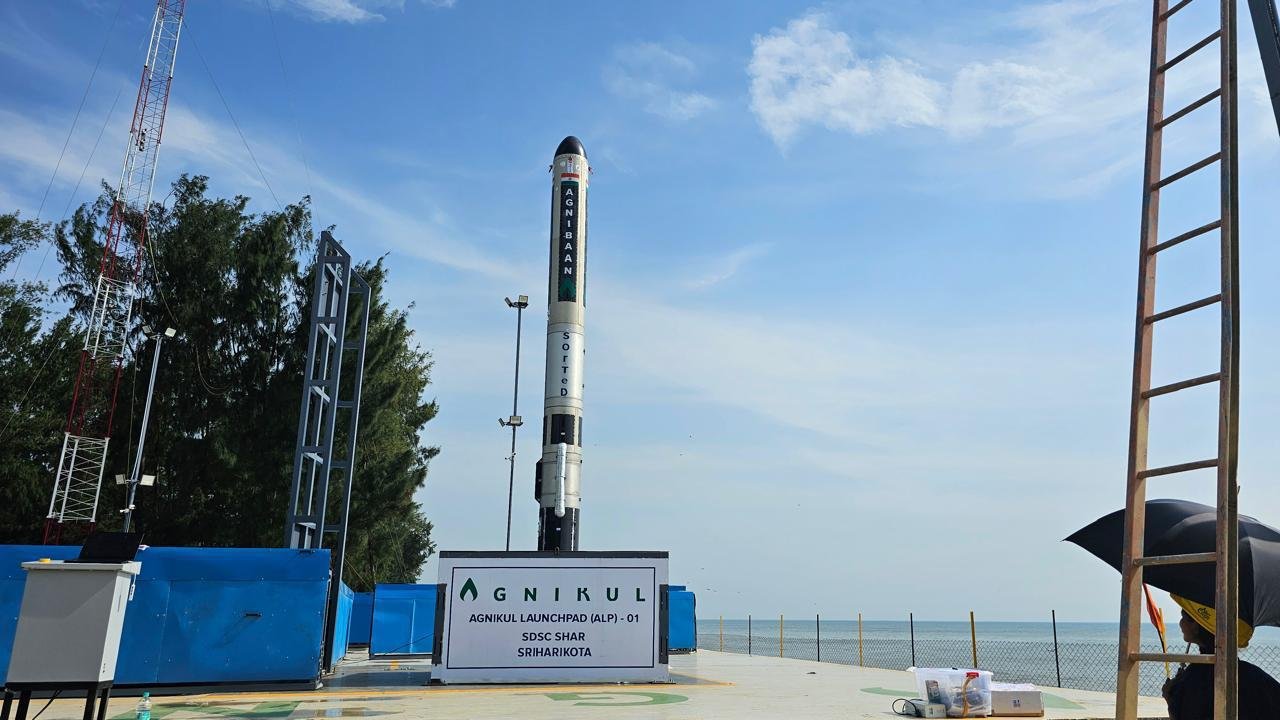
Seven years ago, Srinath Ravichandran was on Wall Street. He took a detour through an aerospace master's at the University of Illinois, moved back to Chennai, and started building rockets from scratch inside an IIT Madras lab. On May 30, 2024 — after four aborted attempts that would have broken lesser teams — his company's Agnibaan SOrTeD lifted off from India's first privately-developed launchpad at Sriharikota, powered by the world's first single-piece 3D-printed rocket engine. Prime Minister Modi called it "a remarkable feat which will make the entire nation proud." ISRO's chairman was there to watch.
That flight — a suborbital technology demonstrator, not an orbital mission — is the engine (literally) driving a $500 million valuation for a company that recorded ₹9 crore (roughly $1 million) in revenue in its last filed fiscal year.
The number deserves scrutiny. So does the technology beneath it.
What Agnikul Actually Built — and Why It Matters
Indian spacetech startup Agnikul has done something that no rocket company anywhere had managed before May 2024: it flew a vehicle powered by a fully single-piece, 3D-printed semi-cryogenic engine, manufactured entirely in-house at its Chennai factory. No welds. No assembled parts. One continuous structure of Inconel, printed layer by layer, then flown.
The significance of this is not merely a manufacturing curiosity. Traditional rocket engines are assembled from hundreds of individual components — turbopumps, injectors, combustion chambers — each welded or bolted together at joints that represent potential failure points. Agnikul's Agnilet engine eliminates the assembly step entirely, replacing it with additive manufacturing. The result is an engine the company claims it can produce in seven days, compressing what typically takes months by nearly 97%.
The propulsion architecture adds another layer of novelty. Rather than the gas-driven turbopumps found in most liquid-propellant rockets — systems of considerable mechanical complexity — Agnikul uses electric pump-fed propulsion. High-discharge brushless DC motors drive the propellant pumps, and the motor speed is controlled in real time by flight software. This is "Software-Defined Throttling": the company can adjust engine thrust almost instantaneously through code rather than through mechanical interventions. When Agnikul successfully test-fired a synchronized cluster of three such engines in February 2026 — a historic first for an Indian private space company — it validated that the software stack can control multiple electric pump systems in concert, a prerequisite for the orbital vehicle.
The practical implication for satellite operators: a rocket that can be customized per mission, sized to payload rather than the reverse, and launched from a mobile pad — what Agnikul calls "Dhanush" — from virtually any geographically optimal location. The company's pitch to customers is essentially Uber for orbital access. No shared rides. No waiting. Launch in two weeks from contract to countdown.
The Funding Round and What the Numbers Actually Mean
In November 2025, Agnikul closed a $17 million round at a $500 million valuation, making it one of the most valuable private spacetech firms in India. Investors included HDFC Bank, Artha Select Fund, Advenza Global, Atharva Green Ecotech, Prathithi Ventures, and 100X.VC, alongside several family offices. In March 2026, the Tamil Nadu government's industrial arm, TIDCO, took an equity stake — the first time a state government body in India has taken equity in a space startup, a signal with implications beyond the check size.
The capital stack to date:
Round | Amount | Key Investors | Milestone Context |
|---|---|---|---|
Seed | ₹3 crore (~$450K) | IIT Madras ecosystem | Company founding, 2017 |
Series B (Oct 2023) | $26.7M | Celesta Capital, Rocketship.vc, Artha Venture Fund | Total raised to $40M |
Series C1 (Nov 2025) | ~$6.7M | Advenza Global, Atharva Green Ecotech | Pre-$500M valuation setup |
Series C (Nov 2025) | $17M | HDFC Bank, Artha Select Fund, family offices | At $500M valuation |
TIDCO (early 2026) | ₹25 crore (~$3M) | Tamil Nadu state government | First state equity in Indian space startup |
Total raised | ~$75.5M | — | — |
FY24 revenue: ₹9 crore (~$1M). FY24 losses: ₹43 crore (~$5M).
That revenue-to-valuation ratio will raise eyebrows among anyone who has spent time in enterprise SaaS. But spacetech isn't SaaS. The capital is not buying current revenue — it is buying the assertion that the technology works, the orbital mission is near, and the addressable market is genuinely global. Whether that assertion holds at $500 million depends almost entirely on what happens next in the launch sequence.
The Wider Context: India's Space Liberalization Is Producing Real Companies
To understand why investors are willing to sit at this valuation, you need to understand what happened to the Indian regulatory environment between 2020 and 2024.
Before 2020, all Indian space activity was under ISRO's exclusive supervision. The sector was not open to private companies in any meaningful sense. India's Space Policy 2023 changed that architecture fundamentally — repositioning ISRO toward research and strategic missions while creating IN-SPACe as a single-window clearinghouse for private participation. Foreign direct investment rules were relaxed. Private launch pads became legally possible and then operationally real.
The result, by the numbers: India's private space sector grew from fewer than 100 startups in 2020 to over 400 registered companies by early 2026, attracting cumulative investments exceeding $500 million. The country's space economy, currently valued at approximately $9 billion, is on a government-projected trajectory to reach $44 billion by 2035, with India's global market share targeted to rise from roughly 2% to 8%. That is the macroeconomic runway Agnikul is building a business on.
Critically, the ecosystem is now producing diversified companies — not just launch vehicles. Pixxel launched India's first private satellite constellation, the Firefly hyperspectral imaging series, via SpaceX Falcon 9 in early and mid-2025. Digantara launched India's first commercial space surveillance satellite. Skyroot Aerospace and Agnikul compete, but also complement, a growing domestic market for launch services that existing providers cannot satisfy at the required cadence. When Agnikul says it wants to target 100 launches per year by 2030, the competition it is primarily worried about isn't Skyroot — it's SpaceX's Transporter rideshare and Rocket Lab's Electron, which dominate the global small-launch market today.
The Expert Case — and the Honest Uncertainty
"What excites us is their commitment to inventing technology that doesn't exist elsewhere. That ethos, coupled with disciplined execution, gives them a truly global edge."
— Anirudh A. Damani, Managing Partner, Artha Select Fund, on Agnikul's November 2025 raise
Damani's framing is the bull case in a sentence. Agnikul is not attempting to replicate what Rocket Lab or Relativity Space built; it is solving a different manufacturing problem with a different propulsion architecture and doing it out of Chennai, not Huntington Beach. The global small-satellite market is real, growing, and structurally underserved on the launch side. If Agnikul achieves orbital capability and genuine launch cadence, the $500 million valuation looks cheap by comparison to how Rocket Lab was priced at equivalent milestones.
The bear case is equally clean: orbital rockets are hard in ways that suborbital demonstrators are not. Agnikul has a world-first in engine manufacturing. It has validated multi-engine clustering. It has not yet reached orbit. The company's own timeline says the first orbital launch will occur three months after test rig construction is complete — and that rig construction will take six to seven months from whenever it started. Revenue in the last filed fiscal year was approximately $1 million against losses five times that. The 350-acre integrated space campus in Tamil Nadu is planned, not built.
None of this disqualifies the company. It does mean the next twelve to eighteen months are not about valuation — they are about demonstrating that the technology transfer from suborbital to orbital is something the team can execute on schedule.
The Counterintuitive Observation: The Revenue Number Is Almost Irrelevant
Here is what conventional startup financial analysis gets wrong when applied to early-stage launch companies: the revenue benchmark that matters is not current revenue. It is launch manifest depth — the number of signed customer agreements for future launches, and the quality of those customers' commitments.
SpaceX's Falcon 9 was not valued on the revenue it was generating during development. It was valued on the contracts, the addressable market, and the credibility of the team. Agnikul's FY24 ₹9 crore in revenue is a rounding error; what the Artha Select Fund's "largest cheque yet" and HDFC Bank's participation are actually buying is a position in the first Indian company that has credibly demonstrated a path to competitive global small-launch economics. The 3D-printed single-piece engine is not just a manufacturing trick — it is a cost structure that, if it holds to orbital scale, could undercut existing competitors in a market that is acutely price-sensitive.
The partnership announced in February 2026 with Neevcloud — building a proof-of-concept space-based AI data center to be launched by Agnibaan as early as 2027 — is another data point in this direction. Agnikul is actively building its own manifest while developing the rocket. That is the right sequencing.
What to Watch
1. The orbital launch window. Rig construction is underway; the first orbital Agnibaan mission comes three months after completion. Watch for a date announcement. If it slips past mid-2027 without an explanation, it matters.
2. IN-SPACe clearances and frequency. India's regulatory environment for private launches has been opening, but launch approvals still move on ISRO timelines. How quickly Agnikul can cycle through approvals for successive missions will determine whether its 100-launches-per-year target by 2030 is engineering ambition or investor fiction.
3. The global customer manifest. CEO Srinath Ravichandran has repeatedly framed Agnikul's mission as "building for the world, from India." The proof of that claim is non-Indian satellite customers signing dedicated launch agreements. European and Southeast Asian new space companies — particularly in Singapore, where the government has been aggressively seeding a commercial space ecosystem — are the most likely early international customers.
4. Stage recovery execution. The company's reusability patent and stage-recovery program are the unit economics argument that gets it toward profitability. Recovery is dramatically harder than launch. Every SpaceX investor learned this the hard way. Watch the first recovery attempt carefully.
5. TIDCO campus timeline. The 350-acre Tamil Nadu integrated facility is Agnikul's manufacturing scale play. Site development timelines in India can compress or expand dramatically depending on state government cooperation. TIDCO's equity stake is both a commitment and an incentive alignment that makes the optimistic scenario more credible.
Key Takeaways
Indian spacetech startup Agnikul has built something technically real — the world's first 3D-printed engine to fly is not a press release, it is a verified engineering milestone. The $500 million valuation is not priced on current revenue; it is priced on the assertion that orbital capability is close, the manufacturing architecture is defensible, and the Indian private space market is structurally positioned to grow from $9 billion to $44 billion by 2035.
The things that are unknown: whether the technology transfers cleanly from suborbital to orbital, whether the launch cadence targets survive contact with operational reality, and whether international customers sign dedicated manifests before Indian domestic demand alone can justify the capital structure.
The things that are known: India's policy environment has genuinely opened for private space companies in a way that did not exist five years ago. Agnikul's founding team includes IIT Madras aerospace faculty, a Wall Street-turned-aerospace CEO, and engineers who have now built, tested, and flown hardware that no one else in the world has flown. HDFC Bank, a deeply conservative Indian institution, wrote a check. The Tamil Nadu state government took equity — the first time that has ever happened in Indian spacetech.
For founders and operators watching this space: the India launch vehicle market is not a curiosity. It is a structural story about a country that liberalized a sovereign capability, built the regulatory infrastructure for private participation, and is now producing credible companies competing for the same small-satellite manifest that Rocket Lab and SpaceX are pursuing. Agnikul may not be the company that wins that market. Its existence proves the market is real.