On May 8, 2026, in a conference room at Hyundai Motor and Kia's headquarters in Seocho-gu, Seoul, two of South Korea's most powerful industrial entities signed a memorandum of understanding. Jaehoon Chang, Vice Chair of Hyundai Motor Group, sat across from Jong-chul Kim, President and CEO of Korea Aerospace Industries. The stated purpose: jointly develop Advanced Air Mobility aircraft powered by electrified aviation powertrains. The unstated subtext: Hyundai's air taxi ambitions, which have burned through significant capital and management credibility over the past two years, need a structural lifeline.
This is why Hyundai teams up with Korea Aerospace Industries — and why that framing matters more than the official press release suggests.
What the MOU Actually Says — and What It Doesn't
The partnership, as announced, has four structural pillars. Supernal — Hyundai Motor Group's dedicated advanced air mobility subsidiary — will lead aircraft design and engineering and apply its electric vehicle powertrain expertise to aviation. KAI, which has spent decades building South Korea's military aviation capability through programs like the KT-1 trainer and the FA-50 light combat aircraft, contributes its integrated fixed-wing and rotorcraft systems capability. Both organizations will cooperate on supply chains, certification processes, and global customer networks. The output is described as a "K-AAM" — a Korea-branded advanced air mobility aircraft intended to compete globally.
What the announcement does not specify: timelines, capital commitments, aircraft configuration, or what happens to the existing S-A2 program that Supernal has been developing — and pausing — since 2024.
That omission is not minor. It is the story.
The Context the Press Release Skips
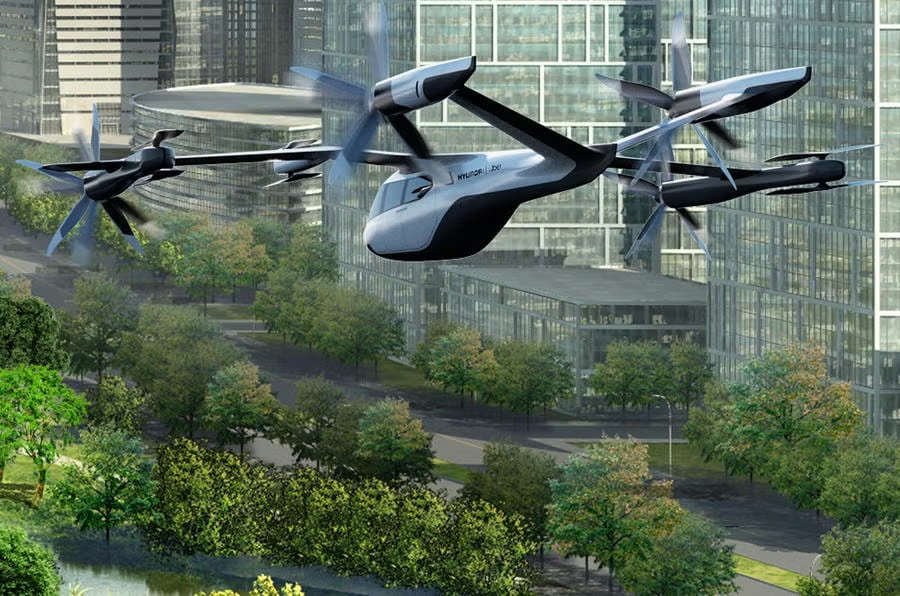
Supernal was established as a Hyundai subsidiary in 2021, backed by a $6 billion commitment from the broader Motor Group through 2028. At CES in January 2024, the company unveiled its S-A2 concept in Las Vegas — a five-seat eVTOL with eight tilting rotors, a V-tail configuration, and an ambitious commercial launch target of 2028 in Los Angeles and Miami. The presentation was polished. The roadmap looked credible.
Then things got complicated.
By August 2025, Supernal CEO Jaiwon Shin — the president of Hyundai Motor Group's entire Advanced Air Mobility division, the architect of its air taxi strategy — resigned alongside CTO David McBride, who had previously led NASA's Armstrong Flight Research Center. The double departure followed reports that Supernal had "paused" its aircraft program, struggling to achieve untethered flight with its demonstrator while competitors continued to advance through certification. As AeroTime reported in December 2025, no new CEO had been appointed. A senior business development director was running operations as interim COO. The program that had been described as a centerpiece of Hyundai's future mobility vision was, by industry assessment, firmly in the second wave of eVTOL developers — trailing Joby Aviation, Archer, and Beta Technologies in the U.S. certification race.
Farhan Gandhi, a chaired professor of aerospace engineering at North Carolina State University and a leading authority on VTOL aerodynamics, was appointed Supernal's new CTO earlier this month. It is the first major executive move since the September 2025 departures. His appointment — and now the KAI partnership — signals that Hyundai is attempting to rebuild the program from a more credible technical and institutional foundation.
"Combining KAI's integrated systems capabilities in fixed-wing and rotary-wing aircraft with Hyundai Motor Group's mass-production system and mobility ecosystem will enable us to develop a K-AAM that leads the global market."
— Korea Aerospace Industries official statement, May 10, 2026
That ambition deserves scrutiny. KAI has genuine aerospace manufacturing capability — it is, by any measure, the backbone of South Korea's domestic defense aviation sector. Its expansion from military programs into civilian air mobility is the coherent institutional logic of the deal. But "leading the global market" is a significant aspiration for a partnership that is starting with an MOU in 2026, in a sector where the front-runners have been building and flying hardware for years.
Hyundai Teams Up With Korea Aerospace: The Industrial Logic
Here is the counterintuitive observation: the eVTOL industry's greatest challenge is not the aircraft. Joby Aviation has made more than 600 flights. Archer's Midnight has cleared its FAA Means of Compliance review. China's EHang received the world's first type certification for a passenger drone in 2023 and is now operating commercially. The certification and flight-test problem is being solved, slowly, by companies that have been grinding through it for years with disciplined focus. What is not solved — and what KAI potentially brings — is the manufacturing scale, supply chain depth, and institutional credibility to move from prototype to certified, producible aircraft.
Hyundai's thesis has always been that its automotive manufacturing capability could compress the production cost curve for air mobility the way it did for EVs. The problem is that aerospace manufacturing is not automotive manufacturing. The materials, tolerances, certification requirements, and failure modes are categorically different. By bringing KAI into the program, Hyundai is acknowledging — implicitly — that it needs a partner who has actually built certified aircraft at production scale, not just cars.
The competitive landscape the partnership is entering:
Company | Status (May 2026) | Key Advantage |
|---|---|---|
Joby Aviation | Stage 4 FAA certification; 600+ flights | Deepest certification progress |
Archer Aviation | FAA Means of Compliance accepted; commercial ops prep | Fastest U.S. commercial deployment timeline |
EHang (China) | Type-certified; commercial operations live | Only certified passenger eVTOL globally |
Beta Technologies | Certification underway; charging network built | Infrastructure head start |
Supernal / Hyundai | Program paused in 2025; leadership transition; MOU with KAI | Manufacturing scale, $6B commitment |
Volocopter | Acquired from insolvency by Wanfeng Group (China) | Surviving |
Lilium | Collapsed twice; assets acquired by Archer | Not surviving |
The gap between Supernal and the leaders is not primarily technological — it is temporal and organizational. Joby has been flying conforming aircraft and working directly with FAA test pilots. Supernal was still doing tethered demonstrator tests in early 2025. That gap does not close through a partnership announcement.
South Korea's Regulatory Bet and the Market Being Built
To understand why this partnership can still matter despite the timeline gap, you have to look at what the South Korean government has been doing in parallel. Seoul laid out its urban air mobility commercialization roadmap in 2020, creating the "K-UAM Grand Challenge" framework that has drawn in telecom giants SK Telecom, KT, and LG Uplus alongside aerospace players. SK Telecom already partnered with Joby Aviation to use its T Map Mobility platform for South Korean air taxi services. Korean Air partnered with Supernal for domestic operations. The Korean government has been building the regulatory sandbox, the vertiport planning frameworks, and the demand-side partnerships that would allow a domestically-produced aircraft — a K-AAM — to find its initial commercial footing without having to fight for position in the already-crowded U.S. and Dubai markets.
That is a meaningful structural advantage. It is also a $6 billion question. Hyundai has committed that capital to Supernal through 2028. KAI brings the aerospace credibility and manufacturing depth. The Korean government has pre-built a market. The question is whether the combined entity can compress a certification timeline that has proved, industry-wide, to be stubbornly resistant to compression regardless of capital or political will.
The eVTOL market is projected to reach $90 billion annually by 2050, with first commercial services expected to begin at premium price points in 2026-2028. Missing the early commercial window doesn't disqualify a player — the market is not winner-take-all — but it does mean competing from a position of followership rather than definition-setting.
What Founders and Operators Should Take From This
The Hyundai-KAI partnership is not primarily a story about air taxis. It is a story about what happens when a well-capitalized incumbent enters a deep-tech market with manufacturing confidence and underestimates the domain-specific expertise required — then has to restructure its approach mid-stream.
Does that pattern sound familiar? It should. It happens in every sector where a large corporation tries to buy its way into a technically complex frontier that startups have been grinding through for years: automotive companies in autonomous driving, banks in fintech infrastructure, media conglomerates in streaming. The pattern is consistent enough to be a lesson: capital and manufacturing scale are necessary but insufficient conditions for winning in markets where certification, regulatory trust, and operational expertise are the actual moat.
KAI's involvement changes the institutional credibility calculus for Supernal. Farhan Gandhi's appointment as CTO brings the aerodynamics authority that the program has lacked since McBride's departure. The $6 billion commitment from Hyundai Motor Group remains in place. Together, these are the conditions for a credible second attempt.
The FAA's eVTOL Integration Pilot Program, launched in mid-2026 across 26 states, is generating the operational data that will define permanent safety standards for the category. Joby, Archer, Beta, and Wisk are inside that program. Supernal is not — yet. Whether the Hyundai-KAI partnership can produce an aircraft that enters that certification ecosystem in time to influence standards, rather than simply conforming to them, is the strategic question that matters.
Key Takeaways
The deal in numbers:
$6 billion — Hyundai Motor Group's committed investment in Supernal through 2028
$21 billion — Hyundai's broader U.S. investment strategy within which AAM sits
600+ — flights completed by Joby Aviation, the certification leader, by end of 2025
0 — untethered flights completed by Supernal's S-A2 demonstrator before program pause
$90 billion — projected annual eVTOL market by 2050
What the partnership gets right: KAI's rotorcraft and fixed-wing systems expertise is genuinely complementary to Supernal's EV powertrain and manufacturing capability. South Korea's regulatory pre-investment creates a domestic commercialization pathway that reduces initial market risk. The new CTO appointment signals the program is being rebuilt with technical authority rather than just executive will.
What remains unproven: No announced timeline for the joint aircraft. No clarity on whether S-A2 continues, pivots, or is effectively replaced by the K-AAM program. No certification path articulated. The certification gap between Supernal and the current leaders is not measured in months — it is measured in years of accumulated test data, regulatory relationship, and airworthiness evidence.
The editorial position: Hyundai's commitment to advanced air mobility is real and the capital is substantial. The KAI partnership is the right structural move given where the program sat after the 2025 leadership crisis. But founders watching this sector should note that the companies now approaching commercial certification — Joby, Archer — never paused. They built, flew, failed, rebuilt, and flew again, year after year, without the luxury of a $6 billion backstop. That discipline, not the capital, is what got them to the front of the regulatory queue.
Money can buy time. It cannot buy flight hours already flown.