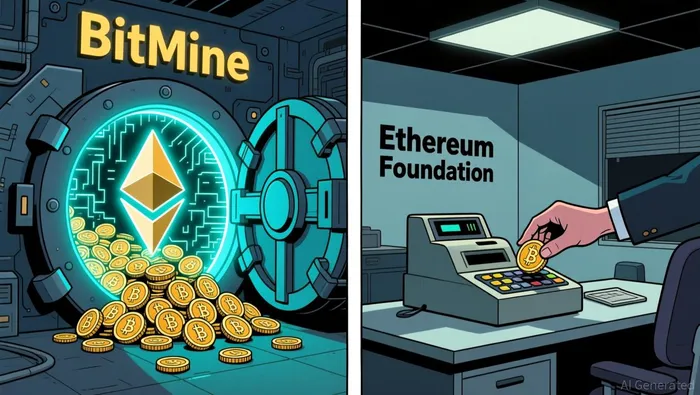
The Ethereum Foundation just sold 10,000 ETH — the native currency of the blockchain it stewards — to a company that has already lost more than six billion dollars on its ETH holdings. And then, the week after, that company bought 101,627 more.
That's not a cautionary tale. That's the story of how institutional conviction works when the asset class is crypto, ETH, and blockchain rails are still being laid under live traffic.
What Actually Happened
On April 24, the Ethereum Foundation confirmed an over-the-counter sale of 10,000 ETH to BitMine Immersion Technologies (NYSE: BMNR) at an average price of $2,387 per coin — a total of $23.87 million. It was the second such direct sale to BitMine; in March, the Foundation sold the company 5,000 ETH at roughly $2,043 apiece.
The Foundation's language was characteristically precise: proceeds fund "protocol R&D, ecosystem development, community grant funding, and more." The OTC structure was deliberate — large block trades executed off public exchanges reduce slippage and avoid the "dumping" optics that have trailed the Foundation for years. Both parties agree on a price. The chain confirms it. No panic, no splash.
For BitMine, the acquisition is a rounding error against a mountain. The firm now holds approximately 4.97 million ETH — about 4.1% of total circulating supply — with a total portfolio value reported at $12.9 billion. Its average purchase price sits around $3,648 per ETH. At current prices near $2,350, that pencils out to roughly $6.3 billion in unrealized losses.
They bought more anyway.
The Structural Bet Neither Side Will Admit Is the Same Bet
Here is the friction hiding in plain sight: the Ethereum Foundation, an organization whose entire mandate is Ethereum's long-term success, sells ETH to fund itself. BitMine, a company whose entire identity is Ethereum accumulation, buys what the Foundation can't hold.
They are, in the deepest sense, on the same side. And yet the Foundation's periodic sales have generated years of community criticism — accusations of sell pressure, misaligned incentives, a lack of conviction. The June 2025 treasury policy was, in part, the Foundation's public answer: cap annual operating expenses at 15% of total treasury, maintain a 2.5-year runway buffer, and begin generating yield through staking rather than continually liquidating holdings.
The Foundation has since staked roughly 70,000 ETH — approximately $154 million — and now earns around 2.7–3.8% annually on that position. Selling 10,000 coins while simultaneously locking 70,000 into validators is, mathematically, net-deflationary pressure on circulating supply. The headline sells the panic; the ledger tells a different story.
"The Ethereum Foundation's new treasury model is essentially what every endowment eventually learns: generate yield, spend the yield, preserve the principal. The OTC sales to strategic buyers like BitMine are actually the least market-disruptive mechanism available — they transfer supply directly to entities that have publicly committed never to sell."
— Onchain Foundation analysis, April 2026
Who Wins, Who Loses, and Who's Pretending Not to Know
BitMine's bull case is elegant: own 5% of a proof-of-stake network, stake nearly all of it, harvest compounding yield, wait for the supercycle. The company has already staked approximately 3.5 million ETH — about 72% of holdings — through its Made in America Validator Network (MAVAN), generating an estimated $330 million annually at full deployment. At a 2.81% composite staking rate, that's over $900,000 per day in ETH-denominated rewards, regardless of price.
Chairman Tom Lee — the Fundstrat strategist who helped build BitMine's ETH-accumulation identity — has been explicit about the thesis: the company isn't a trading desk, it's an index. "BitMine is designed to track the price of ETH and outperform over the cycle," he wrote in February, when the paper losses were most visible. "Unrealized losses during crypto downturns are a feature, not a flaw."
The Foundation's win is simpler: it now has a reliable institutional buyer for its periodic OTC sales that doesn't create open-market sell pressure. SharpLink Gaming was that buyer in July 2025 (10,000 ETH). BitMine has now played the role twice. The relationship is mutually beneficial in a way that's rarely acknowledged — the Foundation maintains operational funding without roiling spot markets; BitMine gets direct supply access at agreed prices without exchange friction.
The losers, for now, are BMNR shareholders. The stock is down more than 22% year-to-date and has shed roughly 84% from its 2025 peak. Average entry of $3,648 against a current ETH price around $2,350 means the equity is underwater by a number that's hard to contextualize without squinting. That said, BitMine carries no debt — a structural advantage that keeps forced liquidation off the table regardless of how long the drawdown extends.
The Governance Question Nobody Is Asking Loudly Enough
Ethereum's proof-of-stake consensus mechanism does not have a formal on-chain voting system in most cases — but economic weight still matters. Validators who stake ETH participate in block proposal and attestation; the concentration of staked supply in a single entity's hands is, at minimum, a theoretical vector for influence.
BitMine holds approximately 4.1% of total circulating ETH supply. It has staked roughly 3.5 million of those coins. For context, the largest staking pools — Lido, Coinbase, and similar operators — have long dominated the validator landscape, and Ethereum's community has debated validator concentration for years. BitMine is a new kind of actor in that ecosystem: a publicly listed American company with a stated goal of reaching 5% of total supply, building its own domestic validator infrastructure through MAVAN.
This is worth watching carefully. Not because the risk is imminent — Ethereum's protocol-layer design has multiple safeguards against single-actor attacks — but because the precedent being set here is unprecedented. A corporation, listed on a major exchange, is attempting to own a meaningful fraction of a sovereign financial network's consensus layer. The regulatory frameworks to assess this simply don't exist yet.
The SEC, the CFTC, and international bodies including the Financial Stability Board have all signaled interest in systemic risk from digital assets. None have addressed the specific scenario of a public company accumulating stake in a proof-of-stake consensus mechanism. That's a regulatory gap that will eventually need filling.
Skeptic's Corner
The bull narrative here is elegant but circular: ETH is undervalued, so buying more ETH at lower prices is smart, because ETH is undervalued. BitMine's "unrealized losses are by design" framing is functionally unfalsifiable — a company that never has to mark its position to market never has to be wrong. BMNR stock is down 84% from peak. Shareholders live in real time; the thesis lives in the cycle.
Key Takeaways
$6.3 billion in unrealized losses hasn't slowed BitMine's accumulation by a single week.
4.1% of all circulating ETH is now controlled by a single NYSE-listed company — a concentration with governance implications the industry hasn't seriously addressed.
72% of BitMine's ETH is staked, generating roughly $330 million annually in expected yield, which changes the company's risk profile significantly from a pure price play.
The Ethereum Foundation's treasury shift — from periodic sales creating sell pressure to a yield-generating staking model — is a structural positive for ETH's circulating supply dynamics that the market hasn't fully priced.
What to Watch
BitMine's 5% target. The company needs approximately 23,000 more ETH to cross that threshold. Subsequent Foundation OTC deals are the most likely direct acquisition path.
MAVAN scaling. If BitMine's domestic validator network launches at scale, it creates an entirely new revenue stream independent of ETH price — and a new data point in the concentration debate.
Regulatory signals. Any comment from the SEC, CFTC, or Financial Stability Board touching on proof-of-stake concentration risk could reprice BMNR dramatically in either direction.
The KelpDAO rsETH situation. The Foundation sold 10,000 ETH while the broader DeFi community was mid-recovery from a $290 million hack affecting KelpDAO's rsETH. Critics noted the silence. How the Foundation responds to ecosystem distress events while running OTC sales will shape community trust for years.
ETH price vs. the thesis. Lee has publicly stated $2,500 was his predicted floor. ETH is currently below it. A sustained break above that level reframes the entire conversation; a further decline tests the "by design" narrative in ways that matter to shareholders, even if they don't matter to the blockchain.
No one can say with confidence what Ethereum is worth, or when. What this deal crystallizes is a more structural truth: the institutions most committed to crypto, ETH, and blockchain infrastructure aren't hedge funds timing entries — they're entities building positions so large they become part of the underlying system. Whether that's visionary or dangerous probably depends on whether you're holding BMNR.
StartupNews.fyi covers the decisions shaping tech's next decade. Nothing in this article constitutes financial advice.