We Work filed for bankruptcy in November 2023 with $18.6 billion in debt and a business model that had convinced the world that leasing offices and subleasing them flexibly was the future. Eighteen months later, an Indian company doing almost exactly that — just to enterprise clients, in large campuses, with Indian Accounting Standards making things look worse than they are — quietly turned profitable. Twice in a row.
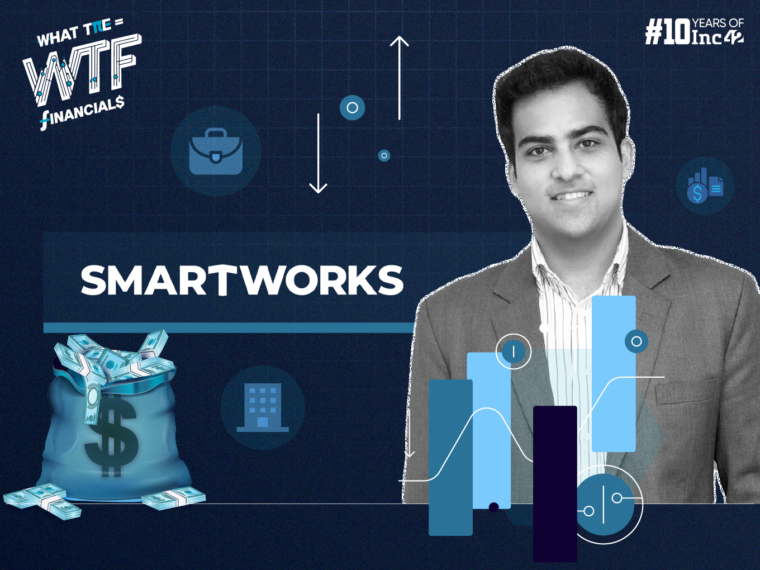
Smartworks Coworking Spaces posted a consolidated net profit of ₹16.62 crore in Q4 FY26, compared with a net loss of ₹8.3 crore in the year-ago period. Total income rose 47% to ₹532.70 crore in the quarter ended March 2026, from ₹362.05 crore in Q4 FY25. For the full fiscal year, Smartworks Posts ₹17 Cr Profit marks a clean break from the ₹63.17 crore net loss of the preceding year. NewsDrum
The number itself is thin. The trajectory it represents is not.
What Smartworks Posts ₹17 Cr Profit Tells You About the Model
During FY26, Smartworks posted a net profit of ₹10.52 crore against a net loss of ₹63.17 crore in the preceding year. Total income increased to ₹1,849.9 crore from ₹1,409.66 crore during FY25. That's a ₹73 crore swing in the bottom line on a revenue increase of roughly ₹440 crore. The operating leverage is real — once the fixed cost of fitting out a campus gets absorbed, incremental revenue starts dropping through. NewsDrum
Normalised EBITDA hit ₹314 crore for FY26, up 75% year-on-year. Normalised ROCE more than doubled to 16%. Those are the metrics Smartworks uses to explain its own business, and they deserve scrutiny.
The company operates under two models. In its primary model, it leases large bare-shell buildings from developers, converts them into branded campuses, and sub-leases seats to corporates on multi-year contracts. Under Indian Accounting Standards (Ind AS), this creates substantial depreciation and interest charges on right-of-use assets — costs that look enormous on a P&L but don't represent actual cash leaving the building. Founder and MD Neetish Sarda has been consistent about this: those accounting charges are expected to reverse when lease escalations kick in, and cash generation looks materially better than GAAP profits suggest.
This is genuinely complicated. It's also genuinely legitimate. The question for investors and competitors alike is whether the model is self-reinforcing or just deferred liability.
The Enterprise Bet, and Why It's Working
Smartworks deliberately doesn't compete for freelancers, startups, or the hybrid work nomad. Every design decision it's made — campus-scale assets typically above 300,000 square feet, 45-60 day turnaround times from signing to handover, deep fit-outs for specific enterprise requirements — has been aimed at a different customer.
Executive Director Harsh Binani has said the company has more than ₹40,000 million in committed revenue, providing strong visibility into future cash flows. Over 90% of revenue comes from enterprise clients, and more than 30% from multi-city engagements. ICICIdirect
That 30% multi-city figure is quietly significant. When a client like an IT services firm or a global bank uses Smartworks in four cities, the switching cost becomes enormous. They'd have to manage four different landlords, four different fit-out vendors, four different compliance teams — everything Smartworks currently handles. Enterprise stickiness in managed offices isn't loyalty; it's friction, and friction is durable.
The timing also helps. In 2025 alone, GCCs — Global Capability Centres — accounted for an unprecedented 38% of office leasing across India's top seven cities, securing 31.3 million square feet, the highest volume ever recorded. By 2030, India is expected to host over 2,500 GCCs employing roughly 2.8-2.9 million professionals and contributing $105 billion in annual revenue to the global economy. Every one of those GCCs needs office space. Most of the mid-market ones — a JPMorgan or a Standard Life — don't want to deal with Indian landlords directly. That's Smartworks' precise sweet spot. JLL
The company launched SmartVantage in September 2025, a platform aimed specifically at streamlining GCC operations. It's not just a workspace product anymore; it's an operating system for how large foreign enterprises set up in India. That's a harder thing to commoditise than a hot desk.
Who Loses Here
The losers aren't individual competitors — they're the assumptions the flex office market made about who the customer was.
Awfis Space Solutions, which targets a broader mix of SMEs and startups with smaller centres across Tier 1 and Tier 2 cities, posted annual revenue of ₹1,260 crore for FY25 — larger than Smartworks, but with a fundamentally different risk profile. WeWork India, which finally reached profitability in FY25 after years of losses, operates Grade A premium properties in eight cities but carries a debt-to-equity ratio of 0.65 compared to Smartworks' 34.6. These aren't comparable companies despite all being labelled "coworking."
The global operators — IWG (Regus, Spaces), which dominates the Asia-Pacific flex market alongside The Executive Centre and JustCo — are also competing in a segment Smartworks isn't really fighting for. India is forecast to grow its flex space at 13.72% CAGR through 2031, the fastest in Asia-Pacific. There's enough demand for multiple models. The question is which model generates sustainable returns.
The loser in this emerging picture might be the old assumptions about India's office market: that enterprises would always prefer traditional leases, that flex operators couldn't serve large multinationals, that you needed a WeWork-style global brand to win corporate mandates. Smartworks is disproving all of those, from Gurugram.
"Our growth trajectory of 30-35% year-on-year is something we are fairly confident about for the next three to four years. The supply we have already blocked and the new space we continue to add is commensurate with that growth."
"Our growth trajectory of 30-35% year-on-year is something we are fairly confident about for the next three to four years. The supply we have already blocked and the new space we continue to add is commensurate with that growth."
— Neetish Sarda, Founder and Managing Director, Smartworks, following Q3 FY26 results
That statement was made in January 2026, before Q4 results confirmed the trajectory. The full-year picture now validates it. What Sarda didn't mention publicly is that this confidence rests on a relatively concentrated bet: Smartworks has committed to adding 2.5–3 million square feet every year, or 45,000–50,000 new seats annually. That's a lot of lease commitments to sign before the clients come.
The Skeptic's Corner
The ₹16.62 crore quarterly profit sounds decisive until you place it against the ₹5,120 crore market cap at which Smartworks currently trades. That's a price-to-earnings multiple that assumes years of profit growth the company hasn't yet demonstrated. Normalised metrics are useful for understanding cash economics; they can also be useful for making things look better than they are.
There's also the occupancy question. Smartworks disclosed strong occupancy trends, but didn't break them out by city or by vintage of centre in its Q4 release. Newer campuses take 12-18 months to stabilise. A portfolio expanding at 2.5-3 million square feet annually means there's always a cohort of underperforming, early-stage centres dragging on aggregate numbers. The aggregate profit figures don't yet distinguish between a mature, cash-generating campus in Hyderabad and a new centre in Coimbatore still ramping.
The India-specific accounting quirk — Ind AS making lease liabilities look enormous — also cuts both ways. When Sarda says escalations will eventually reverse these charges, he's right. But "eventually" is doing a lot of work. If GCC demand softens, or if enterprises start preferring ownership over managed space, the lease liability doesn't reverse; it compounds.
Three Things to Watch
1. FY27 city expansion. Smartworks plans to enter three to four new Tier 1 markets in FY27, primarily driven by demand from existing enterprise clients. Which cities those are, and whether the new campuses reach occupancy at the same pace as the existing portfolio, will determine whether 35% annual revenue growth is real or aspirational. Business Standard
2. GCC policy tailwinds. The Union Budget 2025-26 announced a National Framework for GCCs to promote activity in emerging Tier 2 cities, and Karnataka launched India's first dedicated GCC policy targeting 500 new GCCs by 2029. Smartworks is already present in Tier 2 markets like Ahmedabad, Jaipur, Kochi, Coimbatore, and Indore. If GCC demand spreads beyond the six major metros — and policy clearly wants it to — Smartworks' early position there starts compounding.
3. Singapore operations. Smartworks has a total portfolio of 16.1 million square feet across 66 centres in 15 cities across India and Singapore. The Singapore footprint is small. If the company's enterprise model — large campuses, corporate clients, managed infrastructure — works in a second country, the international expansion case becomes much more interesting for institutional investors evaluating the stock at its current multiple. NewsDrum
The deeper takeaway from Smartworks Posts ₹17 Cr Profit isn't about the rupee figure — it's about which assumptions in India's office market are quietly being retired. Enterprise clients will pay a premium for managed space. GCCs need a local partner, not a global brand. Profitability in the flex office business is achievable without a SoftBank cheque. All three of those assertions looked uncertain twelve months ago. They look considerably less uncertain now.