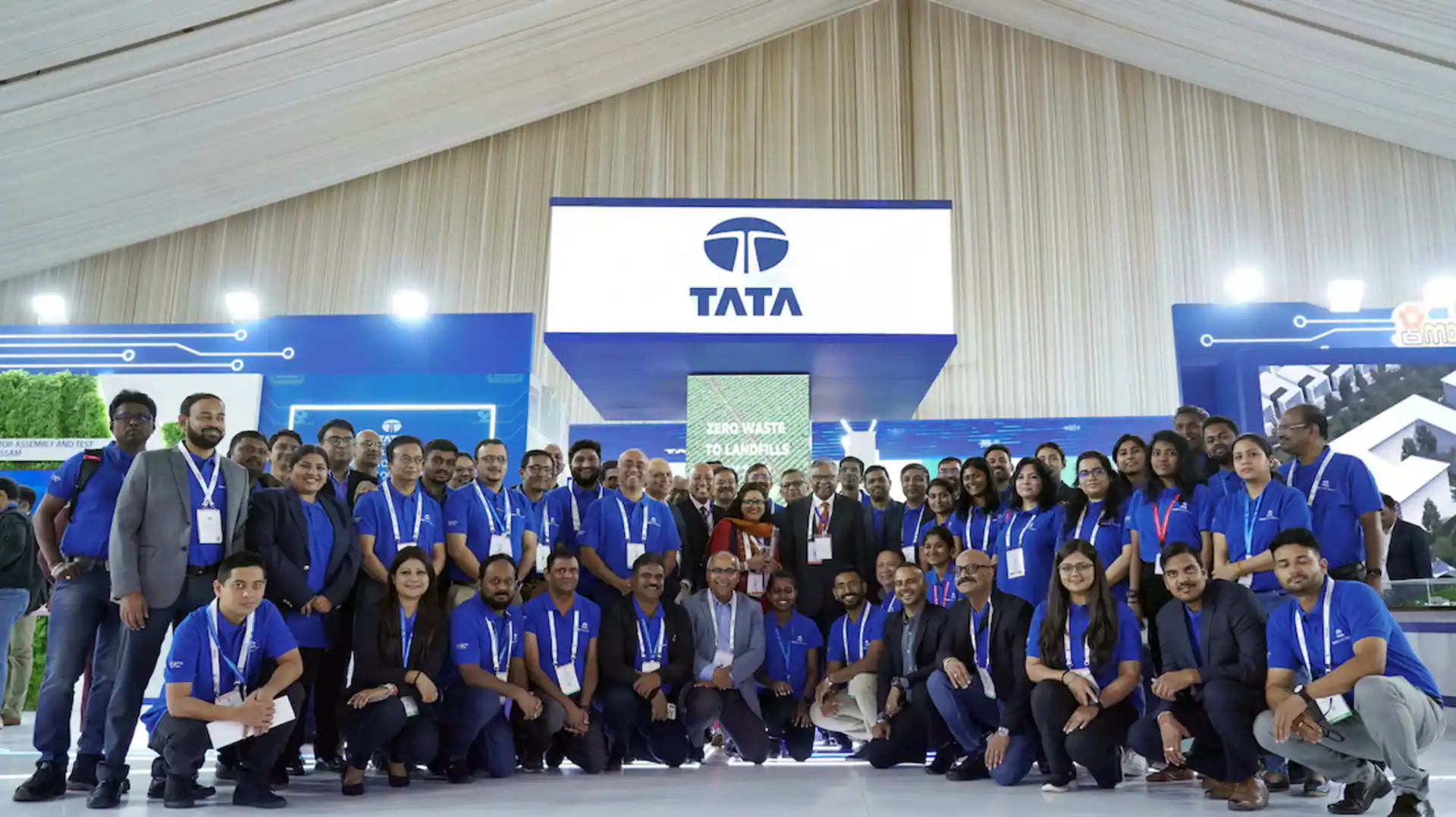
Tata Electronics plans to increase its workforce at its Hosur plant from 60,000 to 75,000 over the next six months. The expansion is driven by Apple's accelerating demand for electronics manufacturing services as the iPhone maker reduces its dependence on Chinese factories. That one sentence contains about a decade's worth of industrial policy ambition, geopolitical realignment, and corporate strategy compressed into a single hiring decision.
This isn't a press release story. It's a signal about who controls the future of global consumer electronics manufacturing — and why founders building hardware, supply chain, or logistics businesses anywhere in the world need to pay attention.
How Tata Got Here This Fast
To understand how dramatic Tata's rise is, consider the revenue trajectory. In FY25, Tata Electronics posted ₹66,601 crore in revenue — a ninefold jump from the previous year's ₹3,752 crore. That is, objectively, one of the most extraordinary single-year revenue expansions any manufacturing company of this scale has ever recorded.
The mechanics of that jump aren't complicated to explain, but they are remarkable to observe in practice. Tata acquired Wistron's iPhone assembly plant near Bengaluru in March 2024, then built its own greenfield facility in Hosur, and then — in January 2025 — acquired a 60% stake in Pegatron Technology India for ₹1,650 crore, giving it control of a second major iPhone assembly hub in Tamil Nadu. In roughly eighteen months, Tata went from peripheral Apple supplier to operator of nearly half of India's iPhone output.
Shipments to America made up nearly 37% of Tata Electronics' FY25 revenue, bringing in more than ₹23,112 crore. Ireland came second at 23%, as Apple's European hub, followed by Taiwan at 15%, with the Indian domestic market accounting for 20%.
The US market alone contributed more than $2.7 billion to Tata Electronics' revenue in a single fiscal year. That's not a sub-business. That's the whole ballgame.
Apple's India Bet Is More Committed Than Reported
Most coverage of Apple's India manufacturing push treats it as a hedge — a hedge against tariffs, a hedge against China risk, a hedge against regulatory disruption. That framing is increasingly wrong.
Apple has laid out plans to move assembly of the majority of iPhones it sells in the US to India by the end of 2026 — a move that would double its current Indian output away from China, where 80% of the 60 million iPhones sold annually in the US are currently produced. Apple scaled iPhone production in India by approximately 53% in 2025, producing nearly 55 million units, up from 36 million in 2024. India now accounts for roughly a quarter of all iPhones made globally.
This isn't a hedge. It's a structural pivot. And Tata sits at the centre of it.
Apple's cumulative exports of iPhones assembled in India under the government's Production Linked Incentive scheme have already surpassed $50 billion. Apple plans to manufacture in India the majority of iPhones it sells in the US market by the end of 2026. The PLI scheme — part of Prime Minister Narendra Modi's Make in India campaign — offered cash rebates of 4-6% on incremental sales over five years. New incentives being designed now push that even higher, with India considering cash rebates of 8-10% for component manufacturing and dedicated industrial zones with pre-approved clearances.
The regulatory and fiscal environment in India has been deliberately engineered to make this moment possible. Finance Minister Nirmala Sitharaman's 2026-27 budget included a rule change that exempts foreign firms from taxes on machinery supplied to their Indian contract manufacturers for five years — a direct response to Apple's lobbying, and a signal that the government will continue bending the policy framework to keep the iPhone supply chain anchored.
The Global Dimension: What This Means for Manufacturing Everywhere
Tata's expansion doesn't happen in a vacuum. It's part of a broader shift in how global companies think about supply chain geography — and it's reshaping competitive dynamics far beyond India.
The counterparty to India's gain is, obviously, China. But the more interesting story is what this means for competing locations. Vietnam, Thailand, and Malaysia have all attracted portions of Apple's supply chain diversification over the past decade. None of them has achieved what India is now doing at scale — because none of them has a combination of population size, government policy alignment, and a capable domestic industrial champion in the form of Tata.
Apple's contract manufacturers in India now employ an estimated 150,000 to 200,000 workers directly, with several multiples of that number in ancillary and support roles. Many of those workers are young women from semi-urban and rural India — a demographic that has historically been excluded from formal industrial employment. That social dimension is part of why the Modi government treats Apple's India expansion as a political priority, not just an economic one.
"India is on the cusp of becoming a global leader in electronics manufacturing, with production value already reaching $101 billion in FY23. However, without a skilled workforce, this potential cannot be realized. By scaling apprenticeships and strengthening industry-academia partnerships, we can close the talent gap and accelerate India's transition into advanced manufacturing." — AR Ramesh, CEO, TeamLease Degree Apprenticeship
For founders and operators building hardware businesses globally, the signal here is direct: India is now a credible manufacturing destination for high-value electronics at scale, not just a cheap labour play. That changes the calculus for anyone evaluating where to build or source.
The Contrarian Take: Tata's Moat Is Shakier Than It Looks
Here's the uncomfortable truth about Tata Electronics' extraordinary rise: almost everything that created it is also a source of fragility.
The 1,673% revenue growth is real, but it's almost entirely Apple-dependent. Tata has one customer that matters. If Apple diversifies its Indian manufacturing relationships beyond Tata and Foxconn — as it has every strategic incentive to do — or if Apple's iPhone demand softens, Tata's revenue trajectory reverses just as dramatically as it ascended. The net loss in FY25 was still ₹69 crore, down sharply from ₹825 crore the year before, but Tata Electronics is not yet a profitable business at the operating level.
Pegatron Technology India, now renamed Tata Electronics Products and Solutions, reported an 84% jump in revenue to ₹34,264 crore in FY25. Profit growth, however, was limited to just 1%, at ₹633 crore. Thin margins on massive revenue is the textbook contract manufacturing story — and it's a story that requires volume discipline, cost control, and flawless execution to sustain. Any quality issue, production disruption, or labour dispute at scale hits the margin immediately.
Then there's the workforce challenge. A report by TeamLease Services predicted that India's electronics manufacturing sector will create 12 million direct and indirect jobs by 2027-28, but could face a shortfall of eight million workers and a skill gap affecting another 10 million people. Adding 15,000 workers at one plant sounds like a supply chain strength. Against an industry-wide deficit of that magnitude, it's also a race against an accelerating constraint.
What to Watch
Tata Electronics' FY26 margin trajectory. Tata Sons has injected ₹3,000 crore into Tata Electronics during FY26. Whether that capital produces profitability or just more revenue will determine how close the company is to a public listing, which has been floated as a medium-term goal by multiple Tata Group insiders.
Foxconn's response. Foxconn still leads India's iPhone assembly with a 52% share against Tata's 37%. As Apple pushes to manufacture the majority of US-bound iPhones in India by end of 2026, how Foxconn and Tata divide that order book — and whether Apple introduces a third assembler — will define the competitive structure of the market for years.
The skills pipeline. Apple's Education Hub in Bengaluru, launched in early 2026 in collaboration with Manipal Academy of Higher Education, offers courses to more than 25 Apple suppliers including Tata Electronics, covering Swift coding, robotics, automation, and smart manufacturing. Whether this kind of initiative actually closes the skill gap — or whether India hits the predicted 8 million worker shortfall first — is the defining operational question for the next two years.
Tata Electronics' move to 75,000 workers at Hosur is a data point. But the real story is the speed with which a conglomerate better known for salt, steel, and software built itself into Apple's second-most-important manufacturing partner in under five years. That's not just an India story. It's a case study in what's possible when government policy, corporate ambition, and geopolitical tailwinds align at the same moment — and a reminder that the next Foxconn might not come from Taiwan at all.