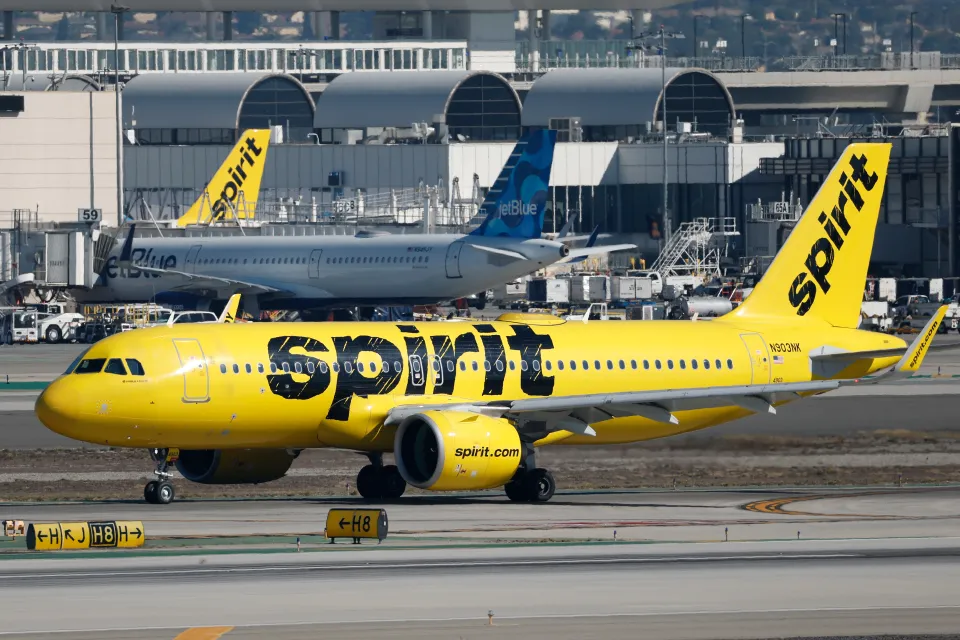
At 3 a.m. on May 2, 2026, Spirit Airlines stopped flying. Not metaphorically. Not as a bankruptcy restructuring euphemism. Its final flight departed from Detroit and landed in Dallas, and then the gates went dark. Seventeen thousand jobs, gone. Fifty thousand people had been on Spirit flights the day before the collapse. By sunrise, one of America's most utilitarian airlines — beloved not for its legroom but for its $35 fares — had ceased to exist. IndexBoxNPR
By noon, a voice actor in his apartment was pitching a crowd of strangers on buying it back.
Hunter Peterson posted a TikTok asking: what if 20% of American adults chipped in the price of a Spirit fare and just... bought it? He called it "Spirit 2.0: Owned by the People." Within hours, he'd thrown up a website — a janky, one-hour job by his own admission — and by Sunday, 36,000 "founding patrons" had pledged nearly $23 million, crashing his servers in the process. By Monday, reports put pledges above $26 million, with the number still climbing.
None of this is legally binding money. Peterson knows the gap between $26 million in internet pledges and the roughly $1.7 billion it would take to actually acquire Spirit's assets. He's said so on camera, with a smirk. But here's what experienced operators should clock: the story stopped being about Spirit Airlines somewhere around hour six. It became about something far more interesting — and far more consequential for anyone thinking about how capital and community interact in 2026.
How Spirit Actually Died
Understanding why the crowdfunding moment landed so hard requires understanding what Spirit's collapse actually was, and it wasn't a sudden failure.
Spirit's strategy had to contend with a myriad of challenges including pressure from mainline carriers, substantial debt, a failed merger, post-bankruptcy vulnerability, grounded aircraft, a contracting network, and high fuel costs. Jet fuel — assumed at $2.24 per gallon in Spirit's restructuring plan — spiked to approximately $4.51 per gallon. The Iran conflict drove energy prices through the roof at exactly the wrong moment for an airline running on margin shavings. AirwaysMag
Bondholders rejected an 11th-hour $500 million bailout from the Trump administration — a deal that would have put the government ahead of creditors and handed it up to a 90% stake. Commerce Secretary Howard Lutnick called Spirit CEO Dave Davis to tell him there was no deal. Republicans in Congress had already balked at what was being characterized as partial nationalization. The irony of that framing, given what came next from TikTok, is almost too clean. CNBC
Spirit had filed for bankruptcy twice since 2024. In February 2026, it held a 3.9% share of U.S. domestic passengers, down from 5.1% a year earlier — and its share was projected to fall to 1.8% in May. The airline was already a ghost before the ghost announced itself. NPR
But consumer advocates were clear about the stakes. "You do not have to fly a small carrier in order to benefit from its presence, because they will bring down the big guys' fares," said William McGee, senior fellow at the American Economic Liberties Project. "Without Spirit flying those routes, everyone will be paying more." NPR
That's the structural argument Peterson's viral moment latched onto, whether he knew it or not.
The Bit That Became a Business Plan
Peterson's pitch was arithmetically elegant: 250 million U.S. adults, 20% of them, each contributing between $30 and $40 — roughly the price of a Spirit fare — would fund the acquisition outright. His TikTok drew 2.8 million views and Google searches for the campaign site spiked 1,000% in a 17-hour window. Yahoo!
But the numbers that actually came in tell a different story than the pitch. The average pledge was $623 — not the $30–$40 fare price Peterson envisioned. Rather than a mass-market nationalization, what emerged was a smaller group of more invested individuals. That's the counterintuitive data point buried in the viral noise. The crowd that showed up wasn't the casual TikTok scrollers. It was people who either genuinely hated what private equity does to distressed assets, believed in the cooperative model, or just wanted to be part of something historically weird. Probably all three. Time News
The proposed ownership model was explicitly modeled on the Green Bay Packers — the NFL's only publicly owned, nonprofit franchise — with every verified member receiving one equal vote on major decisions regardless of pledge size, and profit-sharing dividends distributed proportionally. Peterson wasn't inventing cooperativism from scratch. He was pointing at an existing proof-of-concept that most Americans already know and, in the Midwest at least, practically venerate. Dexerto
"What Peterson accidentally built is a demand signal, not a capital raise. The $26 million matters less than the 40,000 verified email addresses of people who self-selected as willing to pay for a community ownership stake in a consumer brand they felt abandoned by. That's a cap table with a conversion rate most Series A startups would kill for." — Aviation industry observer and startup operator, speaking to StartupNews.fyi, May 2026
In a video posted the following day, Peterson winkingly tried recruiting aviation lawyers, PR people, and financial advisers with a one-word ask: "Help?" He told his followers: "I know what I don't know, but you're committing to this bit, so I'm committing to this bit." TechCrunch
That sentence is actually the most interesting thing about this story. It's the founding rhetoric of a hundred successful startups, stripped of the TED Talk polish.
Why Founders Should Be Paying Attention
The mechanics here matter beyond the spectacle. What Peterson did — in about 72 hours, with no institutional backing, no term sheet, no legal structure — was pre-validate demand for a consumer asset acquisition using social distribution as a fundraising channel.
Is it going to work? Almost certainly not in its current form. The estimated cost of acquiring Spirit's assets is around $1.7 billion, and the campaign's $23–26 million in non-binding pledges represents a significant funding gap. Even if every pledge converted to real money, you're at roughly 1.5% of target. And the history of community-owned airlines is not encouraging. Kiwi International Air Lines, founded in 1992 by furloughed Eastern Airlines pilots who pooled savings, raised $9 million of its $17 million startup capital from employees, filed for bankruptcy in 1996, and was liquidated by 1999. United Airlines tried a partial employee-ownership model in 1995 that collapsed by 2003. Running an airline is genuinely, brutally hard. Running an airline governed by committee is an order of magnitude harder. The American BazaarYahoo!
But the mechanism Peterson deployed is worth isolating from the specific asset he's trying to acquire. Creator-led pre-commitment campaigns — not crowdfunding in the Kickstarter sense, but demand aggregation with an equity or ownership angle — have been building credibility for years in adjacent spaces. Republic has been doing regulated community rounds for startups since 2016. Wefunder has put capital into hundreds of small businesses through Regulation Crowdfunding. The infrastructure exists. What Peterson demonstrated is that the distribution layer — TikTok as a capital formation channel — has matured to the point where a voice actor with no financial background can generate $26 million in intent signals over a weekend.
That's new. And globally, it's relevant. In markets where diaspora capital flows are massive — India, Nigeria, Mexico, the Philippines — the idea of community-led acquisition of assets through creator-anchored campaigns is genuinely unexplored territory. The Spirit campaign is US-centric, but the model it's stress-testing has no geographic constraint.
The Skeptic's Case
Let's be honest about the ceiling here. Peterson needs aviation lawyers, FAA licensing specialists, DOT approval, bankruptcy court standing to make a bid on Spirit's assets, and a capital structure that converts non-binding pledges into actual committed equity — all before other bidders, likely Frontier Airlines or a private equity firm, move on the assets.
JetBlue's 2022 attempt to acquire Spirit was valued at approximately $3.8 billion. Even after the airline's subsequent collapse and asset erosion, $1.7 billion remains the working acquisition target. The gap between the campaign's reality and what it would need to be is not a rounding error. Time News
The regulatory overlay is equally daunting. Running an airline in the United States requires Department of Transportation certification, FAA operating certificates, slots at congested airports, and union negotiations with pilots and flight attendants who are understandably skeptical of ownership experiments after watching Kiwi and United's ESOP collapse. The Air Line Pilots Association, which represents Spirit pilots, has already issued statements focused on worker protections — not worker ownership bids.
And then there's the governance problem that sinks every romantic cooperative experiment: what happens when 40,000 equal stakeholders disagree about whether to cut the Dallas route? The Green Bay Packers model works because shareholders have no meaningful say over football operations. Running an airline is not a sport.
Key Numbers, Without the Spin
$26M+ in non-binding pledges from 40,000+ people in under 72 hours. $1.7B estimated acquisition cost. $623 average pledge — three times the $30–$40 fare price that anchored the pitch. 2.8M TikTok views on the original video. 0 dollars legally committed as of publication.
The gap between the first and second numbers is the whole story — except that the gap isn't the point.
What to Watch
Whether Peterson files any formal legal entity — an LLC, a cooperative structure, or a special purpose acquisition company — within the next 30 days. That's the first real signal of whether this transitions from a content moment to a capital moment.
How Frontier Airlines and private equity respond to Spirit's asset sale process, and whether Peterson's campaign creates any public pressure that influences the bankruptcy court's approach to competing bids.
Whether any institutional operator — a VC-backed aviation startup, a SPAC sponsor, or an existing regional carrier — reaches out to Peterson and proposes using his demand signal as cover for a more conventional acquisition structure. That's where this gets genuinely interesting.
When a TikToker rallies pledges to buy Spirit Airlines, the instinct is to file it under "internet joke" and move on. That's the wrong read. The joke is the wrapper. The actual content is 40,000 people who self-identified, within hours of a corporate collapse, as willing to put money into an alternative ownership structure for a consumer asset they felt the market had failed to protect.
Peterson may not buy Spirit. Almost certainly won't. But the playbook he wrote this weekend — social distribution as demand validation, creator credibility as early-stage trust infrastructure, cooperative framing as an alternative to private equity's image problem — is real. Someone with actual capital and actual lawyers is going to read this story, and they're going to call it a template.
The bit is already working. The question is who picks it up next.