Gen Z consumers are catapulting India's e-commerce to $250B by 2030, driven by AI innovations and creator-led content.
India's e-commerce market is projected to reach $250 billion by 2030 — Whalesbook report.
Generation Z consumers are driving this growth, spending 1.5 times more online than older demographics on lifestyle, beauty, and electronics — Whalesbook report.
Creator-led content is expected to influence one in three retail purchases by 2030 — Whalesbook report.
Artificial intelligence (AI) adoption by retailers is reportedly enhancing productivity by an estimated 35-37% — Whalesbook report.
India's e-commerce market is projected to reach $250 billion by 2030, driven by Generation Z consumers, a Whalesbook report stated on May 18, 2026.
This market transformation is accelerated by AI-driven personalization, the report noted. Creator-led commerce also plays a significant role, Whalesbook added. Quick commerce platforms are expanding rapidly, further fueling growth, the report said.
Platforms like Amazon, Nykaa, and Myntra are recalibrating their strategies, the Whalesbook report stated. They aim to meet demand for instant gratification and hyper-personalization, especially in Tier-2 and Tier-3 cities, the report noted.
Background
India's e-commerce landscape is undergoing a significant transformation, a Whalesbook report said. This change is driven by the unique digital behaviors of Generation Z consumers, the report noted. This demographic is moving away from traditional linear marketing models, Whalesbook stated. They prefer a continuous cycle of discovery, validation, and immediate purchase, the report added. Technological advancements and evolving commerce approaches power this shift, Whalesbook observed.
Generation Z includes over 220 million digitally native individuals, a Whalesbook report highlighted. This group is propelling India's online retail market towards its estimated $250 billion valuation by 2030, the report said. These consumers demonstrate a distinct purchasing power, Whalesbook stated. They spend 1.5 times more on lifestyle, beauty, and electronics online compared to older demographics, the report noted. Their influence is particularly pronounced in Tier-2 and Tier-3 cities, Whalesbook added. Online shopper growth in these areas is double the national average, granting them access to global trends, the report said. Gen Z values authenticity, experiences, sustainability, and digital convenience, often prioritizing these over established brand names, Whalesbook noted. Their impact is expected to contribute nearly $19 billion to the beauty and personal care sector by 2030, the report projected.
Four key forces underpin the market's evolution, a Whalesbook report said. These include inspired commerce, driven by creator-led content, the report noted. This force is projected to influence one in three retail purchases by 2030, Whalesbook stated. Immersive commerce leverages AR/VR, bridging the gap between online browsing and physical evaluation, the report added. This potentially drives incremental revenue, Whalesbook observed.
Instant commerce platforms, such as quick commerce, are set to become a $50 billion sector, a Whalesbook report projected. Fashion and beauty are expected to command 45% of its spend by 2030, the report said. This rapid delivery model is crucial for capturing impulse purchases and minimizing cart abandonment, Whalesbook noted. Intelligent commerce is powered by AI, the report added. Nearly 96% of retailers are adopting AI for personalization, inventory management, and customer service, Whalesbook stated. This adoption is reportedly enhancing productivity by an estimated 35-37%, the report said. AI-driven agents are poised to streamline complex shopping journeys, transforming them into intuitive, conversational experiences, Whalesbook concluded.
India's e-commerce market's Gross Merchandise Value (GMV) reached $65-$66 billion in 2025 and is projected to scale to $170-$180 billion by 2030, a Whalesbook report stated.
Competitive Arena
Established players are adapting aggressively, a Whalesbook report said. Amazon Fashion rebranded its Gen Z platform to 'Serve', the report noted. This platform focuses on trend-driven affordability and expands into smaller cities, Whalesbook stated. It is supported by AI features like Style Snap, the report added. Amazon.com, a global e-commerce leader, has a market capitalization of $2.84 trillion, the report said. Its trailing P/E ratio ranges from 31.1 to 33.25, Whalesbook noted.
Nykaa, a prominent beauty and personal care retailer, leverages influencer marketing, a Whalesbook report stated. It also uses creator collaborations, experiencing significant stock recovery, the report said. Its market capitalization grew beyond ₹70,000 crore, Whalesbook noted. Nykaa's P/E ratio remains exceptionally high, ranging from 447 to over 567, the report added. This indicates substantial growth expectations priced into its stock, Whalesbook observed. Myntra is deepening Gen Z engagement through creator-led campaigns, a Whalesbook report said. It also uses cultural experiences like its 'Glamfest Tour', the report noted.
Generation Z, comprising over 220 million digitally native individuals, is propelling India's online retail market towards an estimated $250 billion valuation by 2030, a Whalesbook report highlighted.
Risks and Future Outlook
Despite the strong growth narrative, significant risks persist, a Whalesbook report warned. Valuation concerns affect Nykaa, which trades at extremely high P/E ratios, the report said. This suggests its valuation may be detached from current fundamentals, leaving it vulnerable to any earnings miss, Whalesbook noted. Intense competition from Amazon and Flipkart/Myntra poses a constant threat to niche players, the report added.
Reliance on influencer marketing, while effective for discovery, carries risks related to authenticity and program expenses, Whalesbook stated. Consumer preferences change quickly, necessitating continuous, high-cost innovation and adaptation, the report said. Logistical challenges in serving Tier-2 and Tier-3 cities can impact profitability, Whalesbook noted. Amazon also faces rising global regulatory scrutiny, which could introduce compliance challenges, the report added. This may affect its operational agility, Whalesbook stated.
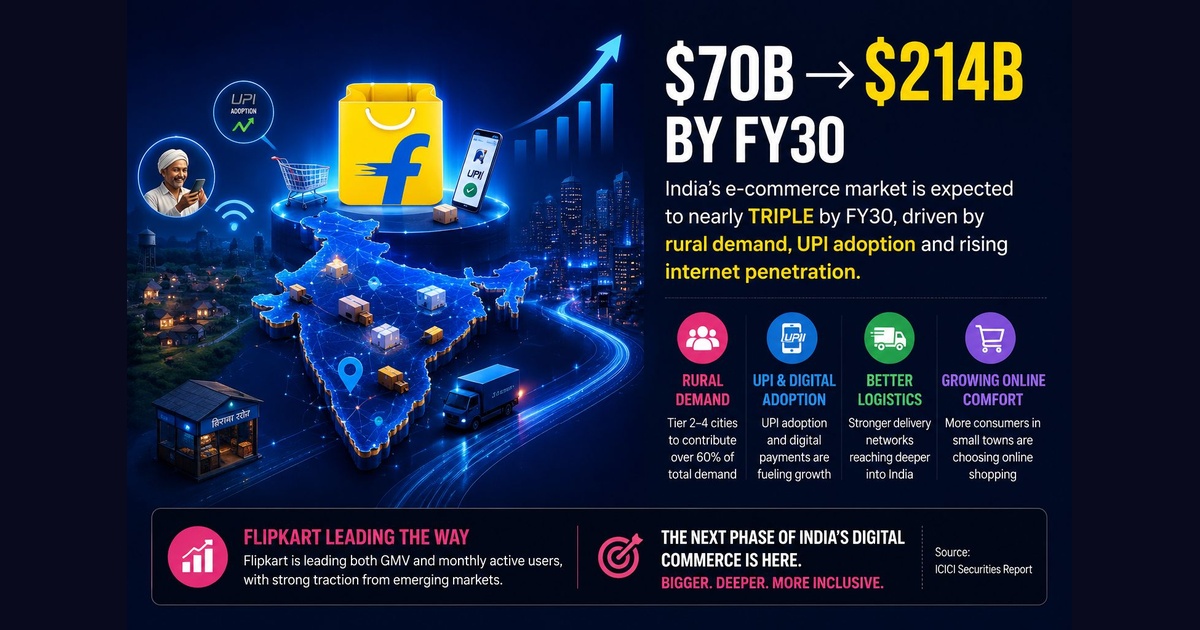
Analysts generally view India's e-commerce sector with optimism, a Whalesbook report noted. Demographic tailwinds and technological integration drive this outlook, the report said. Projections indicate the market will nearly triple from $90 billion to $250 billion by 2030, analysts stated. The integration of AI is expected to enhance productivity and customer experience, Whalesbook noted. Creator-led commerce and instant fulfillment models will continue to shape consumer journeys, the report added. The ongoing expansion into Tier-2 and Tier-3 cities suggests substantial headroom for sustained growth, coupled with increasing per capita online spending, Whalesbook said. Companies will need integrated, data-driven, and experience-centric commerce engines to thrive, the report concluded.
Frequently asked questions
What is fueling India's e-commerce growth?
India's e-commerce growth is primarily fueled by Generation Z consumers, who spend 1.5 times more online than older demographics. This surge is further amplified by the increasing adoption of AI and the powerful influence of creator-led content in purchasing decisions.
How large is India's e-commerce market projected to be?
India's e-commerce market is projected to reach $250 billion by 2030, according to the Whalesbook report.
How much more do Gen Z consumers spend online in India?
Gen Z consumers in India spend 1.5 times more online than older demographics, particularly on lifestyle, beauty, and electronics.
What role does creator-led content play in Indian retail?
Creator-led content is expected to influence one in three retail purchases in India by 2030.
How is AI impacting e-commerce in India?
AI adoption by retailers is enhancing personalization, optimizing logistics, and improving customer experiences, significantly contributing to e-commerce growth.
What categories are Gen Z consumers spending on most?
Gen Z consumers are primarily spending on lifestyle, beauty products, and electronics within the Indian e-commerce market.India E-commerce Surges: Gen Z Fuels AI & Creator Sales.