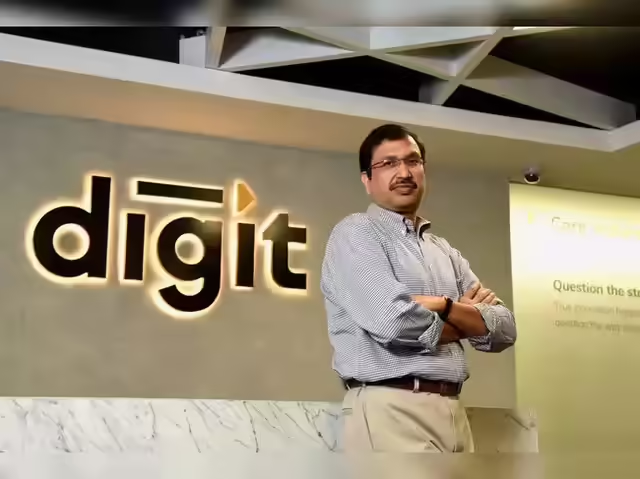
Go Digit General Insurance recorded a 28.8% YoY jump in its PAT to ₹149.4 crore in Q4 FY26, from ₹115.6 crore in the same quarter last year. The company's total income increased 9% YoY and 25% QoQ to ₹3,111.7 crore. For the full financial year FY26, Go Digit posted a net profit of ₹544.35 crore, up from ₹424.94 crore in FY25 — a 28% year-on-year improvement. Total income for FY26 crossed the ₹10,000 crore mark, at ₹10,197 crore. TweakTownNeoGAF
Those are strong headline numbers by any measure. But insurance is an industry where headline profitability can coexist with structurally problematic underwriting, and where the numbers that reveal actual business quality hide several layers beneath the profit line.
The AUM Story and Premium Growth
In FY26, Go Digit sold 1.67 crore policies with ₹22,922 crore in AUM. The company's gross written premium grew 9.8% to ₹11,294 crore, while gross direct premium expanded 16.2% to ₹9,846 crore. TweakTownIn Game News
The divergence between GWP growth (9.8%) and GDPI growth (16.2%) reflects accounting — specifically, Go Digit's use of the "1/n" method that spreads premium recognition over the policy term. On a consistent basis, the underlying business is growing roughly in the 14-16% range, which is comfortably above industry growth and reflects the company's continued market share gains.
Go Digit maintains a diversified portfolio of 88 active products, serving over 8.4 crore customers since inception. That customer base — 84 million people who have held a Go Digit policy at some point — is a distribution achievement. Converting that experience base into repeat customers and cross-sell opportunities is the next growth lever. Wccftech
Motor insurance, which is Go Digit's primary revenue driver, saw a 9.2% YoY increase in net premium earned to ₹1,499.7 crore in Q4 FY26. Go Digit reported a market share of 3.4% in total insurance and 6.5% in motor insurance based on 9M FY26 gross written premium. That 6.5% motor market share — for a company that didn't exist nine years ago — is the number that explains why incumbents like New India Assurance and ICICI Lombard are watching Digit's pricing and product strategy with close attention. TweakTownPressPlay Finance
Kamesh Goyal said during the Q4 earnings call: "AUM has grown to about roughly ₹23,000 crore from ₹19,700 crore in the previous year. So over a period of one year we have added more than ₹3,200 crore of AUM, which is a growth of about 16.3%. Our solvency has now improved to 2.42% and this year quarter on quarter this has been increasing." TweakTown
A solvency ratio of 2.42x against a regulatory minimum of 1.50x provides comfortable headroom. For a company growing premiums at mid-teens rates, maintaining solvency well above regulatory minimums while growing AUM 16% is a balance sheet management achievement that the headline profit number doesn't fully capture.
"AUM has grown to roughly ₹23,000 crore from ₹19,700 crore in the previous year — more than ₹3,200 crore of AUM added, which is a growth of about 16.3%. Our solvency has now improved to 2.42% and this year quarter on quarter this has been increasing."
— Kamesh Goyal, Founder, Go Digit General Insurance, Q4 FY26 earnings call
The Combined Ratio: The Number That Tells the Real Story
Profit in insurance is a function of investment income as much as underwriting performance. The metric that strips away investment returns and reveals whether the core insurance business — collecting premiums, paying claims, managing expenses — is actually profitable is the combined ratio. Below 100% means the underwriting operation generates a surplus. Above 100% means it doesn't, and the business relies on investment returns to achieve overall profitability.
In Q3 FY26, the combined ratio on a 1/n basis was 110.7%, compared with 108.1% in Q3 FY25. Without the 1/n basis, the combined ratio was 108.6%. On an IFRS basis, excluding discounting benefit, the combined ratio was 105.0% compared with 106.2% in the year-ago quarter. PressPlay Finance
In Q2 FY26, the combined ratio came in at 111.4%, compared with 112.2% in Q2 FY25. On a non-1/n basis, the combined ratio improved to 109.9% from 112.2%. syncTObest
A combined ratio above 100% — and consistently so across multiple quarters — means Go Digit's underwriting business is loss-making on a standalone basis. The company's overall profitability depends on its investment income from the ₹22,922 crore AUM being sufficient to cover the underwriting deficit and generate a net surplus. At 2.42x solvency and growing AUM, that arithmetic currently works. But it is a structure that makes the investment portfolio's performance as critical to Go Digit's profitability as its claims management.
The direction of travel is improving. The IFRS combined ratio moved from 106.2% to 105.0% between Q3 FY25 and Q3 FY26. The Q2 non-1/n ratio improved from 112.2% to 109.9%. The trend is downward, which matters — but the distance to 100% represents the structural underwriting challenge that Go Digit, like most general insurers, has not yet fully resolved.
The customer experience data that Go Digit publishes voluntarily in its Transparency Reports — a practice unusual in Indian insurance — provides colour that the financial results alone don't convey. In H1 FY26, the average turnaround time for cashless pre-authorization was 26.9 minutes (fastest at 7 minutes), while hospital discharge approvals averaged 52.5 minutes. Since inception, the company has achieved 40.6 lakh claims settlements with customer satisfaction scores of 95.7% for motor claims and 83.3% for non-motor claims. These are the metrics that justify Go Digit's brand positioning as a simpler, more transparent insurer — and they represent a genuine operational achievement that compounds into customer retention and referral behaviour in ways that don't immediately show up in quarterly results.GameLusterWccftech
The Market Go Digit Is Building In
India's insurance penetration story is simultaneously the most compelling and most overused narrative in Indian fintech. Total insurance penetration in India stands at approximately 4% of GDP, against a global average of 7% and developed market penetration of 10-12%. General insurance penetration is even lower. The headroom is real and large.
India's insurtech market aggregated $2.5 billion in investment in 2024, and India is home to 10 insurtech unicorns and 45 minicorns. Go Digit is the most prominent of those unicorns — the only one that has achieved public listing, sustained profitability, and a genuinely differentiated underwriting position in motor insurance, which remains the largest general insurance category by premium volume. Tom's Hardware
The Infosys contract win — Infosys replaced National Insurance with Go Digit to insure 3.2 lakh employees in July 2025 — is the signal that Go Digit's corporate and group insurance capability is maturing to the point where it can displace incumbents in institutional accounts. That is a different customer acquisition channel from the direct-to-consumer motor insurance business that built Go Digit's market share. It suggests the company is building toward a genuinely multi-segment business. Dataconomy
India's general insurance market generated approximately ₹2.6 lakh crore in gross direct premium in FY26, growing at roughly 12-14% annually. Go Digit's 3.4% overall market share and 6.5% motor share leave considerable room for expansion. The motor insurance market benefits structurally from India's rising vehicle ownership, increasingly mandatory coverage requirements, and the shift from traditional agent-sold policies toward digital-first purchasing that Go Digit is built for.
Key Takeaways
1. FY26 represents Go Digit's most profitable year since founding — but the quality of that profit matters as much as its quantity. ₹544 crore net profit on ₹10,197 crore income is a 5.3% net margin, which is acceptable for a general insurer. The combined ratio trend is the metric to watch for whether that margin is sustainable without relying on investment returns.
2. The combined ratio above 100% is the structural challenge, not a crisis. Go Digit's combined ratio of 105-111% across different accounting bases is improving quarter-on-quarter. Reaching underwriting profitability — below 100% — would represent a step-change in the quality and resilience of the business model.
3. The AUM growth story is underappreciated. ₹22,922 crore in AUM growing 16.3% annually is a substantial investment portfolio generating returns that underpin the company's profitability. As AUM compounds, the investment income cushion against underwriting volatility grows — which is why solvency improvement alongside AUM growth is the right combination.
4. The Infoworks amalgamation creates structural simplification. The proposed amalgamation of Go Digit Infoworks Services into Go Digit General Insurance received no-adverse-observation letters from BSE and NSE in April 2026. Simplifying the promoter holding structure reduces complexity and improves governance clarity for public market investors. In Game News
5. Motor insurance dominance is a strength and a concentration risk simultaneously. 6.5% motor market share is a commercial achievement. Heavy dependence on one category — with its exposure to regulatory pricing changes, weather events, and fraud cycles — means diversification into health, travel, and commercial lines is a strategic necessity, not just an opportunity.
The Honest Counterargument
Go Digit's profit growth is genuine — but it benefits from investment income on a large and growing AUM base in a period when Indian fixed income yields have been favourable. A change in the interest rate environment that compresses investment returns would pressure Go Digit's overall profitability more than most general insurers acknowledge publicly, given that the underwriting business itself runs above 100% combined ratio.
The motor insurance market that provides Go Digit's primary revenue is also price-sensitive and increasingly competitive. Incumbent insurers like ICICI Lombard, HDFC ERGO, and Bajaj Allianz are accelerating their own digital capabilities. Industry motor gross written premium growth was 11.5% in Q3 FY26, while Go Digit grew at 23.4%. That outperformance is partly a reflection of Go Digit's pricing competitiveness — but aggressive pricing that wins market share can create adverse loss ratios that surface in subsequent quarters. PressPlay Finance
Go Digit received a ₹384 crore income tax demand order for AY 2023-24 in March 2026, and a re-affirmed GST demand of ₹154.80 crore in March 2026. These tax disputes — ₹538 crore in combined outstanding demands — represent contingent liabilities that the headline profit numbers don't fully reflect. Management is contesting both; the outcome matters. In Game News
The expense ratio trend also warrants scrutiny. The expense ratio increased to 38.2% from 35.2% a year earlier in Q3 FY26. Rising expense ratios — driven by customer acquisition costs, technology investment, and administrative expansion — are normal for a growing insurer, but they are the primary driver of the combined ratio sitting above 100%. If premium growth decelerates while the expense base remains elevated, the combined ratio could deteriorate rather than improve. PressPlay Finance
What FY26 Signals for India's Insurtech Ambition
Go Digit's FY26 results land at an interesting moment for India's broader insurtech conversation. The insurance sector is one of the few financial services categories where India's penetration is meaningfully below peer economies at similar development stages — and where the case for technology-driven distribution and underwriting improvement is most clearly made by operational data rather than theoretical argument.
Go Digit publishes detailed transparency reports twice a year, sharing real claim data, approval timelines, and customer service metrics, going beyond standard regulatory requirements. A 26.9-minute average cashless pre-authorization turnaround in a sector where the traditional process took hours or days is not a marginal improvement. It is the kind of operational transformation that changes consumer behaviour and builds brand trust at a scale that advertising cannot replicate. GameLuster
The India insurtech market is at the point where proof-of-concept has been convincingly established — by Go Digit, by Acko, by PolicyBazaar's distribution model — and where the question has shifted to whether these companies can reach sustainable underwriting profitability at scale. For Go Digit, FY26 answers "are you a serious business?" affirmatively. The next question — "can you underwrite profitably without relying on investment returns?" — is what FY27 and FY28 will answer.
Kamesh Goyal built Go Digit on the thesis that Indian consumers deserve insurance that doesn't require an agent, doesn't obscure what's covered, and doesn't make claiming feel like a betrayal. Nine years in, with 8.4 crore policy holders, ₹23,000 crore in AUM, and consecutive years of profit growth, the thesis is demonstrably correct. The Indian insurance market's next challenge — underwriting discipline at scale — is the more complex test that Go Digit is just beginning to take.