Banks set credit card eligibility around formal employment, income documentation, and credit bureau history. That criteria works perfectly for salaried professionals in metro cities. It fails systematically for gig workers, freelancers, small traders, students, homemakers, and first-time earners — the same people who run 45 crore UPI transactions every month on their phones. India's credit card penetration remains at 5–6% of the total population, with most usage in cities, compared to 82% in the US. That 5-6% figure represents one of the largest credit distribution failures in any major economy — and, for a fintech with the right product, one of the largest addressable markets. Premiersmi
Credilio's novio is that product. And on April 28, 2026, Credilio announced it had raised ₹100 crore to scale it.
What novio Actually Is — and Why the FD Model Matters
Fintech startup Credilio has raised ₹100 crore (about $10.5 million) in its Series A funding round led by existing backer Cornerstone Ventures, with participation from Shepherd Hill, Roots Ventures, and ESV-Arthya AIF. The funding will be used to scale its UPI-first fixed deposit credit card app novio, at a pre-money valuation of ₹300 crore. Stock TitanStock Titan
The product logic of novio is elegantly simple. A customer places a fixed deposit — as small as ₹5,000 — and receives a credit card with a limit of 90% of that FD amount. The credit limit on the SBM novio Credit Card is 90% of the fixed deposit amount. For example, if your FD is ₹10,000, the available credit limit will be ₹9,000. The FD earns 7% annual interest and remains RBI-insured up to ₹5 lakhs. There is no income proof required, no credit history check, and no joining or annual fee. Guaranteed approval — no income proof, no credit score, lifetime free. TradingViewGlobeNewswire
That guarantee is the commercial breakthrough. Not "easier to get" or "lower documentation." Guaranteed. For a population that has been conditioned to expect rejection from traditional credit card applications — and often stops trying after one or two failed attempts — a guaranteed approval backed by their own FD removes the primary psychological and procedural barrier to credit card ownership.
The FD backing also solves the bank's risk problem. The credit risk on an FD-backed card is structurally near-zero: the bank holds collateral equal to more than the credit limit and only extends 90% of it. For an issuing bank like SBM or DCB, this is an almost risk-free way to extend credit cards to customers they would otherwise decline on unsecured terms. novio makes the underwriting work for both the customer and the bank simultaneously — which is why it has secured partnerships with SBM Bank, DCB Bank, and YES Bank to issue its cards.
"novio is targeting applicants rejected for unsecured credit products, mainly due to lack of credit history and formal employment. These customers are not credit-unworthy — they are credit-invisible. The FD-backed model gives them a guaranteed path into the formal credit system."
— Aditya Gupta, Founder and CEO, Credilio
The B2B Distribution Engine Feeding a Consumer Brand
Understanding novio requires understanding what Credilio has spent five years building underneath it.
novio leverages Credilio's main business as a credit marketplace that allows direct selling agents (DSAs) and financial advisors to digitally sell credit products from over 35 banks and NBFCs. It also helps consumer businesses like e-commerce platforms and D2C brands upsell loans and credit cards to consumers. This business acts as a customer acquisition arm for novio, which targets applicants rejected for these unsecured credit products, mainly due to lack of credit history and formal employment. Stock Titan
The architecture is what makes this particularly elegant. Credilio's B2B credit marketplace processes applications from consumers seeking unsecured credit cards and personal loans across 35+ bank and NBFC partners. When an applicant is rejected — because they lack income documentation, credit history, or formal employment — that rejection event becomes a novio acquisition opportunity. The customer has already demonstrated intent; Credilio already knows their profile; the conversation shifts from "you don't qualify" to "you can get a credit card today with a small FD."
That conversion from rejection to secured alternative is the lowest-cost customer acquisition funnel in Indian fintech. Customer acquisition cost remains the startup's main expense. By capturing the rejection flow from its own B2B marketplace, Credilio dramatically compresses the CAC for novio relative to what a standalone consumer credit card app would spend on paid acquisition. Stock Titan
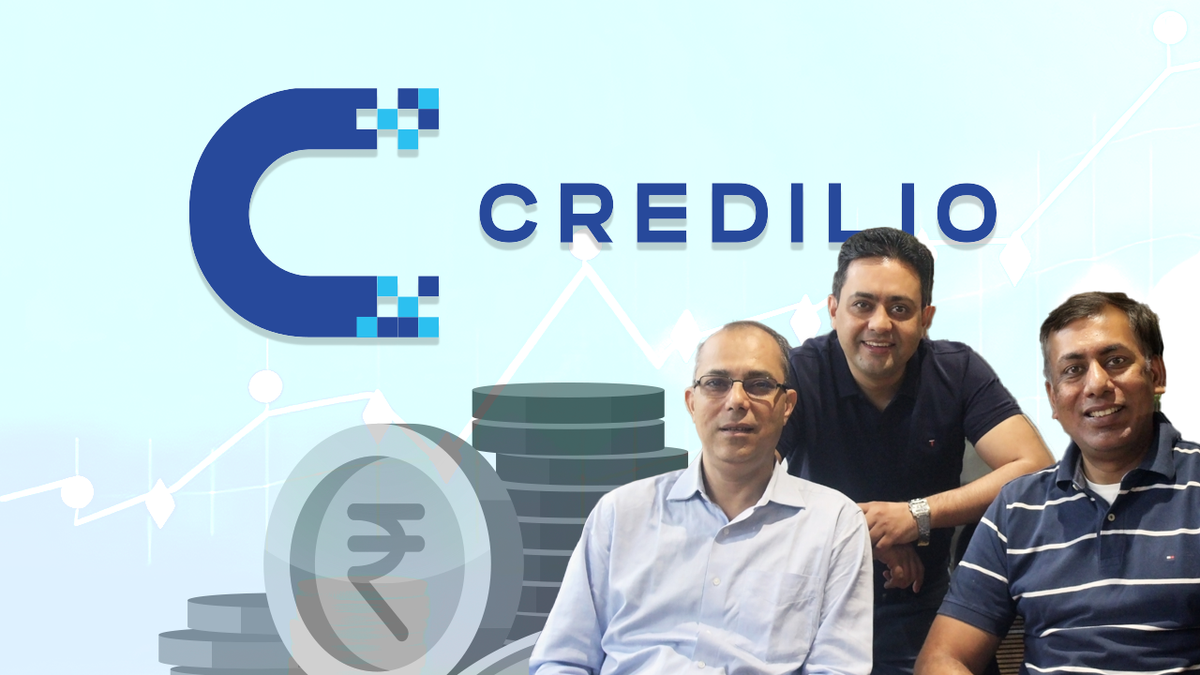
Credilio was founded in 2020 by ex-HSBC bankers Aditya Gupta, Sandeep Ghule, and Anand Kapadia, who earlier founded Transerv — a digital payments solution provider that was acquired by Indiabulls. Former PwC partner Manish Sinha joined as a cofounder last year. That founding team — investment banking backgrounds, a prior fintech exit, and a Big Four accounting partner — assembled around a mission that most institutional credit players had left unaddressed. Stock Titan
Credilio has raised a total funding of $14.5 million to date, including the latest round, from the likes of Exfinity Venture Partners and Param Capital's founder Mukul Agarwal. Stock Titan
The UPI layer is what makes novio's product genuinely different from the FD-backed credit cards that Indian banks have offered quietly for years. Traditional FD-backed cards were plastic first — useful at point-of-sale terminals, less useful for the daily payment behaviour that actually drives credit card habit formation. The novio RuPay credit card can be linked to any UPI app and earns rewards on UPI payments — which means it works at every kirana store, every chai stall, every auto-rickshaw that accepts a QR code. The credit card becomes usable not as a premium payment instrument for large purchases, but as an everyday spending tool for the transactions that actually dominate the financial lives of the customers novio targets. This is the insight that makes novio a product the market can actually adopt, not just one that technically exists.Ethos
The Market Timing That Makes This Round Compelling
UPI-linked credit card usage now accounts for approximately 40% of all credit card transactions by volume. RuPay's share of credit traffic is rising rapidly. Tier II and Tier III India adopted UPI not as an alternative, but as the default payment method. Once UPI became normal, the infrastructure barrier for credit disappeared. MoneyGeekCoinLaw
That infrastructure collapse is the most important market development for novio. In 2018, a credit card for someone in Patna or Surat required a physical card that could be swiped at merchants who mostly didn't have card machines. In 2026, a RuPay credit card linked to PhonePe or Google Pay works at every merchant in those cities who accepts a QR code — which is most of them. The payment infrastructure that novio needs to make its product useful has been built by NPCI and UPI over the last four years. novio arrives to monetise it.
novio is looking to tap Tier II to V cities, where credit card penetration remains limited as banks are unwilling to underwrite lower-tier borrowers. Bihar's credit card penetration stands at 1.5% despite a population of 125 million. Delhi sits at 12%. The national average is 4.6%. The geographic disparity in credit card penetration directly maps to where the unsecured credit eligibility criteria fails — and where novio's FD-backed model fills the gap that the banks have left. Stock TitanGameSpot
India has approximately 45 crore UPI users and fewer than 5 crore credit card holders — a 9-to-1 ratio that represents the structural opportunity novio is addressing. The company is targeting credit invisible consumers in Tier II-V cities, aiming to onboard 5 lakh users by next year from its current base of 1 lakh. Five times the user base in twelve months is an ambitious trajectory — but it is one that the distribution engine and the product-market fit data, rather than speculative optimism, appears to support. Coverager
Key Takeaways
1. The FD-backed guarantee is the product's core commercial innovation. Guaranteed approval with no income proof and no credit score removes the psychological and procedural barriers that have kept 400 million UPI users out of the credit card system. The risk is borne by the collateral, not by the bank's credit assessment — which is why the model works for both issuer and customer simultaneously.
2. The B2B rejection funnel is the CAC moat. Capturing unsecured credit application rejections from Credilio's own distribution network and converting them to novio customers compresses acquisition cost in ways that a standalone consumer credit brand cannot replicate. The customer has already demonstrated intent; the conversion is structural, not paid.
3. UPI integration is what makes the product a daily habit driver. An FD-backed credit card that works on UPI is usable everywhere Indian digital commerce has penetrated — which, in 2026, is most of the country. This is not a metro product given to Tier II users. It is a UPI-native product built for the payment behaviour that already exists in those markets.
4. The revenue model benefits from scale at the usage layer. Credilio earns revenue on every credit card transaction and revolving income from defaults and fees. Interchange on UPI-linked credit card transactions, combined with revolving income from the segment of customers who don't pay in full, creates recurring revenue that compounds with user growth. Stock Titan
5. The FY27 ₹150 crore revenue target requires novio to become the primary growth engine. Credilio expects its top line to grow to ₹150 crore in FY27 as it scales the novio platform. The B2B credit marketplace business grew only 21% in FY26 against a sluggish market. Everything above the current trajectory depends on novio's consumer scaling executing on plan. Stock Titan
The Honest Counterargument
The FD-backed credit card model is not new to India. SBI, HDFC, and most major banks have offered secured cards for years. What Credilio is betting on is that the novelty is not the product but the distribution and the UPI-native design. That is a plausible bet — but execution on consumer brand building in India's crowded fintech space requires marketing investment that ₹100 crore must fund simultaneously with product, team, and working capital.
As per unaudited financials for FY26, Credilio's revenue rose around 21% to ₹100 crore while its loss remained flat at ₹18 crore. Gupta attributed the growth slowdown to sluggish momentum in the broader B2B credit card distribution market. A business growing 21% in a market it describes as sluggish is somewhat dependent on that market recovering — or on novio scaling fast enough to decouple Credilio's growth from B2B distribution momentum. The Series A funds both imperatives simultaneously, which is a lot to ask of ₹100 crore. Stock Titan
The revolving income component — "income from defaults and fees" — in novio's revenue model also warrants honest examination. FD-backed cards help those with limited credit history build profiles. That is the product's best-case outcome: a customer uses novio to establish credit, builds a CIBIL score above 750, and graduates to an unsecured card. The worst-case outcome — a customer who revolves the balance at 42% annual interest because the FD gives them credit they're not yet equipped to manage — creates real consumer harm even as it generates revolving income. At Tier II-V scale, where financial literacy around credit costs is lower, the responsibility that comes with being the first credit product in someone's financial life is significant. Choice Mutual
The competitive response from incumbent banks is also not trivial. A fully digital UPI-powered co-branded credit card by Google Pay and Axis Bank launched in late 2025. Google Pay's distribution reach — 37% of India's UPI market share — dwarfs anything novio can build organically. If Google Pay or PhonePe decides the FD-backed, UPI-native credit card market is worth entering directly, Credilio's distribution advantages become less decisive. MoneyGeek
Why This Round Matters for India's Financial Inclusion Story
The conversation about India's fintech ecosystem has, for most of the last decade, been dominated by two narratives: the UPI miracle and the lending crisis. UPI made digital payments universal. The lending market that followed produced too much unsecured credit too fast for customers who weren't ready for it, generating the delinquency pressure that has shadowed the sector since 2023.
novio's FD-backed model offers a third path: credit that is structurally collateralised, behaviourally appropriate for first-time credit users, and enabled by the UPI infrastructure that India has already built. The customer can spend only what their FD backs. The interest is earned on the FD. The credit limit is visible and bounded. For a first-time credit user in Lucknow or Indore, those are not restrictions — they are the features that make credit feel safe enough to try.
Tier II and Tier III India is seeing long-term structural changes. Incomes are rising. Digital literacy is improving. Formal employment is expanding beyond metros. RBI's long-term payment system vision emphasises inclusive digital credit and deeper penetration outside major cities. CoinLaw
The RBI's vision and novio's product are, for once, pointing in the same direction. Credilio's founders — ex-HSBC bankers who built and exited a payments company before building Credilio — understand the regulatory environment well enough to build with rather than against it. The ₹100 crore Series A is the capital to execute on a product that the market timing, the regulatory environment, and the distribution architecture have aligned to support.
India's credit card market is not 111 million people who want credit. It is 500 million people who use digital payments daily, a significant portion of whom have never been offered credit on terms they can access or afford. novio launched as a separate fintech platform in 2024 with a focus on issuing secured credit cards for underserved borrowers. Two years in, with 1 lakh customers and a fresh ₹100 crore, it is building toward 5 lakh — and, if the model proves out, toward the much larger number that lies beyond. Stock Titan
The 400 million people between UPI and a credit card aren't unbanked. They aren't uncreditworthy. They're just waiting for a product designed around their actual financial lives rather than the documentation requirements of a system built for someone else's.