On April 21, 2026, Alipay launched a new AI Pay-powered payment service that enables OpenClaw-type AI agents to make purchases and complete payments based on user instructions. The announcement is the latest acceleration of a product arc that began in 2025 and has moved at a velocity that the global payments industry is still absorbing. Alipay AI Pay passed 100 million users in February 2026, becoming the first AI-native payment product globally to achieve this milestone, and processed over 120 million transactions in the week of 5–11 February 2026. British BriefThe Register
120 million transactions in a week — from a product that launched less than 18 months earlier. That is not a pilot. That is infrastructure.
What OpenClaw Is, and Why It Changes Everything
To understand why the April 21 launch matters, you need to understand what OpenClaw-type AI agents are, and what it means for them to initiate payments.
OpenClaw-type agents, also known as "lobsters" in China, are autonomous tools that execute tasks on behalf of users without requiring coding or complex setup. They are the Chinese equivalent of what Western AI observers call "computer-use agents" or "agentic systems" — software that doesn't just respond to queries but acts: booking, ordering, renewing, purchasing, managing. The name derives from the claw motif of robotic task execution; "lobsters" is the colloquial shorthand in Chinese tech circles for agents that grab and act on your behalf. Tech Policy Press
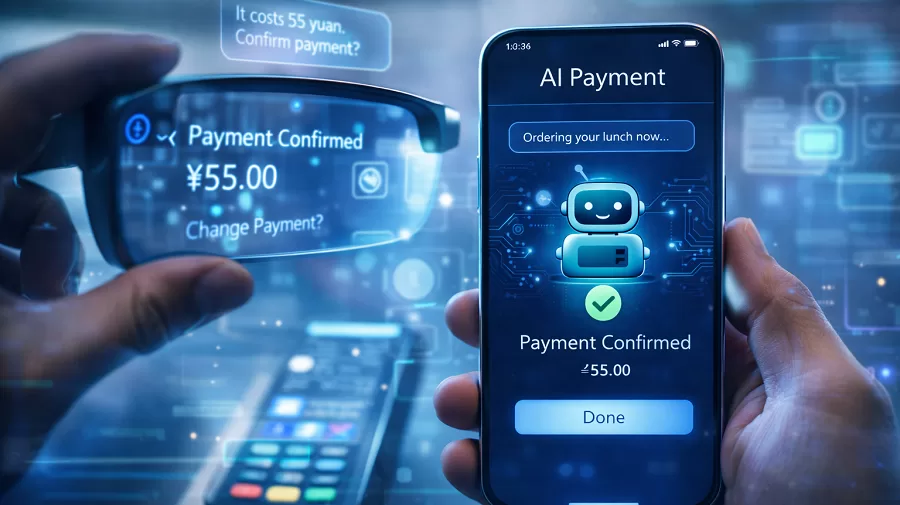
The new service requires no coding or technical setup. Users install Alipay AI Pay into their AI agent, state a voice command to enable payment functionality, and complete identity verification. From that point, the agent can handle purchases in three steps: the user states a need, confirms the order, and authorises payment via Alipay AI Pay. Orders can be modified or cancelled at any point with a single command. GameSpot
Three steps. Voice command. No page-switching. No checkout friction. The agent handles the entire transaction flow except for the explicit authorisation moment — which is retained as a human control point by design.
The new service is now pre-installed on Alibaba Cloud's JVS Claw, and has been rolled out on DTClaw of Ant Group Digital Technologies. Alipay AI Pay is also available to other OpenClaw-type AI agents, including Claude Code and Hermes Agent via easy installation. The inclusion of Claude Code — Anthropic's agentic coding tool — in the list of compatible agents is a signal that Alipay is not limiting its reach to the Alibaba ecosystem. It is building horizontal infrastructure. Euronews
"AI is fundamentally changing the way we think about payments. We are moving from a world where humans initiate every transaction to one where AI agents act on behalf of users — and the payment infrastructure must evolve to support that shift safely and at scale."
— Alipay, official launch statement, April 21, 2026
The Developer Stack: Four Products That Nobody Else Has Built at Scale
The consumer-facing OpenClaw integration is the headline. The developer-facing suite released alongside it is the strategic substance.
Alipay has unveiled a number of developer-facing services to support AI commercialisation more broadly, including Payment MCP Server, enabling developers to integrate payment services to AI agents using natural language; Payment Integration Skill, enabling vibe coding developers to integrate payment services to applications easily using natural language; AI Tipping, providing developers who need to receive tips within an AI agent with convenient payment capabilities; and AI subscription payment, enabling developers to receive payment from an AI agent based on service usage times or duration — each the first of its kind in China. British Brief
Examine each of these in turn, because the commercial logic is distinct.
The Payment MCP Server is the most architecturally significant. MCP — Model Context Protocol — is the standard that allows AI models to interact with external services. By building payment functionality as an MCP server, Alipay makes itself available to any AI agent that speaks MCP, which is rapidly becoming the de facto protocol for agentic integrations globally. Any developer building on MCP-compatible infrastructure can now add Alipay payments with natural language commands, not API documentation and integration engineering.
The Payment Integration Skill targets the vibe coding market — the growing population of non-professional developers using AI-assisted coding tools to build applications without traditional software engineering skills. Making payment integration accessible via natural language to this population extends Alipay's developer reach far beyond the professional engineering community.
AI Tipping addresses a monetisation gap that every creator economy platform has identified but none has natively solved: how do you receive micro-payments within an AI agent interaction? The answer, until now, has been awkward redirects to third-party payment flows. Alipay's solution embeds the tipping mechanism inside the agent itself.
AI subscription payment — billing based on service usage times or duration — is the infrastructure for the metered economy that agentic AI creates. When an AI agent runs tasks on your behalf, it accumulates compute, API calls, and service usage. Billing that consumption in real time, within the agent, without manual invoice processing, is the payment model that agentic services require.
The Agentic Commerce Trust Protocol, launched in January 2026, sits beneath all of these products as the governance layer. Alipay launched the Agentic Commerce Trust Protocol with partners including Alibaba's consumer-facing AI application Qwen App and Taobao Instant Commerce. Qwen App became the first platform to adopt the Protocol, connecting with Taobao Instant Commerce and Alipay AI Pay. A protocol — rather than a product — matters because it creates a standard that other platforms can adopt, extending the network without requiring Alipay to build every integration itself. Protocols compound. Products deprecate.PC Gamer
The Use Case Breadth That Validates the Platform
The 120 million weekly transactions aren't abstract platform numbers. They represent specific commercial contexts that reveal how broadly agentic commerce has already penetrated Chinese daily life.
Alipay AI Pay has expanded into various use cases, including AI agents in apps and mini programs for brick-and-mortar retailers like Luckin Coffee, AI smart glasses like Rokid, consumer-facing AI applications like Alibaba's Qwen, and now OpenClaw-type AI agents. VGTimes
Luckin Coffee — China's dominant domestic coffee chain with over 21,000 locations — embedding Alipay AI Pay means that ordering coffee via an AI agent is not a tech-demo experience. It is a daily consumer behaviour for millions of people who use Luckin as their habitual caffeine source. Rokid's AI smart glasses integration means that the payment trigger can happen from a wearable device, via voice, in a physical environment. Qwen integration means that China's most widely used AI application — with 300 million monthly active users as of December 2025 — routes its commerce through Alipay's infrastructure.
Alipay is also expanding Tap! wearables through its partnerships with Xiaomi, Rokid, and RayNeo. The wearables expansion is significant because it positions Alipay's payment infrastructure at the hardware layer of China's AI consumer device ecosystem — not just the software layer. If the next interface for commerce is smart glasses or AI-enabled wearables, Alipay intends to be the payment layer before those devices ship at scale. Atelier Sakura
The $0.00 switching cost for developers who already use MCP is the distribution engine. Every developer building MCP-compatible AI agents who wants payment functionality now has a no-code path to Alipay integration. In a world where the MCP ecosystem is growing exponentially, that distribution mechanic compounds without proportionate sales or marketing investment from Alipay.
Key Takeaways
1. 120 million weekly transactions establishes Alipay AI Pay as infrastructure, not a feature. At that transaction volume, the ecosystem has self-sustaining momentum — merchants are building for it, developers are integrating it, and consumers are habituated to it. That is a different category of market position than any Western competitor currently occupies in agentic payments.
2. The MCP Server architecture is the strategic masterstroke. By making Alipay payments accessible via the Model Context Protocol, Alipay embeds itself into every MCP-compatible AI agent globally — not just Chinese ones. Claude Code's inclusion in the compatible agent list is the clearest signal of this horizontal ambition.
3. The four developer tools — MCP Server, Integration Skill, AI Tipping, AI Subscription — collectively define the monetisation infrastructure of the agentic economy. No single Western payments company has shipped all four simultaneously. Stripe has agentic commerce ambitions. Google has the Universal Commerce Protocol. Neither has the live transaction volume to validate the model.
4. The Agentic Commerce Trust Protocol is a standards play, not just a product launch. Protocols that become industry standards generate more durable competitive advantage than products that can be copied. Alipay's January 2026 launch of ACT, adopted first by Qwen and Taobao, is an attempt to set the governance standard before competitors can.
5. The global implications depend entirely on Ant Group's ability to operate outside China. Alipay's regulatory history — Ant Group's 2020 IPO suspension, the subsequent restructuring, ongoing scrutiny from Chinese regulators — constrains international expansion in ways that the product roadmap alone cannot overcome.
The Global Race Alipay Is Winning Domestically
Alipay is not building in a vacuum. The race to own agentic payments infrastructure is happening simultaneously across the Pacific — and the Western field is fragmented and, as yet, without the transaction volume to validate its claims.
In January 2026, Google announced the launch of its Universal Commerce Protocol in partnership with Etsy, Shopify, Target, Wayfair, and Walmart, endorsed by Adyen, American Express, Mastercard, PayPal, Stripe, Visa, and Worldpay. It is compatible with Google's previously announced Agent-to-Agent protocol and Agent Payments Protocol, as well as with MCP. Stripe and Tempo, with Visa as a design partner, have recently launched their Machine Payments Protocol for AI-agent-to-AI-agent payments. The frontrunners in the West remain Google's Universal Commerce Protocol and OpenAI's Agentic Commerce Protocol due to their respective answer engine market share. SteamDB
That is a large coalition of brand names assembled behind Western agentic payment standards. It is also, conspicuously, a coalition that announced a protocol rather than a transaction volume. Google's Universal Commerce Protocol is endorsed by Visa and Mastercard — and has no equivalent to 120 million weekly transactions demonstrating that the model works at consumer scale.
Stripe admits in its 2025 annual letter that "agentic commerce suffers from having been overhyped too early in some corners" but that it "has the potential to be generationally impactful" if universal interoperability is achieved. Stripe's candour is admirable. It is also, read against Alipay's February 2026 transaction numbers, a concession that the most credible real-world validation of agentic commerce has happened in China, not in San Francisco. SteamDB
The gap between protocol announcement and transaction reality is where Alipay's advantage lives. China's AI ecosystem — tightly integrated around Alibaba, Ant Group, Baidu, and a dense network of AI application developers building on Qwen, Baidu's Ernie, and others — provided a captive testing environment for agentic commerce that no Western ecosystem could replicate. Chinese consumers are already comfortable with super-app-style embedded commerce; the transition to agent-initiated commerce required less behavioural change than it would in markets where checkout remains a discrete, human-controlled step.
The Honest Limitation
Alipay's domestic momentum is extraordinary. Its international applicability is structurally constrained.
Ant Group's planned IPO was suspended by Chinese regulators in November 2020, triggering a restructuring that took years to resolve and left the company under persistent regulatory scrutiny. Its ability to expand internationally — particularly into Western financial markets — is limited by the geopolitical environment in which Chinese fintech companies now operate. The US, EU, and UK all impose various restrictions on Chinese financial services operators that limit the deployment surface for Alipay AI Pay beyond Southeast Asia and selected markets where Ant Group has established regulatory footholds.
Security is built into every layer of the new service: activation requires user initiation and identity verification, each payment requires explicit user authorisation, and a 24/7 risk control system monitors transactions. Those security controls are appropriate for consumer deployment. They also represent points of regulatory scrutiny in markets where data localisation, cross-border payment monitoring, and AI system transparency are increasingly legislated. What works frictionlessly in China's regulatory environment may encounter significant compliance overhead in the EU's DORA framework or the UK's FCA's Consumer Duty. Euronews
The OpenClaw agent category itself also carries an adoption question outside China. "Lobsters" — autonomous agents executing purchases on a user's behalf — are a mature concept in China's WeChat and Alipay super-app ecosystem. In Western markets, consumer trust in AI agents initiating purchases remains nascent, and the liability questions around agent-initiated errors, fraudulent agent deployments, and consumer recourse are unresolved.
Why This Matters for Global Payments — Now
The conventional wisdom in payments is that infrastructure is built slowly, that trust is earned across decades, and that network effects are difficult to redirect. Alipay's AI Pay trajectory challenges all three assumptions.
It took PayPal fifteen years to become essential infrastructure. It took Stripe a decade to be the default payments API for startups. Alipay AI Pay reached 100 million users in less than eighteen months. The velocity is different because the distribution mechanism is different: MCP protocol adoption by developers multiplies reach without proportionate Alipay effort, and Alibaba's 300-million-user Qwen application provided an immediate consumer surface that no Western payments company building from scratch can replicate.
For fintech founders and payments operators watching this space, the lesson is architectural. Alipay didn't build a better checkout button. It built payment infrastructure that is native to the agent layer — that speaks MCP, that integrates via natural language, that operates inside AI agent flows rather than interrupting them with a redirect. The checkout button is the relic of the browser era. Alipay is building for the era where the browser is optional and the agent is primary.
Whether Google's Universal Commerce Protocol, Stripe's Machine Payments Protocol, or Alipay's Agentic Commerce Trust Protocol becomes the global standard for agentic commerce payments will be determined over the next two to three years. Alipay enters that competition with one advantage none of its Western competitors can quickly replicate: it has already done it, at scale, with real consumers making real purchases. 120 million transactions in a week is not a benchmark. It is proof