Comparisons between robots and humans are inherently imperfect. As one social media user quipped, “my car can outrun a cheetah too.” Yet the result signals rapid progress in robotics performance.
The improvement is striking when measured against last year’s event, where the fastest robot completed the race in two hours and 40 minutes.
Honor’s Winning Entry
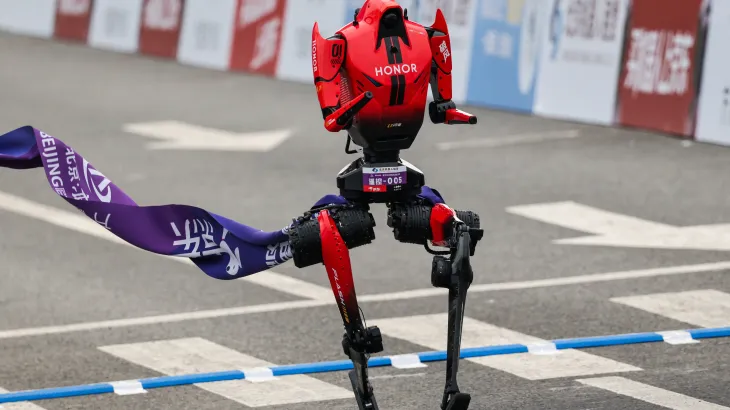
The top-performing autonomous robot was built by Honor, better known for smartphones than athletic robotics. According to reports, a different Honor robot actually clocked a faster time of 48 minutes and 19 seconds — but that machine was remotely controlled.
Because the competition weighted autonomy heavily in scoring, the fully autonomous 50:26 robot was declared the official winner.
The distinction matters. Remote-controlled robots rely on human operators for balance and navigation, while autonomous systems must interpret terrain and adjust gait independently in real time.
Autonomy as the Real Benchmark
Roughly 40% of the participating robots competed autonomously, while about 60% were remotely controlled, according to Beijing’s E-Town technology hub.
Not every machine performed flawlessly. Some stumbled at the starting line, and at least one robot collided with a barrier during the race.
Such incidents highlight how far robotics still has to go in stability, perception and real-world adaptability.
Still, shaving nearly two hours off last year’s best time underscores rapid iteration in locomotion algorithms, battery efficiency and mechanical design.
What the Time Really Means
Unlike humans, robots are not constrained by muscle fatigue or oxygen capacity. Their performance depends on motor torque, battery endurance and software precision.
The Beijing event serves less as a human-versus-machine contest and more as a benchmark for bipedal robotics.
Sustained running over 21 kilometers requires dynamic balance, terrain adaptation and energy management — challenges that extend beyond simple walking demonstrations.
For robotics developers, the half-marathon format offers a stress test for endurance and autonomy.
China’s Robotics Push
The race also reflects China’s broader push into advanced robotics and embodied AI.
As AI systems become more capable in software domains, translating that intelligence into physical mobility remains a major frontier. Autonomous locomotion has applications ranging from logistics and disaster response to elder care and industrial inspection.
Events like the Beijing half-marathon provide public demonstrations of progress while reinforcing the country’s ambition in robotics development.
A Milestone, Not a Finish Line
The headline-grabbing time may suggest robots have overtaken humans in endurance running.
In reality, the benchmark reflects a different category of performance entirely.
Humans compete on biological limits. Robots compete on engineering iteration.
What the 50:26 finish truly represents is acceleration — not just in speed, but in development cycles.
Last year’s robots struggled to finish in under three hours. This year’s autonomous machines crossed the line in under one.