When Piotr "Łatwogang" Garkowski, a 23-year-old content creator from Warsaw, clicked "go live" on YouTube on April 17, 2026, he had committed to something structurally absurd: for every like on a TikTok announcement video, he would listen to a single song on loop for one second on stream. His post amassed enough likes for nine days of constant streaming. Notes From Poland Nine days. The same song. One small apartment. A nation watching.
When the stream ended at 9:37 p.m. CEST on April 26, total donations for the Cancer Fighters Foundation had surpassed 250 million Polish złoty — approximately $69 million — making it the largest charity livestream ever recorded. MarketScreener The previous Guinness World Record, set just seven months earlier, was $19.5 million. Łatwogang didn't beat it. He didn't even double it. He crushed it by more than three-to-one — from a small Warsaw flat, with no corporate backing, no platform deal, and no promotional budget.
How an 11-Year-Old's Song Started Everything
This story does not begin with Łatwogang. It begins with Maja Mecan, an 11-year-old girl from Oława who has been fighting acute myeloid leukaemia for almost three years and is now battling her third relapse.
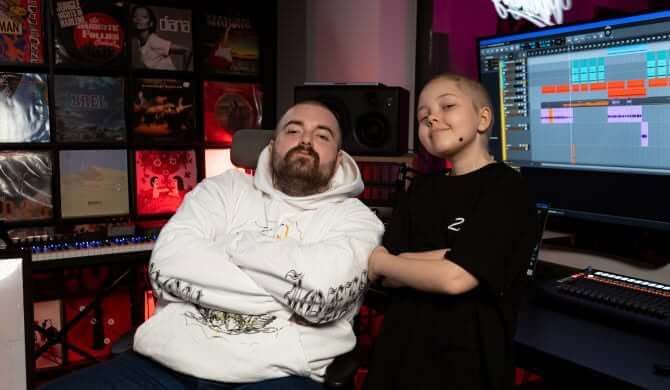
Together with Polish rapper Bedoes 2115, Maja recorded a track called Ciągle tutaj jestem (diss na raka) — "I'm Still Here (A Diss Track Against Cancer)" — with all royalties going to the Cancer Fighters Foundation, which has supported people with cancer since 2015. Two Continents The song went viral. Its title is the whole thesis: defiance framed as a music genre, a child refusing to be defined by her diagnosis, turning her fight into a cultural artefact.
When Łatwogang heard it, he posted his challenge on TikTok: one like, one second of stream. Over 767,000 likes arrived. Two Continents The mathematics were unavoidable. Nine days of non-stop broadcasting, beginning April 17 and ending April 26, all in service of the Cancer Fighters Foundation. The original target evaporated almost immediately. What replaced it exceeded anyone's imagination.
"We're reaching for the stars, reaching for space, to help those who need it most, the innocent children who fight the hardest battles every day."
— Marek Kopysc, President, Cancer Fighters Foundation
The Record It Shattered — And the Records Before That
To understand how seismic this is, you need the context of how charity livestreaming has evolved over the past twelve months.
In August 2025, MrBeast (Jimmy Donaldson), Adin Ross, and xQc raised $12 million during an 18-hour Kick stream for MrBeast's TeamWater campaign — officially certified by Guinness World Records as the most ever raised during a single livestream. Quasa That record lasted weeks. French streamers Adrien "ZeratoR" Nougaret and Alexandre "Dach" Dachary then raised €16.1 million (approximately $18 million) during ZEvent 2025 in September, a four-day event in Montpellier bringing together over 70 streamers to beat it. Dexerto
The progression tells a story: $12 million in August 2025, $18 million in September 2025. Then, eight months later, from a single apartment in Warsaw: $69 million. Not a marginal improvement. A complete reordering of what's possible.
The charity livestreaming record has now been broken three times in under a year — each time by a wider margin than the last. What Łatwogang achieved didn't just move the record; it retired the previous frame of reference entirely.
At peak, 1,577,039 people watched the stream simultaneously, with an average of 89,801 concurrent viewers over 179 hours and 16.1 million total hours watched. Streamer For comparison: the Super Bowl draws around 120 million viewers in the US. Łatwogang's peak audience was a fraction of that — but it was sustained, it built organically, and critically, it converted viewers into donors at a rate that no traditional broadcast philanthropy model has matched.
Nine Days That Became a National Moment
What distinguished this stream from its predecessors wasn't just the scale. It was the texture — the accumulation of moments that turned a single creator's challenge into a collective Polish cultural event.
Robert Lewandowski, one of the world's most recognisable footballers, appeared on stream and returned to TikTok specifically to support the campaign. He and his wife Anna Lewandowska contributed 1 million złoty. Streamer Six-times Grand Slam champion tennis player Iga Świątek also joined the effort. MarketScreener Celebrities, actors, musicians, and journalists passed through the Warsaw flat across nine days — not as scheduled promotional appearances, but as genuine participants in something that had taken on a momentum of its own.
Head-shaving became the defining visual ritual of the stream. Actress Edyta Pazura pledged to shave her head once donations hit 50 million złoty — and her husband, beloved actor Cezary Pazura, was the one holding the razor. Streamer Kasix, who survived a stroke at 25, had grown her hair for five years before shaving it at the 13 million złoty milestone. Fashion blogger Maffashion joined remotely from Marbella and shaved her head live once the counter crossed 46.25 million złoty. Streamer
Rapper Bedoes 2115 — whose song with Maja had sparked the entire campaign — shaved his own mother's head live on camera. She, too, had battled cancer. Two Continents That single moment encapsulates what made this stream different from its predecessors: the personal stakes were visible, immediate, and real. This wasn't a celebrity challenge divorced from the cause. The cause was woven into every moment.
Polish rapper Tede video-called fellow rapper Peja after 17 years of silence to bury the hatchet on their long-running feud on stream — at 164 million złoty raised. Two Continents A nine-day charity broadcast became the venue for one of Polish hip-hop's most talked-about reconciliations. Pop singer Doda called television personality Magda Gessler live and publicly ended years of public tension between them. The stream became a space where Poland processed things it had been holding.
Key Takeaways
1. The mechanics of the challenge were the product. One like equals one second of stream time is a participation model, not just a donation model. Every person who liked the TikTok video became a co-author of the nine days. That sense of shared authorship is what drove the scale of subsequent donation behaviour.
2. The previous Guinness record fell by 3.5x. Łatwogang raised more than $69 million against a previous best of $19.5 million. This isn't incremental progress — it's a structural demonstration that a sufficiently authentic cause, amplified by the right creator at the right cultural moment, can generate philanthropy at a scale that dwarfs traditional institutional fundraising.
3. Maja Mecan is the moral centre of this story. The song recorded by an 11-year-old fighting her third cancer relapse was not marketing material. It was evidence of the cause's reality. The creative impulse that produced a diss track against cancer — defiant rather than mournful — resonated globally in a way that conventional charity messaging rarely achieves.
4. Corporate Poland followed citizen Poland. Companies including Tymbark made contributions totalling millions of złoty across the nine days. Brand participation followed audience momentum rather than preceding it — a reversal of the usual corporate charity model.
5. The Cancer Fighters Foundation now faces a transparency imperative. The foundation described the funds as representing "not only a great opportunity to help, but also a huge responsibility," and announced a dedicated website to provide details on how the money would be spent. Notes From Poland At this scale, operational execution and public accountability will be as important as the fundraising achievement itself.
What This Tells Us About How Philanthropy Actually Works in 2026
The conventional wisdom about charitable giving holds that it flows from institutional relationships — from galas, from corporate foundations, from major donors with strategic interests in a cause. What Łatwogang demonstrated is that a sufficiently compelling narrative, delivered in real time by a creator with genuine investment in the outcome, can mobilise resources at a scale that traditional philanthropy simply cannot match on comparable timelines.
The milestone caught MrBeast's attention after Polish esports figure Wojtek Kardyś tagged him in a viral X post celebrating the stream hitting 100 million złoty. Dexerto When the creator who held the previous record acknowledges the person who broke it, it completes a passing of the torch — and signals to the global creator economy that the model is not exhausted but accelerating.
The history of digital philanthropy shows a pattern: each record-breaking event normalises a higher baseline. The 2021 ZEvent's $11.9 million seemed extraordinary at the time. MrBeast's $12 million in August 2025 felt like the ceiling. ZEvent 2025's $18 million felt like an anomaly. None of those conceptual ceilings survived contact with what a 23-year-old in Warsaw built around a song recorded by a sick child.
There is a harder question underneath the celebration. Łatwogang himself described the fundraiser as a "miracle" in comments to Polskie Radio, downplayed his own role, and said of the children fighting cancer: "I believe that only they should be spoken of as people who have done something great." Notes From Poland That instinct — to redirect credit back to the cause rather than claim it — is itself part of what made the campaign work. Creator-led philanthropy fails, consistently, when the creator becomes the story. When the cause remains the centre, the audience stays engaged.
Notably, Polish MP Łukasz Litewka participated in the broadcast the night before his tragic death — one of his last public appearances. Two Continents The stream that was supposed to be a fundraising challenge became, in the end, a document of a specific nine days in Polish public life — joyful, grief-touched, and wholly unexpected.
The Honest Limitation
Scale of fundraising and quality of outcome are not the same thing. The Cancer Fighters Foundation acknowledged that the funds come with "massive responsibility" to ensure transparent spending. Notes From Poland Deploying over 250 million złoty effectively — in a sector where institutional capacity and procurement infrastructure determine whether donations reach patients — will be a multi-year operational challenge. The stream ended; the work begins.
There is also the question of what this model can be repeated. The nine-day format, the song, the personal stakes, the organic celebrity accumulation — these elements cannot simply be reproduced on demand. The global creator economy is full of streamers who have attempted challenge-based fundraising and raised small fractions of their audience's potential. Łatwogang's achievement was partly structural and partly irreducibly specific to a particular moment in Polish culture.
What can be taken from it is the architecture: a participation mechanic that makes audience members feel like co-creators; a cause with visible, named, personal stakes; a narrative that unfolds in real time rather than being packaged in advance; and a creator whose transparency about their own limitations reads as authenticity rather than weakness.
The Guinness record has already been updated. The donation page for the Cancer Fighters Foundation remains open. And somewhere in Oława, an 11-year-old who recorded a diss track against cancer is waiting to find out what 250 million złoty can do.