Meta has signed an agreement with Overview Energy, a startup seeking to collect sunlight in satellites orbiting Earth and convert it into electricity to support the grid, to receive up to 1 gigawatt of space solar energy. Simultaneously, Meta has reserved up to 1 GW/100 GWh of ultra-long-duration energy storage capacity with Noon Energy, with an initial 25 MW/2.5 GWh pilot demonstration targeting 2028. Two announcements. Two technologies that don't yet exist at commercial scale. One company that has concluded the conventional energy market cannot deliver what its AI ambitions require. BloombergCoherent Market Insights
This is not a PR exercise. It is a procurement strategy built for a world where the grid is full, the interconnection queues stretch years long, and the gap between AI's power demand and the planet's ability to supply it is widening faster than anyone publicly admits.
The Problem That Made Space Solar Necessary
To understand why Meta is contracting for satellites in geosynchronous orbit, you need to understand the infrastructure crisis that made the alternative untenable.
The total domestic pipeline reached 241 GW in 2025, and there are currently 160 GW of committed large-load requests in the pipeline, representing 22% of total peak demand. Those interconnection queues — the bureaucratic and physical bottleneck between a new power project and the grid — can stretch five to ten years in many US markets. The International Energy Agency projects that global data centre electricity consumption will more than double to around 945 terawatt-hours by 2030. Meta's commitment to building 30 gigawatts of renewable power sources, with a focus on industrial-scale solar, runs directly into this queue problem. You can sign power purchase agreements. You cannot sign away the interconnection backlog. WeCovrFortune Business Insights
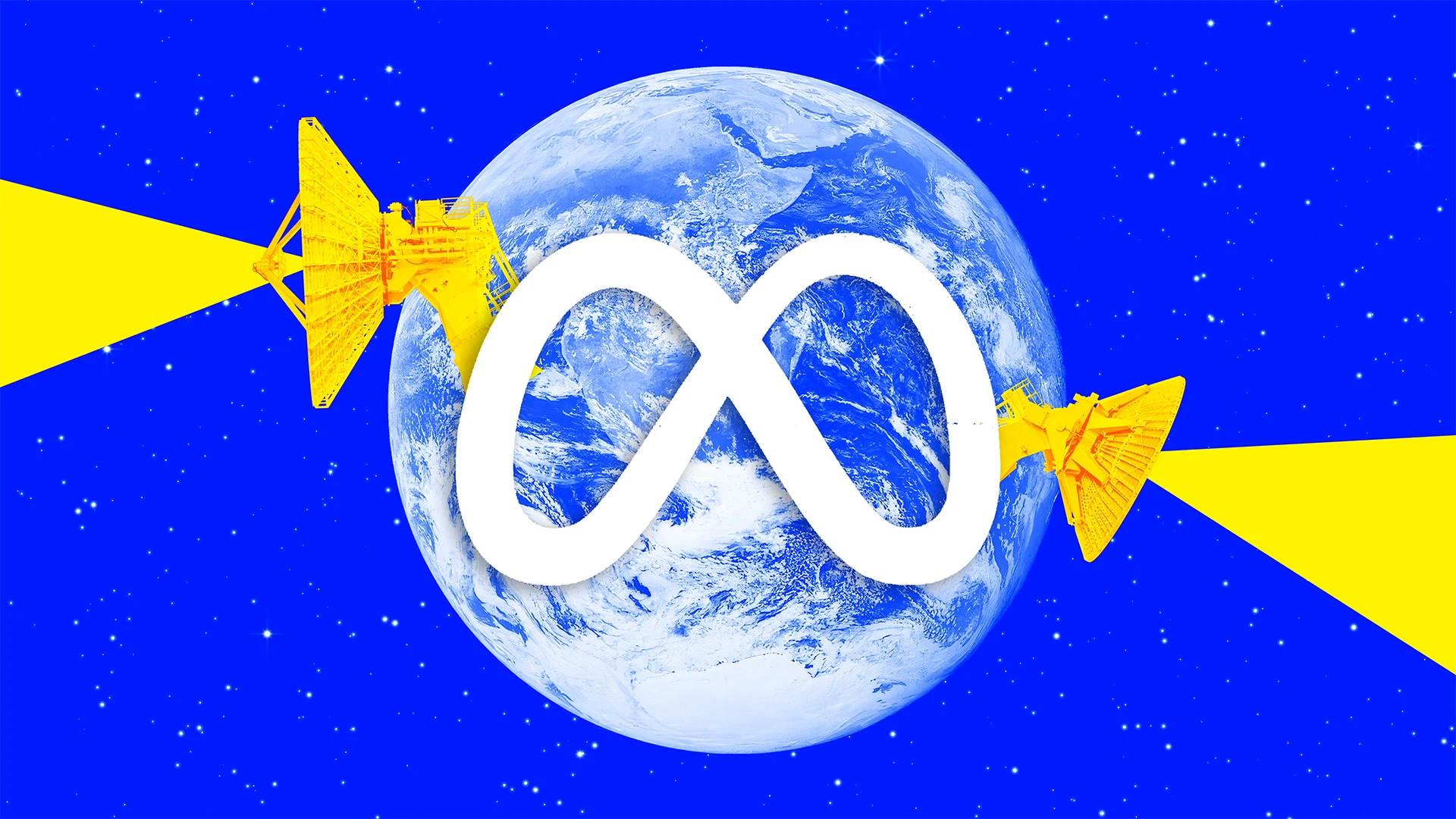
Space solar sidesteps it. Overview's satellites collect continuous sunlight in geosynchronous orbit and beam it as near-infrared light to existing ground solar installations, which convert it to electricity. The approach extends solar farm output through the night without new land, new grid connections, or new infrastructure on the ground. The genius of the model is not the space hardware — it's the terrestrial bypass. By directing energy to solar farms that already have grid connections, Overview avoids the interconnection queue entirely. The satellite becomes an extension of infrastructure that already exists, not a new project navigating a broken approval process. GlobalData
Overview has argued it makes more sense to place the power source for orbital data centres in space rather than the centres themselves. "Put the thing that doesn't need the maintenance and can last for a long time in space," said Overview CEO Marc Berte. "Put the energy part into space as opposed to putting the processing part in space." That argument has found at least one influential convert. Micah Walter-Range, president of consulting firm Caelus Partners, told SpaceNews the approach makes more sense than orbital data centres — a concept that SpaceX and Blue Origin have also been quietly pursuing — because it leverages existing terrestrial infrastructure rather than replicating it in orbit. Genasys Technologies
"Space solar technology represents a transformative step forward by leveraging existing terrestrial infrastructure to deliver new, uninterrupted energy from orbit. We are excited to help bring this new energy technology to market."
— Nat Sahlstrom, Vice President of Energy and Sustainability, Meta
What Overview Energy Actually Is — and What It Isn't Yet
Overview Energy emerged from stealth in December 2025. It is based in Ashburn, Virginia — the heart of the data-centre-dense northern Virginia corridor that houses a significant portion of the world's internet infrastructure. Its advisory board includes Jim Bridenstine and Mike Griffin, both former NASA Administrators, and Joseph Kelliher, former FERC Chairman — a lineup assembled to navigate precisely the regulatory and technical complexity that space-based power transmission requires.
Overview Energy has raised $20 million to develop its system beaming solar power from space to Earth using infrared lasers. Against a 1-gigawatt commercial commitment, that is a seed-stage capital base. Overview has already demonstrated power transmission to the ground from an aircraft, and is planning to launch a satellite to low Earth orbit in January 2028 to perform its first power transmission from space. Berte expects to begin launching the satellites that would fulfil the commitment to Meta in 2030, with a goal of flying 1,000 spacecraft in geosynchronous orbit. Each satellite is expected to provide power for more than a decade. Mordor IntelligenceMordor Intelligence
The metric Overview developed for this contract is itself a signal of how novel the arrangement is. Overview developed a new unit — megawatt photons — defined as the amount of light required to generate a megawatt of electricity. The first commercial capacity reservation agreement for space-based solar energy by any company has required the invention of new commercial language to describe it. Mordor Intelligence
Orbital arrays offer a 30% power boost by eliminating atmospheric attenuation and provide roughly five times the energy yield of terrestrial systems by operating outside the day-night cycle. Those are the engineering arguments. The commercial argument is simpler: a solar farm that produces electricity 24 hours a day is worth dramatically more than one that produces it for eight. WeCovr
The Noon Energy partnership addresses a different but equally fundamental problem. Lithium-ion batteries — the current default for grid-scale storage — provide four to six hours of backup. That covers the evening peak. It does not cover a cloudy week in January, or a grid event that stretches across multiple days. Noon Energy's technology uses modular, reversible solid oxide fuel cells and carbon-based storage to provide over 100 hours of energy storage — far beyond what today's lithium-ion batteries can deliver. One hundred hours. That is four days of continuous power delivery from a storage system, not from generation. For a data centre that cannot afford to go offline under any conditions, that duration changes the fundamental risk calculus of renewable-only power procurement.Coherent Market Insights
Meta's Energy Portfolio Is Becoming a Diversified Asset Class
The Overview and Noon Energy announcements did not arrive in a vacuum. They are the latest additions to what Meta has quietly assembled into the most diverse corporate energy portfolio in the technology sector.
In January 2026, Meta announced agreements with Vistra, TerraPower, Oklo, and Constellation — making it one of the most significant corporate purchasers of nuclear energy in American history — supporting up to 6.6 GW of new and existing clean energy by 2035. Nuclear provides firm baseload power: generation that runs regardless of weather, time of day, or seasonal variation. It is the highest-reliability source available. In March, Meta struck a deal with Entergy Louisiana that promised an additional $2 billion in customer savings, while also joining a voluntary "ratepayer protection pledge" alongside Microsoft, Amazon, Oracle, Google, OpenAI and Elon Musk's xAI, committing to fund their own data centre power needs and grid infrastructure rather than passing costs to consumers. StartupHub.aiStartupHub.ai
Read across those announcements and a clear portfolio logic emerges: nuclear for firm baseload, geothermal for consistent renewable generation, terrestrial solar at scale for daytime capacity, space solar to extend that solar capacity through the night, and Noon Energy's 100-hour storage to bridge any remaining gaps. Each technology addresses a specific failure mode in the others. Together, they describe a company trying to engineer its way to 24/7 clean power without relying on a grid that wasn't built for its requirements.
This pattern shows that AI companies are no longer treating electricity as a back-office utility expense. Electricity has become a strategic input similar to land, chips, fibre, and water. That framing matters enormously. When energy is a utility, you buy it from whoever sells it cheapest. When it is a strategic input, you secure it the way you secure semiconductor supply — through long-term contracts, technology partnerships, and vertical integration. Meta is doing all three simultaneously. Aon
The scale of AI's energy appetite is restructuring the global power sector in real time. Tesla initiated a major expansion of US solar cell manufacturing in February 2026, targeting a 100-gigawatt power push for AI data centres, while considering expanding its Buffalo, New York factory and exploring sites in Arizona and Idaho. SpaceX filed an FCC application in January for permission to deploy up to 1 million satellites as orbital data centres, citing always-on solar energy as a primary motivation. Blue Origin filed plans for up to 51,600 orbital data centre satellites in March. Starcloud, a startup focused on orbital data centres, raised $170 million on March 30 shortly after filing its own FCC application for up to 88,000 satellites. StartupHub.aiGenasys Technologies
The race has moved from cloud to orbit in under eighteen months.
The Honest Counterargument
The caveats are substantial. The 2030 commercial delivery date is eight years from Overview's founding, in a sector — space solar power — that has produced ambitious concepts but no commercial systems anywhere in the world. The technical challenges of building, launching, and maintaining a geosynchronous satellite capable of continuous high-power energy transmission at commercial scale remain unsolved. The agreement grants Meta early access to capacity from Overview's system; it does not guarantee that the system will exist as planned, and financial terms are undisclosed. GlobalData
The competitive landscape for long-duration storage also warrants scepticism. It is still significantly cheaper to deploy more solar panels on Earth than to capture sunlight and send it down from space. Overview's sunlight-beaming satellites won't be alone: Aetherflux is also gearing up to demo its power transmission system with portable ground stations, and UK-based Space Solar hopes to send power to a demonstrator in Iceland by 2030. Multiple well-funded teams are working the same problem. Not all of them will succeed, and none has demonstrated commercial viability. Precedence Research
The regulatory dimension is also genuinely complex. Space-based power transmission requires coordination across spectrum licensing, launch approval, satellite operations, and energy delivery regulation — jurisdictions that span the FCC, FAA, FERC, and potentially multiple state utility commissions. A capacity reservation agreement signed in 2026 for delivery in 2030 is a bet that those regulatory pathways will open in parallel with the engineering.
Key Takeaways
1. This is the first commercial capacity reservation for space-based solar energy in history. Meta has not just signed a deal — it has created a new commercial category. Every subsequent agreement of this type will reference this one as the precedent.
2. The terrestrial bypass is the real innovation. By directing satellite-beamed energy to existing solar farms rather than new ground stations, Overview Energy sidesteps interconnection queues that block conventional renewable projects for years. Meta isn't just buying power — it's buying a regulatory shortcut.
3. Noon Energy's 100-hour storage duration changes the clean-power calculus for data centres. Lithium-ion covers hours. Carbon-based solid oxide storage covers days. For an always-on AI infrastructure operator, that difference is the gap between renewable-supplemented and renewable-primary.
4. Meta's energy portfolio now spans six distinct technologies. Nuclear, geothermal, terrestrial solar, space solar, short-duration storage, and ultra-long-duration storage. No other technology company has assembled a comparable diversification of power sources. This is vertical integration applied to electrons.
5. The 2030 timeline is real risk. Overview's $20 million raise against a 1 GW commitment, a first orbital demonstration not until 2028, and no commercial space solar system existing anywhere in the world means this deal is as much a strategic signal as a procurement instrument. If the technology fails to deliver, Meta has lost little — the financial terms were not disclosed — but the data centre power problem remains.
What This Means for the Global Energy and AI Ecosystem
Meta's announcements will generate imitators. That is the point. For startups in the space economy, the demand signal from a hyperscaler may prove as important as the engineering itself. Overview Energy's $20 million raise — modest by any measure — will look very different to venture investors now that Meta's name appears on a capacity reservation agreement. The next fundraising round will be larger. The next deal will be easier to close. That is how frontier technology markets shift from speculative to credible: not through engineering breakthroughs, but through commercial validation by buyers who can afford to be wrong. Fortune Business Insights
Alphabet's $4.75 billion acquisition of Intersect Power reflects the same logic applied to terrestrial infrastructure — hyperscalers moving from power purchase agreements to direct ownership of generation assets, because utility timelines and capacity allocation mechanisms no longer match the speed of AI's expansion. Meta, constrained by regulatory limits on owning generation assets in the US, is pursuing the same vertical integration logic through long-term capacity reservations instead of acquisitions. WeCovr
The global AI data centre energy crisis is not a problem that will be solved by any single technology. It will be solved — if it is solved — by a portfolio of approaches deployed simultaneously across geographies and use cases. Meta's April 27 announcements are the clearest statement yet from any hyperscaler that this is understood, and that the search for solutions has now extended 22,000 miles above the Earth's surface.
Twelve months ago, space-based solar power was an engineering concept that academics debated in conference papers. Today, it is in the procurement strategy of one of the five most valuable companies on the planet. That is how fast the energy constraint is reshaping the technology industry's priorities — and how far its consequences are reaching.