For years, the playbook was simple: if someone posted something harmful on your platform, you weren't responsible. Section 230 of the US Communications Decency Act gave platforms broad immunity from liability over user-generated content, and Big Tech leaned on it hard. That protection hasn't disappeared, but courts are finding creative ways around it — and it starts with a deceptively simple argument: what if the harm isn't really about the content, but about how the platform was designed in the first place?
That's exactly what a California jury concluded in March 2026. A California jury found that Meta and Google were negligent in designing platforms that contributed to youth addiction and mental health problems, ordering the two companies to pay a combined $6 million in damages — with 70 percent of that figure attributed to Meta. cyberpeace The dollar amount sounds modest on its own, but this was a bellwether trial — the verdict is connected to roughly 2,000 other pending cases brought by parents and school districts. cyberpeace The floodgates are open.
A day before that verdict landed, Meta took an even harder hit in New Mexico. A New Mexico jury ordered Meta to pay $375 million in damages, finding that the company failed to protect young users from child predators on Instagram and Facebook, and that it had misled consumers about the safety of its platforms in violation of state consumer protection laws. cyberpeace That's not a rounding error — that's the kind of judgment that gets board meetings called on a Sunday.
What makes these cases genuinely different from the content-moderation battles of years past is where the blame is being placed. Lawyers aren't arguing that Meta failed to remove a specific post or video. They're arguing that features like infinite scroll, algorithmic amplification, and engagement-based ranking systems were deliberately engineered to keep users — including children — hooked. Internal documents and former employee accounts have suggested that Meta knowingly built addictive mechanics into its platforms, with algorithmic features designed to trap users in engagement loops at the expense of their wellbeing. cyberpeace Meta has pushed back firmly on this framing, maintaining that teen mental health is a complex issue that can't be laid at the feet of a single app, and the company has said it will appeal the verdicts.
Industry veterans have started drawing comparisons to the tobacco litigation of the 1990s — and it's not a stretch. The core argument is structurally similar: did the company know its product was harmful, and did it keep selling anyway? "The question courts are asking is no longer just whether harm occurred," as legal observers have noted, "but whether businesses knowingly built systems that profit from behavioral vulnerability." That framing, if it keeps sticking, changes everything.
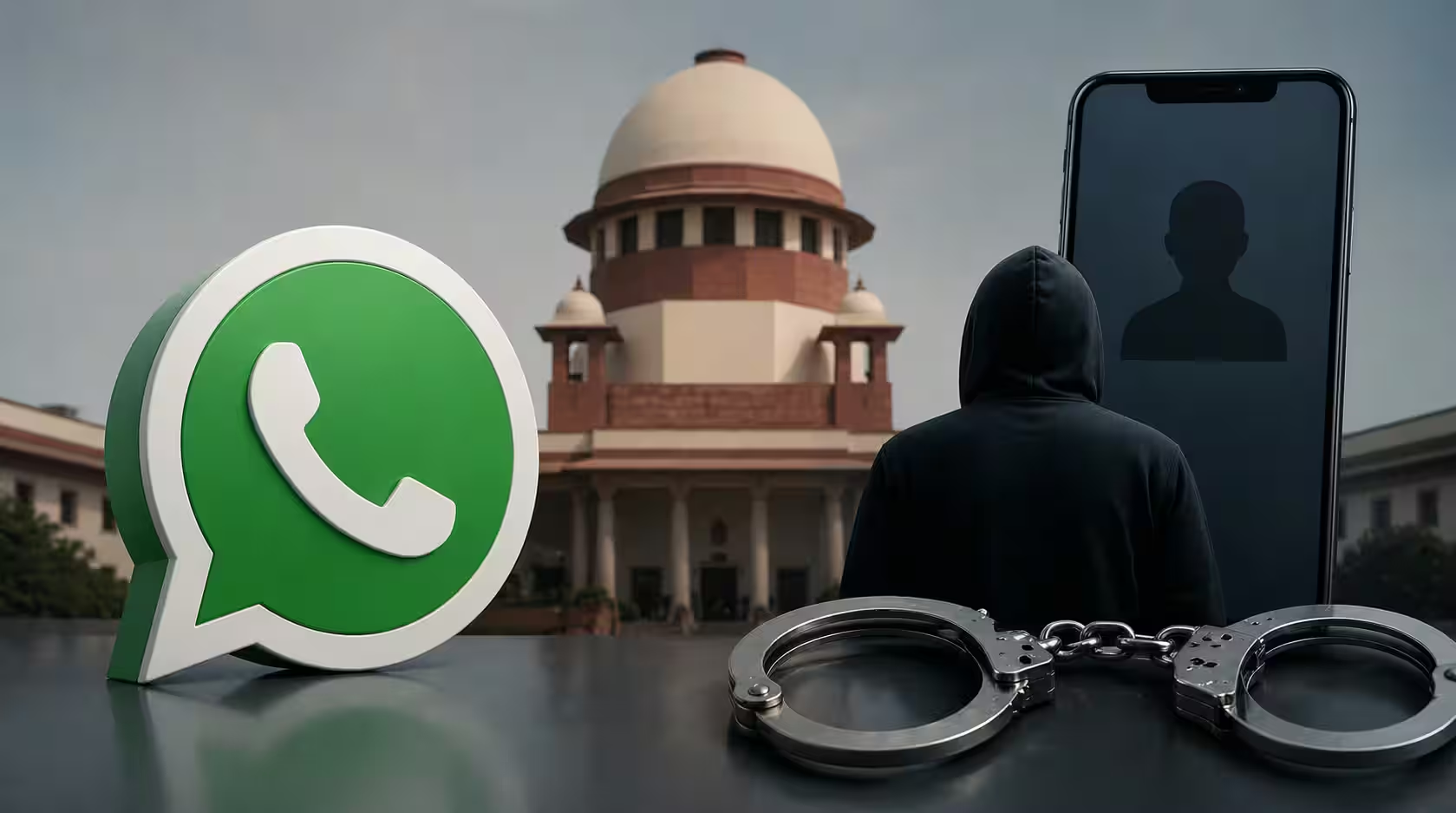
The legal exposure doesn't stop at mental health. In April 2026, a class action lawsuit was filed alleging that WhatsApp messages were being accessed by Meta employees and third-party contractors, despite the platform's long-standing end-to-end encryption guarantees. cyberpeace For a product that has built its brand on privacy and security, this allegation — if proven — cuts at the core of user trust. It also fits a pattern that observers have noted across Meta's history: privacy policies and consent mechanisms that consistently lag behind the actual reality of how data gets used.
There was at least one front where Meta held its ground — for now. In November 2025, US District Court Judge James Boasberg ruled that Meta was not a social networking monopoly, finding that the FTC had not proven that the company's acquisitions of Instagram and WhatsApp violated antitrust law. cyberpeace The FTC wasn't done though — the agency appealed the ruling, continuing to argue that Meta broke antitrust laws through those acquisitions and that American consumers have been harmed as a result. cyberpeace Legal analysts have noted an uncomfortable irony in this case: by the time the trial happened, five years after the lawsuit was originally filed, the social media market had changed so substantially — with TikTok emerging as a dominant player — that it undermined the FTC's original market definition claims. cyberpeace The structural concern about concentrated platform power remains very real, even if this particular legal argument didn't land.
Zoom out and the picture becomes even more significant. What's happening to Meta right now isn't just about one company's legal bills. It represents a fundamental shift in how courts, regulators, and civil society are choosing to think about platform power. The immunity era isn't over, but it has visible cracks. When liability is tied to design decisions rather than user-generated content, the accountability framework for all digital platforms begins to shift. cyberpeace Every major social platform — TikTok, YouTube, Snap, X — is watching these cases with considerable anxiety.
For the startup world specifically, the stakes are worth understanding clearly. The next generation of consumer apps will be built in an environment where "we're just a platform" is no longer a complete legal defense. Features that maximize engagement, retain users compulsively, or collect behavioral data may need to be designed with liability in mind from day one — not as an afterthought when the lawyers call. The venture capital calculus for social and consumer apps is quietly shifting too, as investors begin factoring in the litigation exposure that comes with scale.
Meta is a $1.4 trillion company with the legal firepower to fight these battles for years. But the verdicts are piling up, the appeals will take time, and the narrative is shifting in ways that are hard to reverse. Courts across the country are no longer asking whether a platform hosted harmful content. They're asking whether the platform was built to produce it. That question — simple, pointed, and increasingly hard to dodge — is the one that is going to define the next chapter of tech regulation worldwide.