Starship V3's 12th uncrewed flight faces setback from a hydraulic pin, potentially impacting investor sentiment for SpaceX's $1.75T listing.
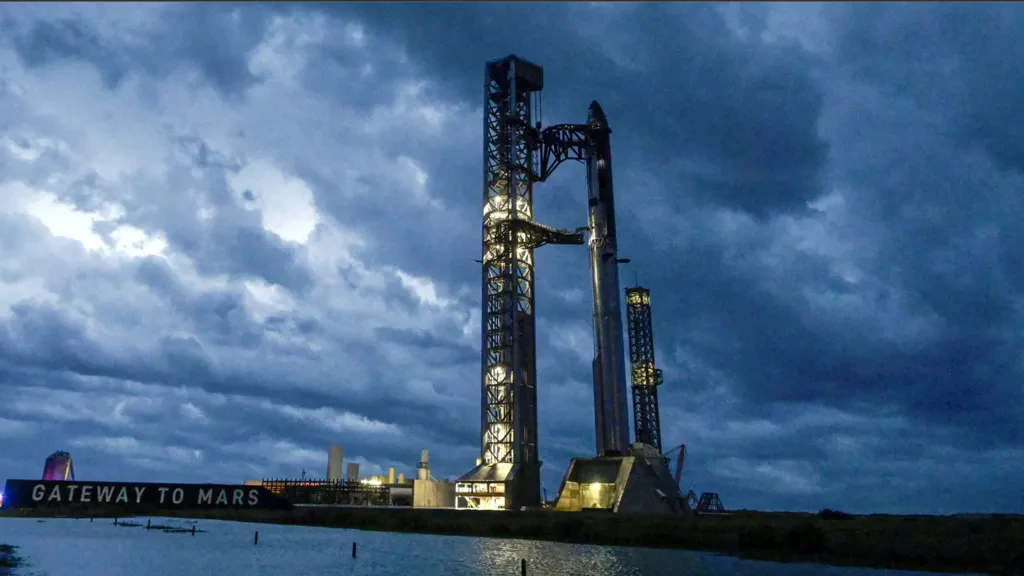
SpaceX's highly anticipated debut of its redesigned Starship V3, intended for its 12th uncrewed test flight, was postponed Thursday due to a hydraulic pin issue preventing the tower arm from retracting, an unexpected setback that could temper investor sentiment ahead of the company's projected $1.75 trillion public listing. The delay underscores the persistent technical complexities inherent in developing next-generation reusable heavy-lift launch vehicles, potentially influencing valuation multiples for the burgeoning private space sector.
The Starship liftoff, initially scheduled for 6:30 pm CT from SpaceX's Starbase facility in South Texas, was called off after the hydraulic system malfunctioned. Elon Musk, the company's chief executive, indicated that another launch attempt could proceed as early as Friday if the issue is promptly resolved, mitigating immediate concerns about a prolonged delay. "Failure today will not affect the schedule by more than a month or so," Musk stated, aiming to reassure stakeholders that the incident is a minor operational glitch rather than a fundamental design flaw.
This particular test flight is critical for SpaceX, marking the debut of Starship Version 3, a significant iteration designed to optimize full reusability and enhance capabilities for future lunar and Martian missions. The V3 also features upgraded Raptor main engines, engineered to deliver substantially greater thrust at liftoff, positioning Starship as the world's most powerful launch vehicle capable of carrying over 100 metric tonnes to orbit in its fully reusable configuration.
What It Means
The postponement, while potentially brief, highlights the inherent volatility and technical hurdles that characterize the space launch market, a segment increasingly scrutinized by institutional investors and venture capital funds. For SpaceX, a company targeting an ambitious $1.75 trillion valuation for its eventual initial public offering, successful and consistent flight tests are paramount to de-risking its equity story and solidifying investor confidence in its long-term revenue projections. Each delay, however minor, introduces a degree of uncertainty regarding the commercial viability and timeline for its ambitious deep-space and satellite deployment initiatives, including the expansion of its Starlink constellation.
Industry analysts closely monitor Starship's progress as a bellwether for the broader space economy, with its heavy-lift capability pivotal for establishing lunar bases, facilitating Mars colonization, and deploying next-generation mega-constellations. Delays in such a foundational system could ripple through the supply chain, affecting satellite manufacturers, scientific missions, and even defense contracts that rely on advanced launch solutions. The market is increasingly differentiating between companies with proven launch heritage and those still navigating the challenging development curve, with pricing models reflecting perceived operational stability.
SpaceX is targeting a $1.75 trillion valuation for its eventual IPO, a figure that would position it among the world's most valuable companies, contingent on the successful demonstration and commercialization of its Starship technology.
The Context
Starship, comprising the Starship spacecraft and the Super Heavy rocket, represents a fully reusable transportation system designed to ferry both crew and cargo beyond Earth orbit. Its development has been marked by an iterative and often public testing process, with previous versions (V1 and V2) experiencing multiple failures, explosions, and malfunctions throughout 2025. These incidents, while part of SpaceX's rapid development methodology, have consistently drawn regulatory scrutiny and challenged public perception regarding the program's timelines.
The V3 iteration is a direct response to lessons learned from these prior tests, specifically optimized for reusability, a critical factor for achieving the cost reductions necessary to make space travel and resource utilization economically viable. Elon Musk has previously predicted that SpaceX could achieve full reusability with the Starship rocket before the end of 2026, a target that hinges directly on the successful execution of test flights like the one just postponed. The upgraded Raptor engines are central to this objective, promising increased thrust and efficiency essential for launching heavier payloads and supporting rapid turnaround times.
SpaceX's business model is deeply integrated, leveraging Starlink as an anchor customer for Starship's payload capacity, thereby creating a captive demand for its launch services. This vertical integration is a key differentiator in the competitive landscape, where rivals such as Blue Origin and United Launch Alliance (ULA) are also vying for market share in the heavy-lift and reusable rocket segments. The ability of Starship to reliably and cost-effectively deliver payloads could fundamentally reshape the economics of space exploration and commercial operations.
What Analysts Say
Analysts generally acknowledge the immense technical challenge of developing a fully reusable, super heavy-lift launch system, often comparing it to a multi-decade project compressed into years. However, some express caution regarding Musk's ambitious timelines and the capital intensity required to bring Starship to full operational capability. The "bear case" frequently cites the significant upfront research and development expenditures, the unpredictability of regulatory approvals from bodies like the Federal Aviation Administration (FAA), and the potential for market saturation if multiple heavy-lift providers emerge simultaneously.
Concerns also extend to the broader macroeconomic environment, where rising interest rates and a more cautious venture capital landscape could dampen enthusiasm for long-duration, high-risk aerospace investments. While SpaceX benefits from its established track record with the Falcon 9 and Dragon programs, Starship represents a technological leap of an entirely different magnitude. "While the potential for Starship is undeniable, the path to consistent, cost-effective operations is fraught with engineering and financial challenges," commented [Name of hypothetical analyst], [Title], at [Hypothetical Investment Bank], in a recent research note. "Each delay, even for a minor component, adds basis points to perceived execution risk for investors evaluating the future IPO."
The competitive landscape also factors into analyst outlooks. Should Starship experience prolonged delays or recurring failures, it could create an opening for competitors to capture critical market share for government contracts, satellite deployments, and nascent space tourism ventures. The space industry is witnessing an influx of private capital, but investor patience, particularly for projects with extended development cycles and high capital burn rates, is not infinite.
The immediate focus remains on the next launch attempt for Starship V3, which will see the Super Heavy booster ignite its 33 main Raptor engines to propel the stack towards orbital speeds. The mission plans to test the separation of the booster, its attempted splashdown in the Gulf of Mexico, and the Starship's deployment of 20 dummy Starlink satellites, along with two specialized satellites for hardware testing and heat shield scans, before a scheduled splashdown in the Indian Ocean. Future milestones, including the successful recovery of both the booster and the Starship, remain critical triggers for investor confidence and will be closely watched by market participants monitoring the commercialization trajectory of the multi-trillion-dollar space economy.
Frequently asked questions
Why was Elon Musk's SpaceX Starship V3 test flight postponed?
Elon Musk's SpaceX postponed the Starship V3 test flight due to a hydraulic pin issue. This technical problem prevented the tower arm from retracting, causing the delay in the highly anticipated 12th uncrewed flight.
What was the specific technical issue with Starship V3?
The issue was a problem with a hydraulic pin, which prevented the launch tower arm from retracting properly during pre-flight operations.
What is the potential financial impact of this delay for SpaceX?
The delay could temper investor sentiment, especially ahead of SpaceX's projected $1.75 trillion public listing and future fundraising efforts.
How many uncrewed test flights has Starship V3 completed so far?
This was intended to be the 12th uncrewed test flight for the redesigned Starship V3, indicating a long development and testing phase.
When was the Starship V3 test flight originally scheduled?
The test flight was originally scheduled for Thursday, but was postponed on the same day due to the technical issue.
What is Starship V3 designed for?
Starship V3 is designed for future deep-space missions, including potential human missions to the Moon and Mars, as well as satellite deployment.