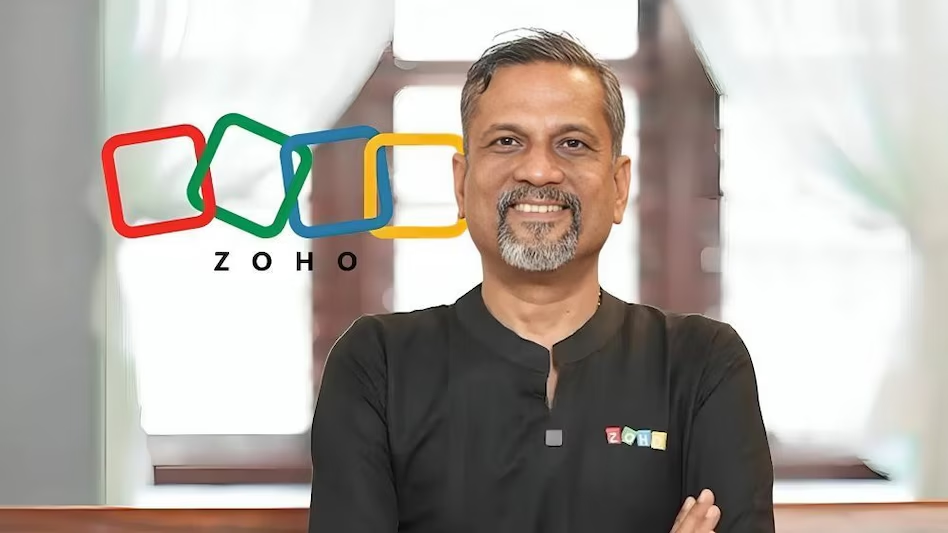
Zoho founder Sridhar Vembu explains the strategic decision behind not expanding work-from-home, contrasting with PM Modi's appeal.
The global discourse surrounding the future of work continues to evolve, with companies worldwide grappling with the optimal balance between remote flexibility and in-person collaboration. Amidst this ongoing re-evaluation, Zoho, a prominent technology firm, has articulated a strategic decision regarding its work-from-home policy. Sridhar Vembu, the founder of Zoho, stated that the company decided not to expand its work-from-home arrangements following an appeal from Prime Minister Modi. Vembu further elaborated on the rationale behind this decision, emphasizing that face-to-face collaboration and in-person problem solving are more effective for research and development teams. This stance offers a pertinent case study in the broader international debate over workplace models, reflecting a growing sentiment among some industry leaders who champion the benefits of physical proximity for specific functions, particularly those requiring intense innovation and collective problem-solving.
The Pre-Pandemic Landscape: A Gradual Evolution of Work
Before the unprecedented global shifts of recent years, the concept of work-from-home, or remote work, existed primarily as a niche benefit or a solution for specific operational requirements. For decades, the conventional wisdom held that a centralized office environment was the bedrock of productivity, fostering team cohesion, facilitating direct supervision, and enabling spontaneous collaboration. While advancements in digital communication tools had begun to lay the groundwork for distributed teams, the widespread adoption of remote work was largely sporadic and limited to certain industries or roles, such as freelance creative endeavors or specialized consulting. Companies might offer occasional work-from-home days or establish small, geographically dispersed teams, but the overarching organizational structure remained firmly anchored to physical office spaces. The default assumption was that presence equated to productivity, and innovation thrived within the bustling confines of corporate campuses. This era was characterized by a gradual, often cautious, exploration of remote possibilities, rather than a fundamental reimagining of the workplace.
The Global Pivot: Pandemic-Driven WFH Expansion
The global health crisis that emerged abruptly transformed this conventional paradigm. In a sudden and unprecedented move, organizations across nearly every sector and geography were compelled to transition their workforces to remote setups overnight. What was once a gradual trend accelerated into a global imperative. Companies rapidly deployed technological solutions, from video conferencing platforms to cloud-based collaboration tools, to ensure business continuity. This period marked a dramatic expansion of work-from-home arrangements, affecting millions of employees globally. The initial phase saw many organizations reporting unexpected resilience, and even some benefits, such as reduced commuting times, increased geographical talent pools, and potential cost savings on office infrastructure. However, the rapid shift also brought challenges, including issues of digital fatigue, maintaining company culture, ensuring equitable access to technology, and managing the blurred lines between professional and personal life. Despite these hurdles, the widespread adoption proved that, for many roles, work could indeed be performed effectively outside the traditional office, permanently altering perceptions of workplace flexibility and efficiency.
The Shifting Tides: Return-to-Office Momentum
As the immediate crisis subsided and new operational norms began to emerge, a discernible shift in global corporate strategy commenced. The initial enthusiasm for an exclusively remote future began to temper, giving way to a more nuanced understanding of hybrid models and, in many instances, a renewed emphasis on the benefits of in-person work. This period has been characterized by a growing return-to-office momentum across various industries and regions. Companies started to weigh the perceived advantages of remote work against the tangible benefits of co-location. Arguments for returning to the office frequently centered on the importance of fostering innovation, strengthening company culture, facilitating mentorship and professional development, and enhancing team cohesion through direct, informal interactions. Many leaders expressed concerns about the long-term impact of sustained remote work on creativity, spontaneous ideation, and the organic cross-pollination of ideas that often occurs in shared physical spaces. This has led to a diverse range of strategies, from mandated full-time office returns to flexible hybrid arrangements, all reflecting a global recalculation of the ideal balance between flexibility and collaboration.
Zoho's Deliberation: A Strategic Non-Expansion
Against this backdrop of global workplace re-evaluation, Zoho’s decision stands as a clear articulation of a particular strategic direction. Sridhar Vembu, the founder of Zoho, communicated that the company opted not to expand its work-from-home policy. This decision was reportedly influenced by an appeal from Prime Minister Modi, suggesting a confluence of corporate strategy and national leadership perspectives. While many organizations worldwide were either scaling up their remote capabilities or navigating complex hybrid transitions, Zoho chose a path of maintaining its existing, presumably more office-centric, operational framework without further expanding remote options. This move indicates a deliberate choice to prioritize specific operational models, particularly given the context of a leadership appeal, which can often underscore broader national economic or social objectives. It signifies a concrete stance in the ongoing debate, signaling a belief in the inherent value of physical presence for the company’s core functions, rather than a continued embrace of broader remote expansion.
Key Insight: Zoho founder Sridhar Vembu stated the company decided not to expand work-from-home after PM Modi’s appeal, underscoring a strategic choice influenced by national leadership and a focus on in-person collaboration.
The R&D Imperative: The Case for In-Person Collaboration
The core of Zoho's decision, as articulated by Sridhar Vembu, rests on the belief that face-to-face collaboration and in-person problem solving yield superior outcomes for research and development teams. This perspective highlights a crucial aspect often debated within innovation-driven sectors globally. Research and development, by its very nature, thrives on a dynamic interplay of ideas, rapid iteration, and often serendipitous discovery. In a co-located environment, the informal whiteboard session, the impromptu discussion sparked by an overheard conversation, or the immediate visual cues exchanged during a complex technical challenge are commonplace. These elements, while partially replicable through digital platforms, are often considered more fluid, efficient, and impactful when individuals share a physical workspace. The nuanced non-verbal communication, the rapid exchange of complex information, and the collective energy generated in a shared creative space are factors that many leaders in the R&D domain continue to champion. For teams tasked with pushing the boundaries of technology and developing novel solutions, the immediate feedback loop and the organic flow of discussion in person can accelerate discovery and refinement processes. This particular emphasis from Zoho suggests a strong conviction that physical proximity remains a critical catalyst for pioneering innovation and effective troubleshooting, especially within the specialized demands of R&D.
The Broader Implications: A Global Perspective on Workplace Models
Zoho's specific decision, while rooted in its own operational philosophy and influenced by local appeals, resonates with a broader global re-evaluation of workplace models. Across continents, companies are continuously experimenting with and refining their post-pandemic strategies. Some organizations have fully embraced remote-first approaches, structuring their operations to maximize geographical flexibility and tap into a wider talent pool. Others have settled on various hybrid models, aiming to blend the benefits of remote work with the advantages of office presence, often requiring employees to be in the office for a set number of days each week. Then there are companies, like Zoho appears to be, that are leaning towards a more office-centric model, particularly for critical functions. The rationale behind these diverse approaches is multifaceted, encompassing considerations of productivity, innovation, corporate culture, employee well-being, talent acquisition, and operational costs. Zoho’s stance provides a tangible example of a company prioritizing the specific dynamics of in-person interaction for its R&D efforts, contributing to the rich tapestry of evolving global workplace paradigms. This ongoing experimentation underscores that there is no single universal solution, and that the optimal model often depends on a company's specific industry, culture, and strategic objectives.
Key Takeaways
Zoho decided not to expand its work-from-home policy, a decision informed by PM Modi's appeal.
Sridhar Vembu emphasized that face-to-face collaboration and in-person problem solving are more effective for R&D teams.
This decision reflects a growing global debate on the optimal balance between remote and in-person work, particularly for innovation-focused functions.
The company's stance highlights the strategic value placed on physical proximity for fostering creativity and efficiency in specific operational areas.
Leadership and Local Context: The Role of PM Modi's Appeal
The mention of Prime Minister Modi's appeal as a factor in Zoho's decision adds a significant layer of context, particularly from a global perspective. In many countries, national leaders and governmental bodies actively engage with the corporate sector to promote specific economic or social objectives. Such appeals can range from calls for increased investment in certain industries to encouragement for particular employment practices. In this instance, a national leader's appeal regarding work-from-home arrangements suggests a broader governmental interest in shaping the post-pandemic economic landscape. This could stem from concerns about urban economic activity, the vitality of central business districts, or broader national productivity narratives. For a company like Zoho, operating within this national context, such an appeal can serve as a powerful signal. It demonstrates how corporate decisions, even those related to internal operational models, can be influenced by, and align with, governmental vision and encouragement. This interplay between corporate strategy and national leadership highlights the unique dynamics that can shape business practices in different regions around the world, making Zoho's specific decision a blend of internal strategic assessment and external contextual influence.
The Future of Work: A Continuously Evolving Paradigm
The global journey from a predominantly office-centric model to a widespread embrace of remote work, and now to a re-evaluation emphasizing specific forms of in-person collaboration, illustrates the continuous evolution of the workplace. Zoho’s decision not to expand work-from-home, directly linked to a national appeal and justified by the distinct needs of its R&D teams, serves as a compelling case study in this dynamic landscape. It underscores that while flexibility remains a valued attribute, the perceived advantages of physical proximity, especially for functions demanding intense innovation and rapid problem-solving, are gaining renewed prominence. As companies worldwide continue to navigate the complexities of hybrid models, remote-first structures, and office-preferred environments, the experiences and articulated rationales of organizations like Zoho will contribute significantly to the evolving understanding of how work is best performed. The debate is far from settled, and the strategic choices made by global technology leaders will continue to shape the paradigm of work for years to come.
Frequently asked questions
Why did Zoho decide not to expand its WFH policy?
Zoho founder Sridhar Vembu stated the company made a strategic decision not to expand its work-from-home policy, despite PM Modi's appeal for WFH. The article will detail the reasons behind this choice.
Who is Sridhar Vembu?
Sridhar Vembu is the founder of Zoho, a prominent technology firm.
What was PM Modi's appeal regarding WFH?
PM Modi had made an appeal concerning work-from-home, though the specifics within this preview aren't detailed, Zoho's decision is a response to it.
What is Zoho's current stance on work from home?
Zoho has decided against expanding its work-from-home policy, indicating a preference for its current, or a more in-person, operational model.
How does Zoho's decision affect the future of work discourse?
Zoho's decision adds a significant perspective to the ongoing global discussion about balancing remote flexibility with in-person collaboration in the tech industry.
Where can I find more details on Zoho's WFH strategy?
The full article on moneycontrol.com provides further insights into Zoho's strategic decision and Sridhar Vembu's rationale.