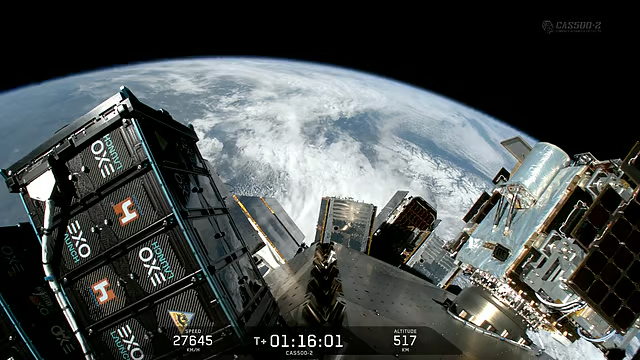
On May 3, 2026, a SpaceX Falcon 9 rocket lifted off from Vandenberg Space Force Base in California carrying something no rocket had ever carried before: a satellite that sees clearly whether the sky above your target is perfectly blue or a wall of monsoon cloud. GalaxEye's Mission Drishti — the world's first OptoSAR satellite — separated from the Falcon 9 just over an hour after launch and entered orbit. The startup's Bengaluru control room erupted. Prime Minister Narendra Modi called it "a major achievement." ISRO posted congratulations. And somewhere in the boardrooms of Planet Labs, ICEYE, and Capella Space, analysts quietly began updating their competitive landscape decks.
GalaxEye announces Successful Launch of Mission Drishti, and what makes this more than a feel-good national milestone is the technology itself — a genuine global first that no well-funded Western competitor beat them to.
What OptoSAR Actually Means
Earth observation has lived with a fundamental tension for decades. Optical satellites produce beautiful, intuitive imagery — the kind a human analyst can read in seconds. But clouds block them. Darkness blocks them. For a country like India, where the monsoon renders optical imaging nearly useless for months at a time, this isn't a minor inconvenience; it's a strategic blind spot.
Synthetic Aperture Radar solved the weather problem. SAR satellites beam microwave pulses toward Earth and reconstruct images from the reflected signals — day or night, through cloud or rain. The catch: SAR imagery looks nothing like a photograph. It's grainy, counterintuitive, and notoriously difficult to interpret without specialist training. Building AI models on SAR data alone is expensive and slow because the labeling work requires expertise few organisations have at scale.
The obvious solution — put both sensors on the same satellite — sounds straightforward. It isn't. The engineering challenge is synchronisation. Two sensors capturing the same patch of ground from slightly different vantage points, or at slightly different moments, produce data that's inherently misaligned. Fusing it after the fact introduces errors. Every Earth observation company knew this. None had solved it commercially. Until now.
Mission Drishti's proprietary "SyncFused" sensor suite co-locates a high-resolution SAR antenna and a 7-band multispectral imager on a single platform, capturing both data streams simultaneously from the same perspective. The result is inherently aligned, analysis-ready imagery that arrives pre-fused. No post-processing artefacts. No temporal offset between the optical and radar captures. And because the optical layer provides the visual intuition, AI model training on the combined dataset becomes dramatically faster and cheaper — a compounding advantage that will matter enormously as defence and intelligence customers scale their automated target recognition pipelines.
Five Years, Nine Funding Rounds, 500 Test Flights
GalaxEye's origin is the kind of founding story that sounds implausible until you look at the receipts. CEO Suyash Singh, CTO Denil Chawda, and co-founders Kishan Thakkar, Pranit Mehta, and Rakshit Bhatt were teammates on IIT Madras's Avishkar Hyperloop team — one of 21 finalists out of 1,600+ global entrants in SpaceX's Hyperloop competition. They pivoted from pods to pixels, incorporated in 2021, and set out to solve Earth observation's cloud-cover problem from a small office in Bengaluru.
What followed was methodical and gruelling. Before touching satellite hardware, the team logged over 500 aerial test flights using drones, Cessna aircraft, and high-altitude platforms to validate their sensor fusion technology. They launched a payload on ISRO's PSLV under the POEM mission to gain early orbital experience. Their structural qualification model was tested at ISRO's U R Rao Satellite Centre, subjected to the thermal extremes and vibration loads of actual launch conditions.
The funding journey tracked the technical progress. A pre-seed from Speciale Invest, then a $6.5 million Series A led by Mela Ventures and Speciale Invest, with participation from ideaForge, Rainmatter, Navam Capital, and Anicut Capital. Notable angels included Nithin Kamath of Zerodha and EaseMyTrip co-founder Prashant Pitti. Then came Infosys, which committed ₹17 crore (~$2 million) through its Innovation Fund — a corporate validation that carried strategic weight beyond the cheque size. Total funding now stands at approximately $20 million across nine rounds, with a fresh raise planned following this orbital milestone.
For a 190-kilogram satellite — the heaviest spacecraft ever built by an Indian private company — that capital efficiency is striking. Planet Labs burned through hundreds of millions building its optical constellation. ICEYE raised over $150 million before achieving comparable scale in SAR. GalaxEye reached its world-first moment on roughly $20 million.
"Mission Drishti marks our first mission and the culmination of over five years of sustained R&D. With the satellite now successfully in orbit, we are already witnessing strong global interest in the differentiated datasets enabled by our OptoSAR payload — from international government and commercial stakeholders alike."
— Suyash Singh, Co-founder and CEO, GalaxEye
The Commercial Architecture Behind the Milestone
The satellite business model here is more sophisticated than "we launch, you subscribe." GalaxEye has structured Mission Drishti as the anchor of a Data-as-a-Service platform, with a distribution partnership with NewSpace India Limited (NSIL) — the commercial arm of ISRO — to sell imagery globally. That NSIL relationship is significant: it gives GalaxEye access to ISRO's international customer network and lends government-grade credibility to what is still a Series A-stage startup.
The eight-week commissioning and calibration phase now underway will be followed by initial commercial imagery delivery to early customers. Defence and security agencies are expected to generate the majority of early revenue — GalaxEye's advisory board spans DRDO, ISRO, Waymo, and Swiss Re, signalling its dual commercial-and-defence positioning from the start. The satellite's onboard AI enables real-time data processing, reducing the latency between capture and actionable intelligence — a critical metric for military and disaster-response customers who cannot wait hours for a ground station pass.
The broader constellation plan calls for 10 OptoSAR satellites by 2030, with the next several units launching within 30 months. At full deployment, the constellation will achieve a two-day global revisit time, meaning any point on Earth can be imaged every 48 hours in all-weather, fused optical-radar format. A second-generation satellite platform — approximately 300 kilograms, capable of 0.5-metre resolution imagery — is already in preliminary design.
The addressable market is enormous and growing fast. Analysts project the global Earth observation market will reach $7.5 billion within the next decade, with the satellite imagery services segment growing at a CAGR of over 12%. The defence intelligence, surveillance, and reconnaissance (ISR) segment alone — where fused, all-weather imagery commands premium pricing — accounts for a substantial portion of that. GalaxEye is entering this market with a differentiated product at a moment when geopolitical tensions are driving governments worldwide to invest heavily in persistent monitoring capabilities.
India's Private Space Inflection Point
To understand why Mission Drishti matters beyond GalaxEye itself, you need to understand how recently Indian private space was essentially nonexistent.
The Indian National Space Promotion and Authorisation Centre (IN-SPACe) was established only in 2020, the year GalaxEye was founded. Before that regulatory framework opened, private companies had no legal pathway to build and launch commercial satellites in India. Five years later, approximately 200 private space startups have emerged, working across launch vehicles, satellite platforms, communications infrastructure, and data services.
Mission Drishti is the most technically ambitious outcome yet from that ecosystem. It arrives alongside Agnikul Cosmos's semi-cryogenic engine development and Skyroot Aerospace's Vikram launch vehicle programme — but GalaxEye's achievement is distinctive because it didn't just build an Indian first. It built a world first.
Pawan Goenka, chairman of IN-SPACe, put it plainly: "As more Indian space companies demonstrate their capabilities through real missions and engagement with global customers, confidence in India's space ecosystem will continue to strengthen, creating greater demand both in India and overseas."
That confidence loop matters. GalaxEye's partnership with NSIL for global distribution, combined with its defence-oriented customer pipeline, positions it to generate revenue in USD and euros — not just rupees. That international revenue potential will be central to its next funding round valuation.
Key Takeaways
The technology is real, and it's a genuine global first. No other satellite from any country had fused optical and SAR data on a single platform at commercial scale before May 3, 2026.
The business model is designed for defence-led, commercially-extended revenue. NSIL distribution + onboard AI + dual-use positioning gives GalaxEye access to high-value government contracts while building toward commercial data subscriptions.
Capital efficiency sets a new benchmark. Reaching an orbital world-first on ~$20 million challenges assumptions about what it costs to compete in the Earth observation market.
The constellation is the real bet. A single satellite is a proof point. Ten satellites with 48-hour global revisit create a persistent intelligence layer — the product governments and large enterprises actually want to buy.
India's private space sector just got its clearest proof of concept. Mission Drishti validates the IN-SPACe regulatory framework and will accelerate both domestic and international capital flowing into Indian spacetech.
The Honest Counterargument
No launch coverage should ignore the distance between orbit and revenue. GalaxEye now faces eight weeks of commissioning, then the hard work of converting strong global interest — which Singh describes as robust — into signed contracts, delivered data, and repeat customers. The Earth observation market is crowded with well-capitalised competitors. ICEYE has 40+ SAR satellites already operating. Planet Labs has over 200 optical satellites. Maxar's WorldView constellation sets the gold standard for high-resolution optical imagery.
GalaxEye's differentiation argument — fused data, not just more data — is compelling on paper. Whether defence procurement cycles, commercial data standards, and the startup's 10-satellite timeline align fast enough to generate the revenue needed for its next funding round is the question that matters more than any congratulatory post from the Prime Minister's office.
The technology has cleared the hardest test. Now comes the business.
GalaxEye announces Successful Launch of Mission Drishti at a moment when the Earth observation industry is consolidating around a simple realisation: coverage beats resolution as the primary customer requirement. A satellite that can see anywhere, anytime, through any weather — and deliver imagery that non-specialist analysts can immediately interpret — is not a niche product. It's the foundation of a category. Whether GalaxEye builds that category or gets acquired by someone larger who wants the technology is almost a secondary question. The more important fact is that five engineers from Chennai, working with $20 million and five years, just moved the entire field forward.
![Apple reports Q2 2026 earnings: $111.2 billion in revenue, up 17% [Charts]](https://startupnews-media-2026.s3.us-east-1.amazonaws.com/startupnews-in/uploads/2026/05/manual-1777704093949-pjwq8qf0b.jpeg?X-Amz-Algorithm=AWS4-HMAC-SHA256&X-Amz-Content-Sha256=UNSIGNED-PAYLOAD&X-Amz-Credential=AKIAZQ3DRHCSCL44VIMT%2F20260504%2Fus-east-1%2Fs3%2Faws4_request&X-Amz-Date=20260504T122920Z&X-Amz-Expires=604800&X-Amz-Signature=ebb12e7c0e62faa4af1479606436d60cf39c97e3527069564d9c2d41c42e54b0&X-Amz-SignedHeaders=host&x-amz-checksum-mode=ENABLED&x-id=GetObject)