Excellent. I now have everything I need for a well-sourced, contextually rich article. Filing now.
There's a timing detail buried in Lovable's mobile launch announcement that the company's PR team probably hoped nobody would dwell on. The new iOS and Android app arrived shortly after Apple addressed what vibe coding apps can and can't do on its App Store. That's a diplomatic way of describing what was, for much of the past two months, a running regulatory confrontation — one that removed apps from the store, froze update pipelines, and forced competitors to gut or reroute core features. Lovable navigated the obstacle, but the path it took tells you more about the company's strategic position than any press release will.
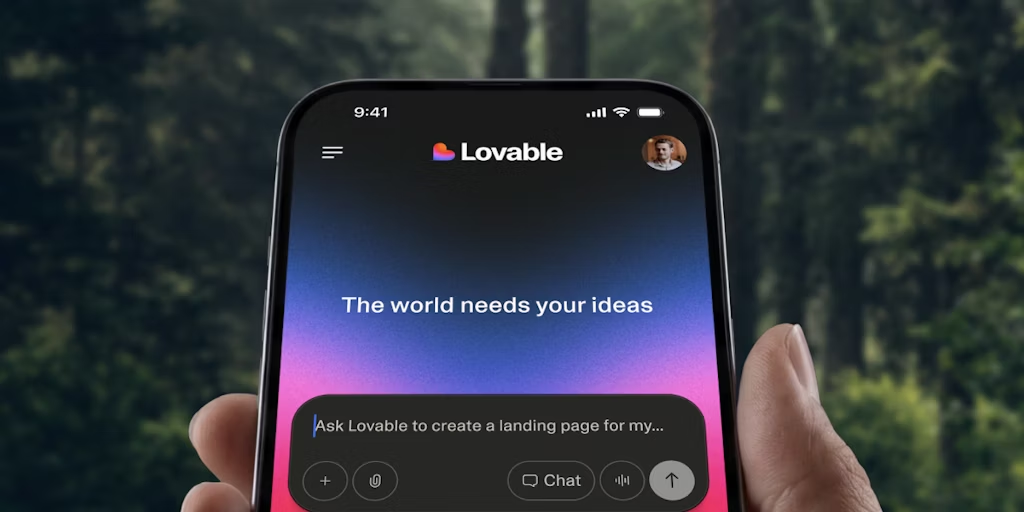
The mobile app itself is straightforward enough. It's pitched to would-be builders as a way to vibe code on the go via voice or text prompts, letting users kick off Lovable to work on an app idea from anywhere — with the agent running autonomously after receiving input. Users can switch between their phone and desktop, picking up projects mid-build, and receive notifications when a build is ready to review. Prior to this week, Lovable was browser and desktop only.
What it can't do, and this matters, is run the apps it builds inside the app itself. To comply with Apple's rules, vibe coding apps are no longer able to run their generated apps inside the host app — those previews were moved to web browsers. Lovable's new app touts the ability to turn ideas into "working websites or web apps" — web being the operative word, and not an accident.
The enforcement battle that cleared the runway
To understand why Lovable's mobile entry is significant, you need to understand what happened in March 2026. In mid-March, Apple had quietly blocked updates for vibe coding apps including Replit and Vibecode, without public explanation — developers described receiving rejections citing Guideline 2.5.2 but no advance warning that enforcement was intensifying.
Apple's stated position was that the problem wasn't vibe coding per se, but apps that violated section 2.5.2 of the App Review Guidelines — the rule prohibiting apps from downloading, installing, or executing code that changes the app's functionality after review. Vibe coding tools, by definition, generate and run new code in response to user prompts. The conflict was structural.
The most prominent casualty was Anything, an app whose co-founder Dhruv Amin said Apple had been preventing updates since December 2025 before pulling the app entirely on 30 March. Amin attempted a compromise — modifying the app so vibe-coded outputs would preview in a web browser rather than execute inside the app — but Apple blocked that update and removed the app regardless. (It was later permitted back after further adjustments.)
The market context is striking: according to reporting by The Information, new apps submitted to the App Store rose 84% in a single quarter as vibe coding went mainstream, with Apple's full-year 2025 total reaching 557,000 new app submissions — the largest annual wave since 2016. Apple was, in a real sense, being flooded by the consequences of its own platform's attractiveness to a category it hadn't sanctioned.
Lovable, crucially, builds web apps rather than native iOS binaries. Prompt-to-app builders like Lovable, Bolt, and v0 are unaffected by the specific enforcement because they produce web applications — React, Next.js — not native iOS binaries. That architectural fact made Lovable's App Store entry cleaner than competitors' — it was never trying to run native code inside a native app. Its mobile launch sidesteps the crackdown not because Apple granted it an exception, but because Lovable's product was already structured to comply by design.
The $6.6 billion company built in two years
For VCs still sizing up the opportunity here, Lovable's numbers remain difficult to ignore. Stockholm-based Lovable raised $330 million in a Series B led by CapitalG and Menlo Ventures at a $6.6 billion valuation — more than triple the $1.8 billion valuation it achieved in its Series A just five months earlier in July 2025. Khosla Ventures, Salesforce Ventures, and Databricks Ventures also participated.
CEO Anton Osika has claimed Lovable reached $100 million ARR faster than OpenAI, Cursor, Wiz, and every other software company in history — then doubled that figure to $200 million in just four months. Enterprise customers include Klarna, Uber, and Deutsche Telekom. Uber used Lovable to cut design concept testing from six weeks to five days; a large healthcare organisation developed a patient journey visualisation app suggested by a nurse that is now incorporated into every invoice.
"Lovable has done something rare: built a product that enterprises and founders both love. The demand we're seeing from Fortune 500 companies signals a fundamental shift in how software gets built." — Laela Sturdy, managing partner, CapitalG
The mobile app is the next logical move in that growth arc. Lovable's core thesis is that non-technical builders — product managers, marketers, founders without engineering co-founders — should be able to ship working software from a text prompt. Moving that capability to mobile extends the surface area of where an idea can be captured and acted upon. The commute, the meeting, the 2am thought: all of it becomes potential build time.
The contrarian case
Here's what investors should sit with, though. Lovable's remarkable revenue growth has not been entirely smooth, and the mobile launch can't be evaluated outside that context. Barclays research showed Lovable's traffic was down 40% from peak as of September 2025, raising questions about whether vibe coding had peaked as a consumer trend. Osika pushed back, arguing retention remained strong, and the November ARR figure appeared to validate that. But the traffic data and the retention claim aren't mutually exclusive — a platform can retain paying users while bleeding casual experimenters who tried it once and left.
The vibe coding category has also become extraordinarily crowded in a compressed timeframe. Cursor, made by Anysphere, surpassed $2 billion in annualised revenue and was valued at $29.3 billion after a $2.3 billion funding round co-led by Accel and Coatue. Bolt.new, Replit, v0, and Base44 all occupy adjacent segments. The $6.6 billion valuation implies a roughly 33x revenue multiple — aggressive for a company of any vintage, let alone one founded in 2024.
The mobile app doesn't change the unit economics. It expands the top of the funnel. Whether that translates to paid conversion — or simply adds more free-tier users who try the product, build something imperfect, and churn — is the real question. The App Store and Play Store are discovery engines, but they're also graveyards for apps that can't survive without marketing spend behind them.
The global picture: where vibe coding lands differently
For investors tracking regional exposure, the vibe coding category is still disproportionately a Northern European and American story in terms of where the leading companies are headquartered, but the user base is genuinely global. Lovable's Stockholm base gives it a European credibility narrative — it's cited frequently as Europe's most valuable vibe coding startup — and its Series B investor roster includes Deutsche Telekom's T.Capital, suggesting a deliberate push into enterprise markets in Germany and the broader DACH region.
Gartner projects that by 2026, low-code development tools will account for 75% of new application development, up from 40% in 2021, while Forrester reports that 87% of enterprise developers already use these platforms. Those figures hold globally, but the implications differ by market. In markets with large developer talent shortages — India, Southeast Asia, parts of Latin America — the ability to build functional web apps without engineering hires has more acute commercial value. Lovable's mobile launch removes one more friction point for users in those markets, where smartphone-first internet access is still the norm and desktop-first tools carry a structural disadvantage.
EU regulatory context adds another layer. Apple's App Store enforcement of vibe coding apps is already being examined alongside broader Digital Markets Act scrutiny of App Store gatekeeping. A CNBC column published in late March argued Apple's crackdown puts it on the wrong side of history, and EU regulators have separately been scrutinising App Store gatekeeping under the Digital Markets Act. The fact that Lovable's product architecture sidesteps this fight entirely — by staying web-native — is a competitive advantage that has regulatory durability. If Apple's enforcement tightens further, Lovable's exposure is limited in a way that native-code competitors' isn't.
Three things worth watching
Whether Lovable's mobile app drives meaningful paid conversion or primarily inflates free-tier signups. The company's $400 million+ ARR projection for 2026 depends on growth rate, not just traffic — and the two aren't the same thing.
How Apple's App Store enforcement evolves over the next two quarters, particularly under EU Digital Markets Act pressure. A forced relaxation of Guideline 2.5.2 would dramatically change the competitive dynamics for native-code vibe coding apps like Replit, and would narrow Lovable's current architectural moat.
Whether an acquisition or IPO signal emerges. Lovable has raised $648 million in total and completed at least one acquisition — Molnett — in November 2025. At a $6.6 billion valuation with 146 employees, the company is carrying enormous capital efficiency expectations. The path to a public listing — or a strategic exit to one of its enterprise customers — is a question every investor in the category should be modelling right now.
The mobile app is a feature. The story underneath it is about whether a two-year-old Swedish startup can keep compounding fast enough to justify a valuation that would have been unthinkable for a company this young just eighteen months ago. That answer won't come from an App Store launch. But the launch, and how cleanly Lovable navigated the regulatory turbulence around it, says something real about how the company is being run.