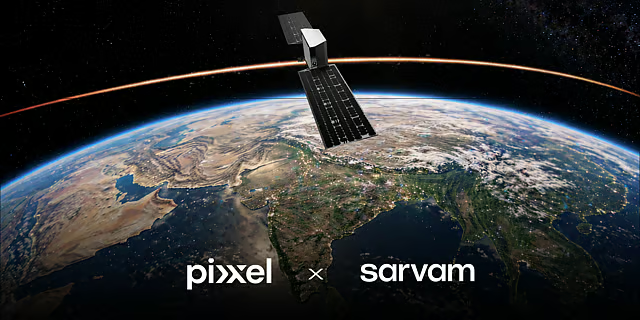
Indian startups Pixxel and Sarvam are collaborating to launch data centers in space, following Agnikul's Neev Cloud. A new frontier for digital infrastructure.
The concept of a data center, traditionally a sprawling terrestrial facility consuming vast tracts of land and energy, is undergoing a profound reimagination. From the arid plains of Arizona to the frigid landscapes of Iceland, these digital fortresses have anchored our connected world. Now, a nascent but ambitious movement is looking skyward, proposing to shift significant computational loads beyond Earth's atmosphere. This orbital leap, once the stuff of science fiction, is rapidly gaining traction, propelled by the urgent demands of real-time data processing and the strategic imperative of space-based autonomy.
At the forefront of this emerging paradigm in India are two formidable players: Pixxel, a pioneer in hyperspectral earth imaging, and Sarvam AI, a generative AI startup focused on Indian languages. Their announced intent to develop an orbital data center represents a significant escalation in the country's private space and AI ambitions. This move follows a foundational collaboration between Agnikul Cosmos, a private launch vehicle developer, and Neev Cloud, a hyperscale cloud provider, to establish space-based data infrastructure. The pattern is clear: India's burgeoning space-tech ecosystem is actively exploring how to process the deluge of data generated in orbit, rather than simply downlink it.
The Genesis of Orbital Compute: Why Space?
Terrestrial data centers face inherent limitations. Latency, the time delay in data transmission, is dictated by the speed of light through fiber optics or air, and the physical distance to the processing unit. For critical applications like autonomous navigation, disaster response, or high-frequency trading, even milliseconds matter. Furthermore, Earth-bound facilities are vulnerable to natural disasters, geopolitical disruptions, and physical security breaches. They also consume immense power, contributing significantly to global carbon footprints.
Space offers a compelling alternative. For satellite constellations like Pixxel's, which generate petabytes of hyperspectral imagery, processing data closer to its source is not merely an efficiency gain; it is a necessity. Imagine a satellite capturing an image of an agricultural field. Instead of sending raw, multi-gigabyte data packets down to Earth for analysis, an orbital data center could run AI models directly on the satellite's platform, identifying crop stress or soil anomalies, and only transmitting a concise alert or processed map. This dramatically reduces downlink bandwidth requirements and accelerates actionable intelligence.
The physics of space also present unique advantages. In the vacuum of orbit, the speed of light is maximized, enabling faster inter-satellite communication. The extremely cold environment offers natural cooling for hardware, potentially reducing the energy overhead associated with thermal management on Earth. Moreover, the physical isolation of space provides a distinct layer of security against terrestrial intrusions, though it introduces new challenges related to cyber and physical attacks in orbit.
Pixxel's Hyperspectral Imperative
Pixxel's core business revolves around deploying a constellation of hyperspectral imaging satellites. Unlike traditional cameras that capture light in three primary color bands (red, green, blue), hyperspectral sensors collect data across hundreds of contiguous spectral bands. This allows for an unparalleled level of detail, revealing "fingerprints" of materials and phenomena that are invisible to the human eye. For instance, it can differentiate between types of crops, detect specific minerals, or monitor gas leaks with remarkable precision.
The granularity of hyperspectral data, while incredibly valuable, comes at a cost: sheer volume. A single hyperspectral image can be orders of magnitude larger than a conventional satellite image. Downlinking this raw data for an entire constellation, 24/7, would overwhelm even the most robust ground station networks. This is where an orbital data center becomes indispensable. By performing initial processing, compression, and AI-driven analysis directly in orbit, Pixxel can drastically reduce the data sent to Earth, making its services more efficient, responsive, and ultimately, scalable.
Sarvam AI's Edge in the Exosphere
Sarvam AI's involvement signals a fascinating convergence of space technology and artificial intelligence. Sarvam is building large language models (LLMs) specifically tailored for Indian languages and cultural contexts. While the full-scale training of foundation models would remain a terrestrial endeavor due to its immense computational demands, orbital data centers offer Sarvam compelling opportunities for edge inference and specialized model deployment.
Consider AI models designed to detect specific patterns in hyperspectral data, such as identifying illegal mining activities, assessing climate change impacts on forests, or tracking urban sprawl. Sarvam could develop and optimize these analytical models, which could then be deployed on Pixxel's orbital compute platform. This enables real-time, autonomous decision-making in space, processing data as it is collected, rather than waiting for ground processing. It also opens doors for future applications, perhaps even distributed AI training for smaller, specialized models across a network of orbital nodes, leveraging the unique characteristics of space for faster model iterations or enhanced data privacy for sensitive applications.
The Precedent: Agnikul and Neev Cloud
The collaboration between Agnikul Cosmos and Neev Cloud laid crucial groundwork for this orbital ambition. Agnikul, known for developing India's first privately built rocket, 'Agnibaan SOrTeD', provides the launch capabilities essential for deploying such infrastructure. Neev Cloud, a prominent Indian hyperscale cloud provider, brings the expertise in building and managing robust, scalable data infrastructure. Their partnership, focused on creating cloud-like services in space, demonstrates a clear strategic intent within the Indian tech ecosystem to extend digital frontiers beyond Earth.
This previous announcement validated the concept of a hybrid space-ground cloud architecture. It underscored that the future of data processing will likely involve a seamless interplay between terrestrial and orbital resources, with each optimized for different workloads and latency requirements. The Pixxel-Sarvam venture builds directly on this foundational understanding, targeting specific application layers like Earth observation and AI inference.
Engineering the Celestial Server Room
Building a data center in space is a monumental engineering challenge. Unlike a climate-controlled server farm on Earth, hardware in orbit must contend with extreme radiation, vacuum conditions, and vast temperature fluctuations. Components need to be "space-hardened" – designed and manufactured to withstand these harsh environments, often involving specialized shielding and fault-tolerant architectures.
"The move towards orbital data centers fundamentally shifts the paradigm of data sovereignty and real-time analytics. We are moving from a 'collect and downlink' model to a 'process and transmit insights' model. This isn't just about faster data; it's about enabling entirely new applications that demand instantaneous processing at the point of collection, especially for critical earth observation and defense intelligence. The technical hurdles are immense, but the strategic advantages for nations and enterprises are even greater."
Dr. Anya Sharma, Director of Space Systems Architecture at Orbital Dynamics Labs.
Power is another critical factor. While solar arrays provide continuous energy, the computational demands of AI and data processing require highly efficient hardware and sophisticated power management systems. Connectivity within the orbital network and to ground stations must be robust and high-bandwidth, utilizing technologies like laser communication for inter-satellite links and advanced radio frequencies for Earth communication. Furthermore, the operational autonomy of such systems is paramount. With limited human intervention possible, these orbital data centers must be capable of self-diagnosis, self-repair, and remote management.
Strategic Implications and New Frontiers
The development of orbital data centers carries profound strategic and economic implications. For nations, it offers a pathway to enhanced data sovereignty, reducing reliance on foreign terrestrial infrastructure for sensitive information. For businesses, it unlocks new revenue streams, enabling faster delivery of space-derived insights and potentially offering "compute-as-a-service" from orbit. Imagine a global constellation of orbital compute nodes offering low-latency processing to any satellite in proximity.
The global race for space infrastructure is intensifying. Companies like Amazon with AWS Ground Station, Microsoft with Azure Space, and Google with its partnerships are already integrating space data into their cloud offerings. However, the move to processing data in space represents a more advanced step, creating distributed compute networks rather than merely ground-based gateways. India's aggressive push into this domain, driven by private sector innovation and government support through entities like IN-SPACe, positions it as a significant player in shaping the future of space-based data architecture.
This paradigm shift also connects directly to the broader "Tech in Asia" narrative. As Asian economies continue their rapid digital transformation, the demand for resilient, high-performance computing infrastructure will only grow. Orbital data centers offer a unique solution to address some of these challenges, especially in regions with limited terrestrial infrastructure or for applications requiring global reach and ultra-low latency. The ability to process data at the "space edge" could empower industries from agriculture to logistics across the continent.
Key Takeways
Orbital data centers address critical limitations of terrestrial facilities, including latency, data volume, and vulnerability, by processing data closer to its source.
Pixxel's hyperspectral imaging generates massive datasets, making in-orbit processing essential for efficient data delivery and actionable intelligence.
Sarvam AI's involvement highlights the growing role of AI inference at the "space edge," enabling real-time analytics and autonomous decision-making directly in orbit.
The Agnikul-Neev Cloud collaboration established a crucial precedent, demonstrating India's strategic intent to build robust space-based cloud infrastructure.
Building in-orbit compute demands overcoming significant technical hurdles, including radiation hardening, power management, and autonomous operations, but offers substantial strategic and economic advantages.
The vision of orbital data centers is not without its challenges. The cost of launch, the complexity of deploying and maintaining hardware in space, and the growing concern over space debris are significant hurdles. However, as launch costs decrease and technology advances, the economic viability improves. The Pixxel-Sarvam collaboration, building on the foundation laid by Agnikul and Neev Cloud, marks a pivotal moment. It signals a clear intent to move beyond merely observing Earth from space to actively computing and deriving intelligence in the exosphere. This is a bold step, promising to redefine how we interact with data, how we leverage AI, and ultimately, how we inhabit our digital future, both on Earth and beyond.
Frequently asked questions
What are Pixxel and Sarvam planning?
Pixxel and Sarvam are planning to develop and deploy orbital data centers, shifting data storage and processing capabilities from Earth to space. This initiative follows the successful Agnikul Cosmos-Neev Cloud project.
What is an orbital data center?
An orbital data center is a facility located in space, typically on satellites or space stations, designed to store and process data. It aims to offer advantages like reduced latency for space-based applications and potentially lower energy consumption.
Who are Pixxel and Sarvam?
Pixxel is an Indian space tech company focused on earth imaging satellites, while Sarvam is involved in AI and data solutions. They are collaborating to explore the frontier of space-based computing.
Why build data centers in space?
Building data centers in space can offer benefits such as lower latency for space-based operations, access to unique environmental conditions, and potentially contribute to digital resilience and data security.
What is Agnikul Cosmos-Neev Cloud?
Agnikul Cosmos is an Indian aerospace manufacturer. The "Neev Cloud" likely refers to an earlier or related initiative demonstrating capabilities in space-based infrastructure that paved the way for Pixxel and Sarvam's plans.
How will orbital data centers impact current data infrastructure?
Orbital data centers are expected to complement existing terrestrial infrastructure, serving specialized needs for space-based applications, remote sensing data processing, and potentially offering enhanced resilience and global reach.
![Apple reports Q2 2026 earnings: $111.2 billion in revenue, up 17% [Charts]](https://startupnews-media-2026.s3.us-east-1.amazonaws.com/startupnews-in/uploads/2026/05/manual-1777704093949-pjwq8qf0b.jpeg?X-Amz-Algorithm=AWS4-HMAC-SHA256&X-Amz-Content-Sha256=UNSIGNED-PAYLOAD&X-Amz-Credential=AKIAZQ3DRHCSCL44VIMT%2F20260505%2Fus-east-1%2Fs3%2Faws4_request&X-Amz-Date=20260505T062452Z&X-Amz-Expires=604800&X-Amz-Signature=594000ffb967cf20d3255bc757c40be9bf96398608733726d9b7946e68857cf8&X-Amz-SignedHeaders=host&x-amz-checksum-mode=ENABLED&x-id=GetObject)