Major crypto exchange Coinbase attributes significant trading disruption to Amazon Web Services, impacting traders during market volatility.
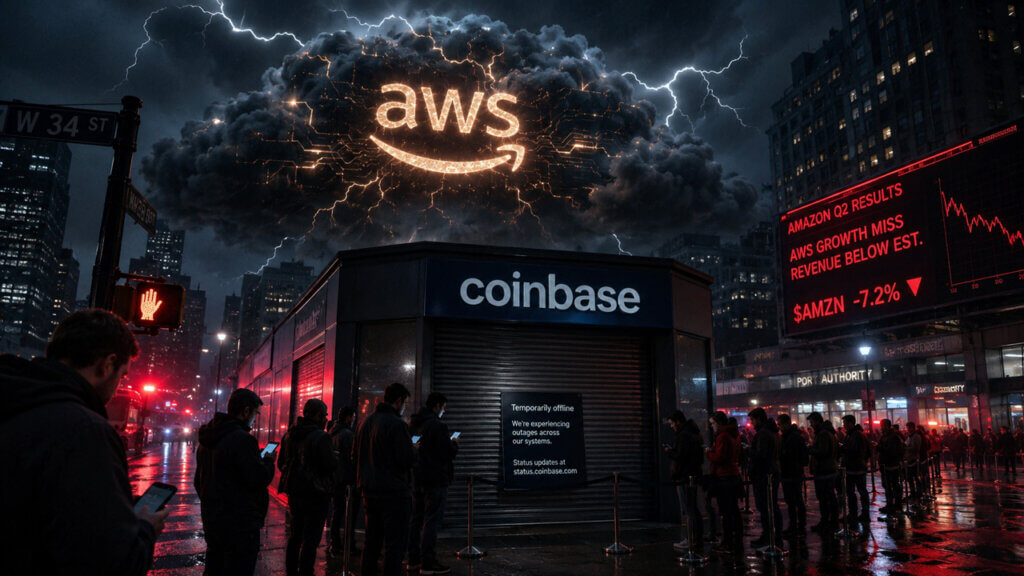
When one of the world's largest cryptocurrency exchanges, Coinbase, suffers an hours-long outage during a period of significant market volatility, the reverberations extend far beyond frustrated traders. The immediate aftermath saw Coinbase publicly attributing the disruption to Amazon Web Services (AWS), specifically an issue with an underlying service. This incident serves as a potent, real-world stress test of cloud resilience strategies and a stark reminder for founders and operators about the true nature of their cloud dependencies.
The outage, which crippled trading, deposits, and withdrawals for a substantial duration, struck at a critical juncture for crypto markets. While AWS itself did not experience a widespread, general outage, the specific service degradation cited by Coinbase highlighted a subtle yet profound challenge: even when a cloud provider's overall status dashboard appears green, specific, critical components can falter, creating a cascading failure for reliant applications.
The Incident: Unpacking the Blame
The disruption hit Coinbase's platform hard, rendering its core functionality inaccessible to millions of users globally. Imagine an equity exchange going dark during a Federal Reserve rate announcement. For crypto traders, moments can mean millions. Coinbase's initial communications were sparse, but later, detailed post-mortems pointed directly to an AWS service issue as the root cause, leading to what they described as a degradation in their primary database clusters.
This isn't a simple case of a single server failing. Modern cloud architectures, especially those built by companies like Coinbase that process billions in transactions, are designed with redundancy across multiple availability zones (AZs) within a region, and often across multiple regions. The implication of Coinbase's statement is that the AWS issue either affected a core service that transcended typical AZ isolation, or that Coinbase's architecture, despite its sophistication, possessed a hidden dependency or single point of failure within its AWS footprint.
The distinction between an AWS-wide outage and an issue with a specific service is crucial. Cloud providers segment their infrastructure to minimize blast radius. A widespread outage is rare; more common are localized degradations impacting specific services, often in particular regions. For a company like Coinbase, which likely leverages a vast array of AWS services for everything from compute and storage to networking and databases, pinpointing the exact failure point and its ripple effects is an intricate task.
Shared Responsibility and Vendor Lock-in
The blame placed on AWS immediately brings the cloud's shared responsibility model into sharp focus. AWS is responsible for the "security of the cloud," meaning the underlying infrastructure, hardware, software, networking, and facilities. The customer, Coinbase in this case, is responsible for "security in the cloud," encompassing their data, applications, operating systems, network configuration, and client-side encryption. This model extends beyond security to operational resilience.
When an application suffers an outage, the question isn't just whose technology failed, but whose architecture failed to adequately abstract or mitigate that underlying failure. Was Coinbase's database architecture sufficiently resilient to a degradation in a foundational AWS database service? Did their failover mechanisms account for the specific nature of the AWS issue?
This incident also ignites the perennial debate around vendor lock-in versus the operational simplicity and cost efficiency of deep integration with a single cloud provider. Building a truly multi-cloud architecture for core transactional systems is astronomically complex and expensive. It often means significant duplication of effort, managing disparate toolsets, and potentially compromising on performance for the sake of redundancy. Many enterprises opt for a multi-AZ or multi-region strategy within a single cloud provider, betting on that provider's internal resilience. The Coinbase incident challenges the robustness of even that sophisticated approach.
The Economics of Downtime in Crypto
The financial services sector, particularly high-frequency trading and volatile asset classes like cryptocurrency, operates on razor-thin margins and requires near-perfect uptime. An outage lasting hours in this environment is not merely an inconvenience; it represents a significant financial loss for both the platform and its users. Traders are locked out of positions, unable to respond to price swings, potentially missing opportunities for profit or, worse, being unable to mitigate losses.
Consider a market movement of just a few percentage points during a several-hour outage. For an exchange like Coinbase, processing billions in daily volume, even a fraction of that represents substantial unrealized revenue. More importantly, it erodes customer trust and confidence. In a competitive landscape where users can easily switch exchanges, reliability is paramount. The reputational damage and the potential for regulatory scrutiny, especially in regions with stringent operational resilience requirements, far outweigh the immediate technical challenge.
This incident underscores that for financial platforms, the cost of downtime is not linear. It compounds exponentially with market volatility and duration. A 30-minute outage during a quiet trading period is one thing; a multi-hour outage during a rapid market correction or rally is catastrophic.
Architectural Resilience: Beyond the Basics
For founders and operators, the Coinbase incident demands a deeper look at architectural resilience. Simply deploying across multiple Availability Zones is often the first line of defense, but this event suggests that even that might not be enough when an underlying cloud service itself experiences a systemic issue affecting multiple AZs within a region. True resilience requires anticipating failures at every layer of the stack.
This includes robust chaos engineering practices to proactively identify weak points, comprehensive monitoring that can distinguish between application-level and infrastructure-level issues, and sophisticated incident response playbooks that account for scenarios where the primary cloud provider is the source of the problem. It means asking uncomfortable questions: What if our primary database service in AWS experiences a degradation that our standard failover cannot circumvent? What if our monitoring stack, also hosted on AWS, is affected by the same outage?
Furthermore, it highlights the importance of diversifying critical components, not necessarily across different cloud providers for the entire stack, but perhaps for specific, high-risk components. For instance, an independent, multi-cloud monitoring system or a separate data ingestion pipeline could provide crucial visibility and alternative pathways during a primary cloud incident.
Cloud Reliance Snapshot:
AWS holds approximately 31% of the global cloud infrastructure market share (as of Q1 2024).
A typical "four nines" (99.99%) availability translates to ~52 minutes of downtime per year. For "five nines" (99.999%), it's ~5 minutes.
The average cost of a single hour of downtime for enterprises can range from $100,000 to over $1 million, depending on industry and scale. For financial services, these figures are often at the higher end.
Lessons for Founders and Operators
This event offers several critical takeaways for those building and operating modern tech businesses, especially those with high-stakes transactional platforms:
Deeply Understand Cloud Provider Dependencies: Don't treat cloud services as black boxes. Understand their internal failure modes, regional dependencies, and the nuances of their SLAs. Your resilience is only as strong as your weakest cloud dependency.
Architect for Systemic Cloud Service Degradation: Go beyond standard multi-AZ failover. Consider scenarios where an underlying cloud service, spanning multiple AZs, experiences issues. This might involve different database technologies, cross-region failover for critical components, or even hybrid cloud strategies for absolute resilience.
Implement Robust, Independent Observability: Ensure your monitoring, logging, and alerting systems are highly resilient and, ideally, not solely dependent on the same cloud infrastructure that might be experiencing issues. An outage shouldn't blind you to its cause.
Refine Incident Response and Communication: Have clear, well-rehearsed playbooks for cloud provider-induced outages. Transparency in communication, while challenging during an active incident, helps maintain customer trust and manage expectations.
Evaluate the True Cost of Downtime: Calculate the tangible and intangible costs of downtime for your specific business. This helps justify investments in advanced resilience strategies, even if they appear expensive upfront.
The Coinbase outage, and its attributed cause to an AWS service issue, is more than a technical hiccup. It's a strategic inflection point for how companies, particularly those in high-value, high-velocity sectors, approach their cloud infrastructure. It underscores that while the cloud offers unparalleled scale and flexibility, true operational excellence requires an unwavering commitment to resilience, a deep understanding of underlying dependencies, and an acceptance that even the most robust infrastructures can, and eventually will, experience failure.
Frequently asked questions
Why did Coinbase experience an outage?
Coinbase stated that the hours-long crypto trading outage was due to an issue with Amazon Web Services (AWS), specifically an underlying service disruption. This led to significant platform instability and prevented users from trading.
What caused the Coinbase trading outage?
The outage was attributed by Coinbase to an underlying service issue within Amazon Web Services (AWS), which hosts a significant portion of Coinbase's infrastructure.
How did the AWS outage affect Coinbase users?
Users experienced an inability to trade cryptocurrencies, access their funds, and monitor their portfolios for several hours, causing frustration during a period of market volatility.
Is Coinbase still experiencing issues?
The article refers to a past incident; for current status, users should check Coinbase's official status page or social media channels.
What is Amazon Web Services (AWS)?
AWS is a comprehensive, broadly adopted, and secure cloud platform, offering over 200 fully featured services from data centers globally, used by many major companies like Coinbase.
How common are crypto exchange outages?
While not an everyday occurrence, crypto exchanges can experience outages due to various reasons, including technical glitches, high traffic, security incidents, or underlying infrastructure problems like those seen with AWS.