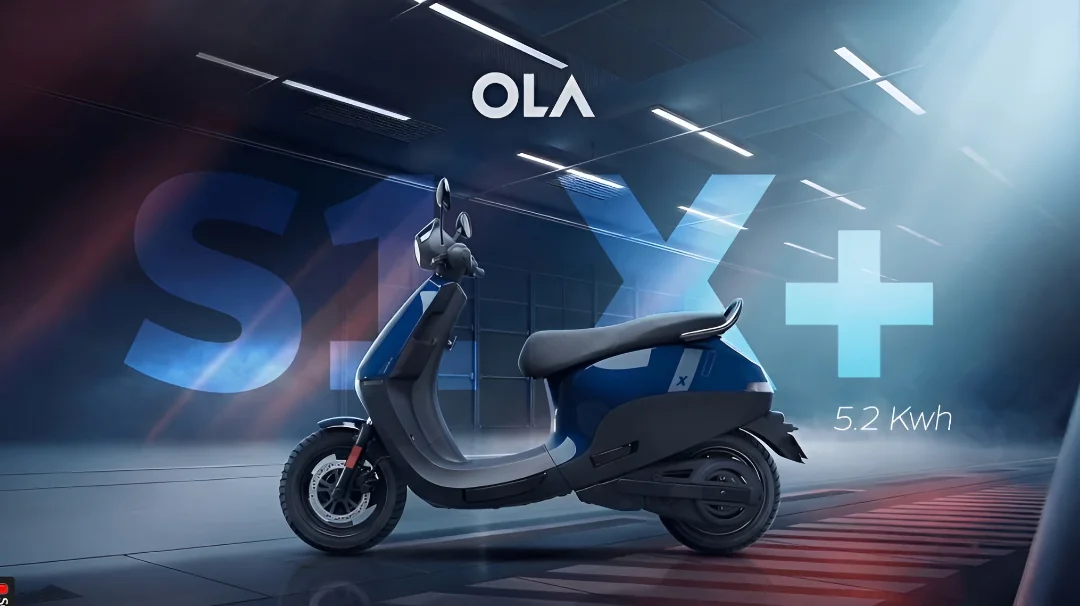
Ola Electric's S1 X+ 5.2 kWh scooter, powered by indigenous 4680 Bharat Cells, receives crucial government certification, boosting India's EV self-reliance.
Ola Electric's receipt of government certification for its 4680 Bharat Cell powered S1 X+ 5.2 kWh scooter marks a critical juncture, not just for the company, but for the trajectory of electric vehicle manufacturing and battery technology self-reliance in India. This isn't merely a compliance milestone; it's a validation of a deeply ambitious vertical integration strategy, signaling a potential shift in the global battery supply chain dynamics.
The core of this announcement lies in the "4680 Bharat Cell." The 4680 cell format, popularized by Tesla, refers to its dimensions: 46mm diameter by 80mm height. This cylindrical cell design is lauded for its potential to deliver higher energy density, improved power output, and enhanced thermal management compared to smaller form factors, leading to greater range and faster charging capabilities. Ola's designation of it as "Bharat Cell" emphasizes its indigenous development and manufacturing intent, a clear statement of national strategic importance in a sector dominated by East Asian giants.
For founders and operators navigating the complexities of EV production, the implications are profound. Dependency on external battery suppliers, predominantly from China, has been a significant geopolitical and logistical vulnerability. Developing and certifying an Indian-made 4680 cell, particularly for mass-market two-wheelers, addresses this head-on. It de-risks the supply chain, offers greater cost control, and potentially accelerates innovation cycles tailored to local market conditions.
The Strategic Imperative of Vertical Integration
Ola Electric's journey has been defined by bold moves and a relentless pursuit of scale. From establishing the world's largest two-wheeler factory, the Ola Future factory, to its aggressive market penetration strategy, the company has consistently aimed to control key components of its ecosystem. The certification of its proprietary 4680 cell is a natural, albeit monumental, extension of this vision.
Vertical integration in battery manufacturing is an incredibly capital-intensive and technologically challenging endeavor. It requires massive investments in R&D, specialized manufacturing facilities, and securing raw materials like lithium, nickel, and cobalt. By investing in its own cell technology and production, Ola is attempting to emulate a strategy pursued by a select few global automotive players, most notably Tesla, to achieve superior cost structures and performance envelopes.
The "Bharat Cell" initiative aligns perfectly with India's broader "Make in India" and "Aatmanirbhar Bharat" (self-reliant India) campaigns. Government support, through production-linked incentive (PLI) schemes for Advanced Chemistry Cell (ACC) battery manufacturing, has undoubtedly played a crucial role in enabling companies like Ola to undertake such ambitious projects. This certification, therefore, is also a testament to the efficacy of these policy frameworks in fostering domestic capabilities in strategic sectors.
Technical Validation and Market Readiness
The specific scooter model mentioned, the S1 X+ 5.2 kWh, is a flagship offering positioning itself in the premium end of the mass-market segment. A 5.2 kWh battery pack promises substantial range, likely exceeding 150-180 km on a single charge, making it highly competitive for urban and even inter-city commutes in India. The government certification, typically from bodies like the Automotive Research Association of India (ARAI) for vehicle type approval and the Bureau of Indian Standards (BIS) for battery safety, signals that the vehicle and its integral battery system meet stringent performance, safety, and quality benchmarks.
For consumers, this certification builds trust. It assures them that the advanced battery technology underpinning the S1 X+ has undergone rigorous testing and adheres to national standards. For Ola, it means faster market deployment and enhanced credibility against competitors who may still rely on imported cells or less integrated supply chains. The 4680 form factor itself suggests a forward-looking approach to battery design, potentially offering benefits in modularity, ease of assembly into packs, and overall vehicle architecture.
"Achieving government certification for an indigenously developed 4680 cell is a monumental hurdle cleared. It validates not just Ola's engineering prowess, but more importantly, it signals India's serious intent to become a global player in advanced battery manufacturing. The strategic implications for energy independence and cost competitiveness for the entire EV ecosystem are immense, though the path to scaled, cost-effective production remains challenging."
Dr. Anjali Sharma, Lead Battery Technologist, Veridian Energy Solutions
Global Relevance and Competitive Dynamics
While the immediate impact is on the Indian market, the long-term implications are global. The race for battery technology leadership is intense, with China currently holding a dominant position in manufacturing capacity and raw material processing. South Korea and Japan also maintain strong footholds. India, through initiatives like Ola's, is attempting to carve out its own space.
If Ola can successfully scale its 4680 cell production at competitive costs and maintain quality, it could position India as a viable alternative source for advanced battery cells. This would resonate with global automakers and EV manufacturers seeking to diversify their supply chains amidst geopolitical tensions and the push for regionalized manufacturing. The intellectual property developed around the "Bharat Cell" could also become an exportable asset, potentially licensed to other manufacturers globally.
However, the global landscape is fierce. Established players like CATL, LG Energy Solution, Panasonic, and Samsung SDI are continually innovating, refining their own 4680 strategies, and scaling production to unprecedented levels. Ola will need to demonstrate not just technological capability, but also industrial scalability, cost efficiency at volume, and robust supply chain management for critical raw materials – an area where China currently holds significant leverage.
Challenges on the Road Ahead
Despite this significant certification, the journey for Ola's Bharat Cell is far from over. Scaling production of advanced chemistry cells is fraught with challenges. Maintaining consistent quality across millions of cells, optimizing manufacturing processes for efficiency, and securing stable, ethical sourcing of raw materials are enormous undertakings. The volatile prices of lithium, nickel, and cobalt also pose significant financial risks.
Furthermore, the rapid pace of battery innovation means that today's cutting-edge technology could be superseded tomorrow. Continuous R&D investment will be crucial to stay competitive. Thermal runaway prevention, cycle life, fast-charging capabilities, and ultimate cost per kilowatt-hour will be critical metrics on which the "Bharat Cell" will be judged against global benchmarks.
For the Indian market specifically, the success of the S1 X+ 5.2 kWh will also depend on broader ecosystem development. Adequate charging infrastructure, robust after-sales service, and consumer education about the benefits and maintenance of advanced EV batteries are all essential for mass adoption. This certification is a powerful enabler, but not a standalone solution to market penetration challenges.
Future Outlook and Strategic Implications
This certification sets the stage for Ola Electric to not only strengthen its position in the Indian two-wheeler EV market but also to potentially become a significant player in the global battery supply chain. The ability to design, develop, and manufacture critical components like battery cells in-house provides a strategic advantage that few of its domestic or even international competitors possess at this scale.
It also sends a clear signal to the investment community and potential partners about Ola's long-term vision and execution capabilities. For other founders and operators in the EV space, Ola's trajectory serves as a case study in aggressive vertical integration and the strategic imperative of controlling core technologies. While not every company can afford to build a gigafactory, the principle of de-risking critical supply chains and investing in differentiating technologies remains universally applicable.
The next few years will be crucial. Ola must now translate this certification into mass production, cost-effective deployment, and demonstrable real-world performance. If successful, the "Bharat Cell" could indeed be a cornerstone of India's energy transition, powering not just scooters, but potentially a wide array of electric vehicles and energy storage solutions, reshaping global perceptions of India's manufacturing prowess in high-tech domains.
Key Takeaways
Strategic Validation: Government certification of Ola's 4680 Bharat Cell confirms the viability and safety of its indigenous battery technology, a significant step in India's journey towards EV self-reliance.
Vertical Integration Advantage: This milestone underscores Ola's aggressive vertical integration strategy, aiming to control critical components like battery cells to de-risk supply chains and optimize costs, mirroring global EV leaders.
4680 Cell Significance: The adoption of the 4680 form factor suggests a focus on higher energy density, improved performance, and advanced thermal management for extended range and faster charging capabilities in models like the S1 X+ 5.2 kWh.
Global Supply Chain Implications: Success in scaling the "Bharat Cell" could position India as a credible alternative in the global battery manufacturing landscape, offering supply chain diversification and potentially export opportunities amidst geopolitical shifts.
Path Ahead: While a major achievement, the company still faces significant challenges in scaling production, maintaining quality, securing raw materials, and competing with established global battery giants on cost and continuous innovation.
Frequently asked questions
What is the significance of Ola Electric's recent government certification?
Ola Electric's government certification for its S1 X+ 5.2 kWh scooter, powered by 4680 Bharat Cells, validates the company's vertical integration strategy and signifies a major step towards India's self-reliance in EV manufacturing and battery technology.
Which Ola Electric scooter model received government certification?
The Ola Electric S1 X+ 5.2 kWh scooter, specifically powered by the 4680 Bharat Cell, received the government certification.
What kind of battery technology does the certified Ola Electric scooter use?
The certified Ola Electric S1 X+ 5.2 kWh scooter uses indigenously developed 4680 Bharat Cells.
How does this certification impact India's EV market?
This certification boosts confidence in indigenous EV manufacturing and battery technology, fostering self-reliance and potentially accelerating the growth of India's electric vehicle sector.
What is the 'Bharat Cell' in Ola Electric scooters?
The 'Bharat Cell' refers to Ola Electric's indigenously developed 4680 lithium-ion battery cell technology, aimed at reducing reliance on imported battery components.
Is the Ola Electric S1 X+ 5.2 kWh scooter available in India?
While the certification marks a readiness milestone, its market availability would typically follow official launch announcements from Ola Electric, affirming its readiness for Indian roads.