The nightmare started with a "missing" zero. On April 19, 2026, Kelp DAO’s LayerZero bridge was drained of $292 million in rsETH in a matter of seconds. Within the hour, the hacker—preliminarily identified by researchers at Cyvers as the Lazarus Group—began the frantic on-chain "wash," routing stolen assets through Circle’s Cross-Chain Transfer Protocol (CCTP) and into Ethereum mixers. As the Kelp team watched the dashboard in a cold sweat, they faced the ultimate crisis of decentralized finance: do they intervene, or do they let the code play out?
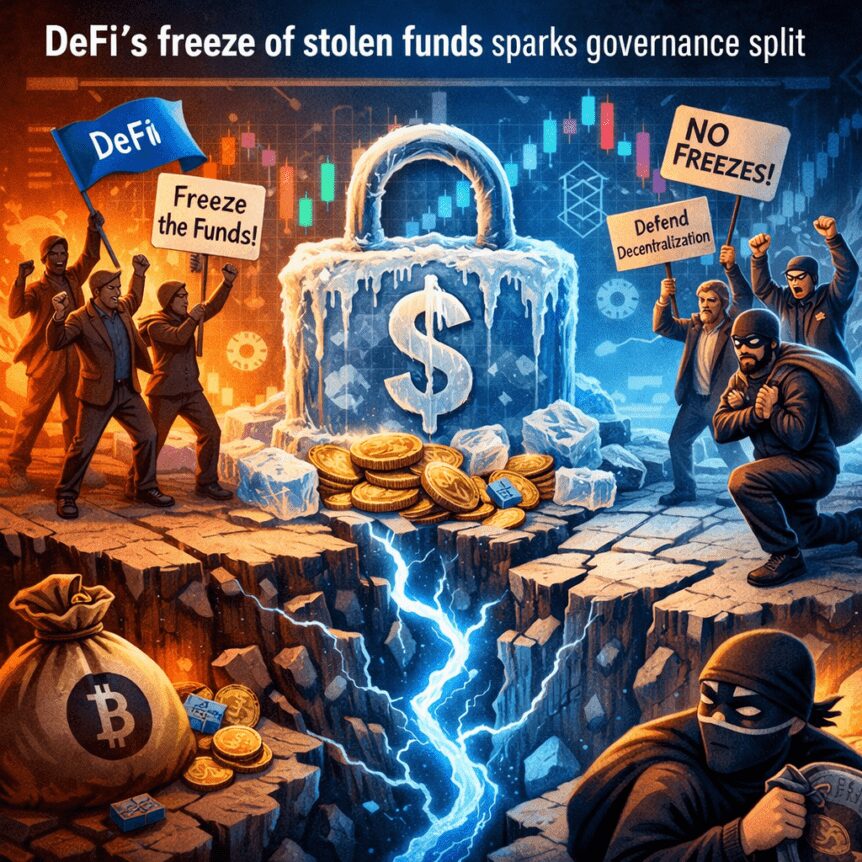
This is DeFi’s Lose-Lose Problem. If a protocol has the "admin key" to freeze stolen funds, it proves the project is decentralized in name only—a "fintech in a crypto trench coat." If it doesn’t, it remains a playground for state-sponsored actors, alienating the very institutional capital it needs to survive. In 2026, the stakes have moved past $10 million bug bounties; we are now witnessing infrastructure heists that threaten the systemic stability of the entire $120 billion TVL ecosystem.
The "God Mode" Paradox
For years, the DeFi ethos was "Code is Law." But as of Q2 2026, hackers have stolen nearly $750 million—April alone accounted for the lion's share of that—and the "Law" is starting to look like a suicide pact. The industry is currently split into two camps: the Purists, who believe any backdoor is a security flaw, and the Pragmatists, who argue that the lack of a "circuit breaker" is a dereliction of duty to depositors.
When Drift Protocol lost $285 million on April 1 after a six-month social engineering campaign, the community debate reached a fever pitch. Drift’s exploit wasn't a smart contract bug; it was a human-in-the-loop failure. When major lending platforms like Aave subsequently froze markets tied to rsETH to limit contagion, they technically "saved" the system, but they also highlighted a glaring truth: centralized control is currently the only effective defense against total collapse.
Regional Fractures and Regulatory Heat
The global dimension of this crisis is palpable. In the European Union, the Markets in Crypto-Assets (MiCA) framework is fully enforceable as of July 1, 2026, demanding that service providers have "clear procedures for asset recovery." Across the Atlantic, the GENIUS Act has begun treating major DeFi protocols as "systemically important financial utilities," a designation that carries mandatory "kill switch" requirements.
Founders in Singapore and Hong Kong—hubs that have historically been more "pro-innovation"—are now finding themselves caught in a regulatory pincer movement. The Monetary Authority of Singapore (MAS) has recently signaled that liquidity providers may be held liable if they fail to implement "reasonable" freezing mechanisms for flagged addresses. For a global protocol, navigating these distinct jurisdictional demands is a logistical nightmare.
"The industry is at a crossroads. We can't keep losing $700 million a quarter and expect pension funds to keep showing up for tokenization. But if we centralize, we lose the 'De' in DeFi. The solution isn't just a 'freeze' button; it's decentralized, programmatic circuit breakers that trigger based on on-chain anomalies, not human intervention." — Deddy Lavid, CEO of Cyvers
Key Takeaways for Founders and Operators
Hybrid Decentralization is the New Standard: Purely immutable protocols are becoming uninsurable. Expect "progressive decentralization" to include emergency pause features during the first $1B of TVL.
The Rise of the Security Council: Projects like Arbitrum are leaning on 12-member "Security Councils" with 9-of-12 multisig quorums to authorize emergency freezes. This is the new "Middle Path."
Bridge Infrastructure is the Weakest Link: Over 70% of 2026’s losses originated in bridge exploits. If you are building cross-chain, your security audit spend should be 3x your marketing budget.
Compliance as a Feature: In regions like the EU, having a verifiable "freeze and recovery" protocol is no longer a choice; it's a license to operate.
The Perspective Piece: The Death of Immuta-BULL-ity
We’ve spent a decade worshipping at the altar of immutability. But in a world where North Korean hackers treat cross-chain bridges like ATMs, immutability is becoming a liability. DeFi’s Lose-Lose Problem isn't just about the money; it's about the soul of the technology. If you build a system that can be frozen by a board of directors, you haven't built a new financial system—you’ve just built a faster, less-regulated version of the SWIFT network. Operators must choose: do they want to be "pure" and broke, or "compliant" and relevant?
The Infrastructure of Intervention
How do you freeze the unfreezable? The technical answer is increasingly found in Multisig Governance and Pausable Contracts. But these are blunt instruments.
Multisig Governance: A group of "guardians" can vote to pause a contract. The Risk: They become a single point of failure for social engineering attacks.
Pausable Contracts: A specific line of code that halts all transactions. The Risk: It destroys the "permissionless" promise and can be exploited by the very admins meant to protect it.
Recent developments in on-chain asset recovery show that the most successful "freezes" are actually happening at the exchange level—where hackers try to off-ramp into fiat. This suggests that the solution may not lie within the DeFi protocol itself, but in a tighter, albeit more centralized, collaboration with the fiat gateways.
As we move through 2026, the question for every operator is no longer if they should have a freeze mechanism, but who holds the key. If it's a DAO of 10,000 users, it’s too slow to stop a hack. If it’s a team of three founders in a Slack channel, it’s a bank. Solving DeFi’s Lose-Lose Problem will require a third way—autonomous, AI-driven security layers that can detect a $290 million drain and halt it in the same block, without a single human ever touching a "God Mode" key. Until then, the "Lose-Lose" remains the cost of doing business on the frontier.