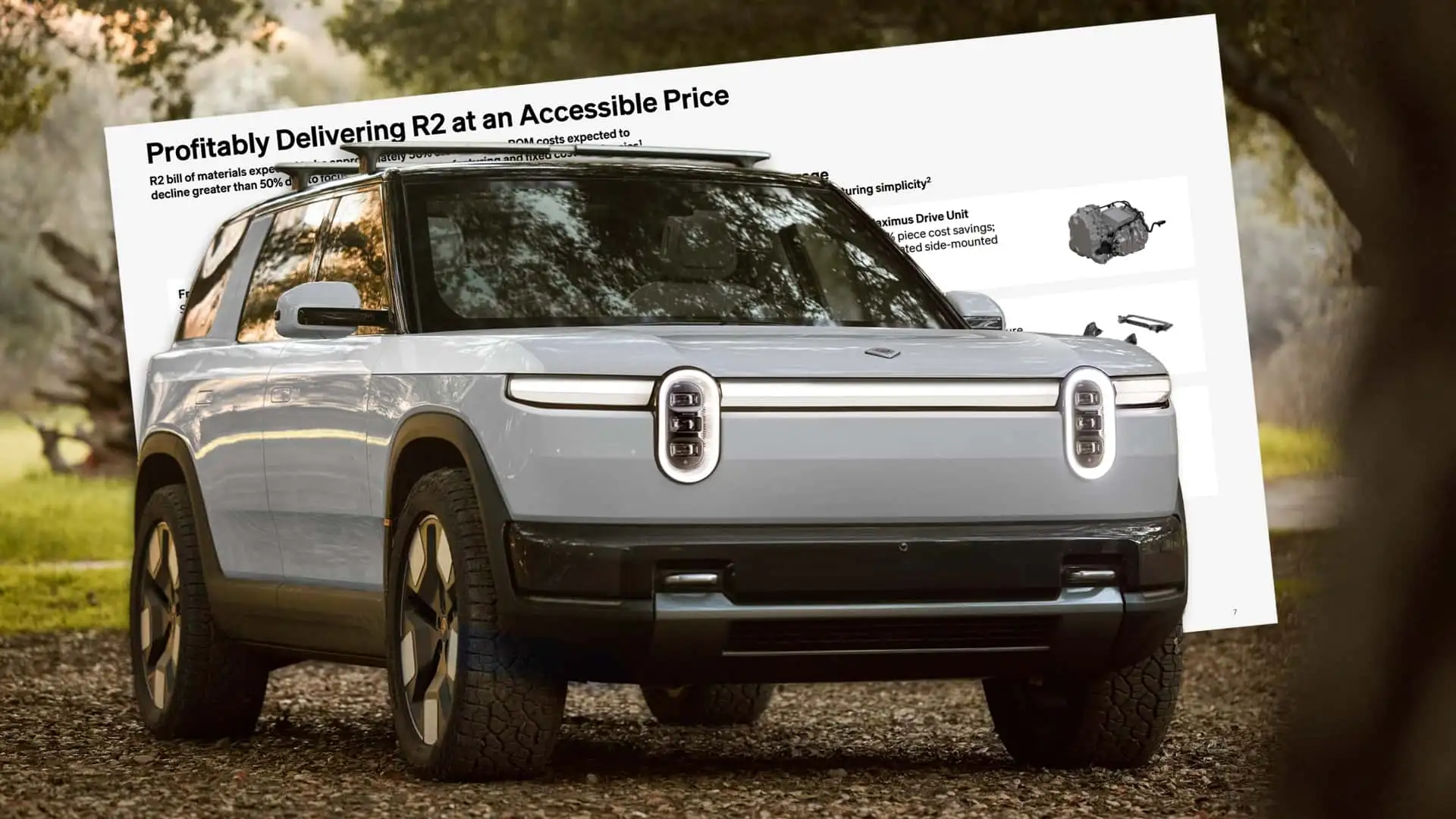
The automotive industry is littered with the corpses of startups that could build a beautiful car but couldn’t figure out how to build a profitable one. For three years, Rivian was the poster child for this paradox: a brand with universal acclaim and a flagship SUV, the R1S, that reportedly lost tens of thousands of dollars every time one rolled off the line.
But as of May 2026, the narrative has fundamentally shifted. With the rollout of the R2, Rivian isn't just launching a new model; they’re launching a new business model. The internal directive was clinical: The Rivian R2 Costs roughly 50% less to build than its predecessor. This wasn't achieved through cheaper leather or smaller screens. It was achieved through a "clean sheet" architectural purge that founders in any hardware-adjacent sector should study.
The Anatomy of a 50% Cut
To understand how Rivian halved its Bill of Materials (BOM), you have to look at what’s missing. The R1S was a "spare-no-expense" halo vehicle. The R2 is an exercise in industrial restraint.
The most dramatic savings live in the chassis. The R1’s sophisticated (and wildly expensive) double-wishbone front suspension has been replaced with a strut design, a move that alone slashed costs by over 70% for that sub-assembly. By moving away from complex hydraulic systems toward simplified, high-volume mechanical components, Rivian is finally playing the same game as mass-market heavyweights like Volkswagen.
The Efficiency Callouts:
Wiring Harness: The R2 features 2.3 fewer miles of wiring than the R1, a massive reduction in both weight and labor-intensive assembly time.
Part Count: Rear door complexity was gutted, ditching 65% of the total part count compared to the R1 series.
The Battery Core: The R2 battery pack uses nearly 10x fewer cells than the R1, moving to a structural design that uses fewer modules and simplified internal busbars.
"Maximus" Advantage
Rivian’s decision to bring drive-unit manufacturing in-house is now paying dividends. The new "Maximus" drive unit integrates a side-mounted inverter, reducing the footprint and the number of high-voltage connections. This vertical integration is the "Tesla playbook" executed with ten years of hindsight. While early Rivian units relied on third-party components that were hard to optimize, the R2 is built around a proprietary stack where every millimetre of copper is accounted for.
"The R2 represents a total rethink of our manufacturing philosophy. We transitioned from 'design for performance' to 'design for manufacturing' without losing the brand's soul. It’s about leveraging fixed cost efficiencies at a scale we simply couldn't touch with the R1 platform."
— RJ Scaringe, Founder and CEO of Rivian
Global Market Dynamics: The Mid-Size War
The R2 arrives at a volatile moment for the global EV market. In Europe, regulatory pressure is mounting for affordable, non-Chinese electric options as the EU weighs tariffs on imported vehicles. Meanwhile, in the US, the R2’s $45,000 starting price puts it directly in the crosshairs of the Tesla Model Y and the Ford Mustang Mach-E.
Rivian’s strategy in Georgia—supported by a projected $4.5 billion DOE loan—is to create a high-volume hub capable of churning out 300,000 units annually. If they hit their target of 4,000 vehicles per week by the end of 2026, they will have effectively transitioned from a boutique luxury brand to a structural player in the global automotive supply chain.
Skeptic’s Corner: The "Good Enough" Risk
The danger in cutting 50% of your build cost is the potential for a "Cheapening" of the brand. The R1S earned its reputation through over-engineered capability—quad-motor setups and tank turns. By moving to a strut suspension and simplified interior materials, Rivian is betting that the "Adventure" brand can survive a move to the mainstream. If the R2 feels like "just another crossover," the premium that supports Rivian’s valuation might evaporate.
Key Takeaways for Founders & Operators
Complexity is the Silent Margin Killer: The 65% reduction in door part counts proves that most "luxury" features add more assembly pain than consumer value.
Vertical Integration is Only a Win at Scale: Rivian’s in-house Maximus motors only make sense because of the projected 300,000-unit volume in Georgia.
Clean Sheet > Iteration: You can't iterate your way to a 50% cost cut. Rivian had to stop trying to fix the R1 and start over with the R2 to hit these numbers.
What to Watch
The Georgia Drawdown: Rivian expects to start drawing on its $4.5 billion loan by early 2027. Any delay there stalls the scale needed to make the R2 profitable.
Model Y Refresh: Tesla won't sit still. A "Juniper" update to the Model Y could trigger a price war that tests Rivian’s new, leaner margins immediately.
The Volkswagen Partnership: Watch how much of the R2’s network architecture ends up in future VW Group vehicles, providing Rivian with crucial licensing revenue.
As we look at the data, the conclusion is inescapable: The Rivian R2 Costs are a testament to what happens when a tech company finally starts thinking like a manufacturing company. Rivian spent five years learning how to build a car; with the R2, they’ve finally learned how to build a business.