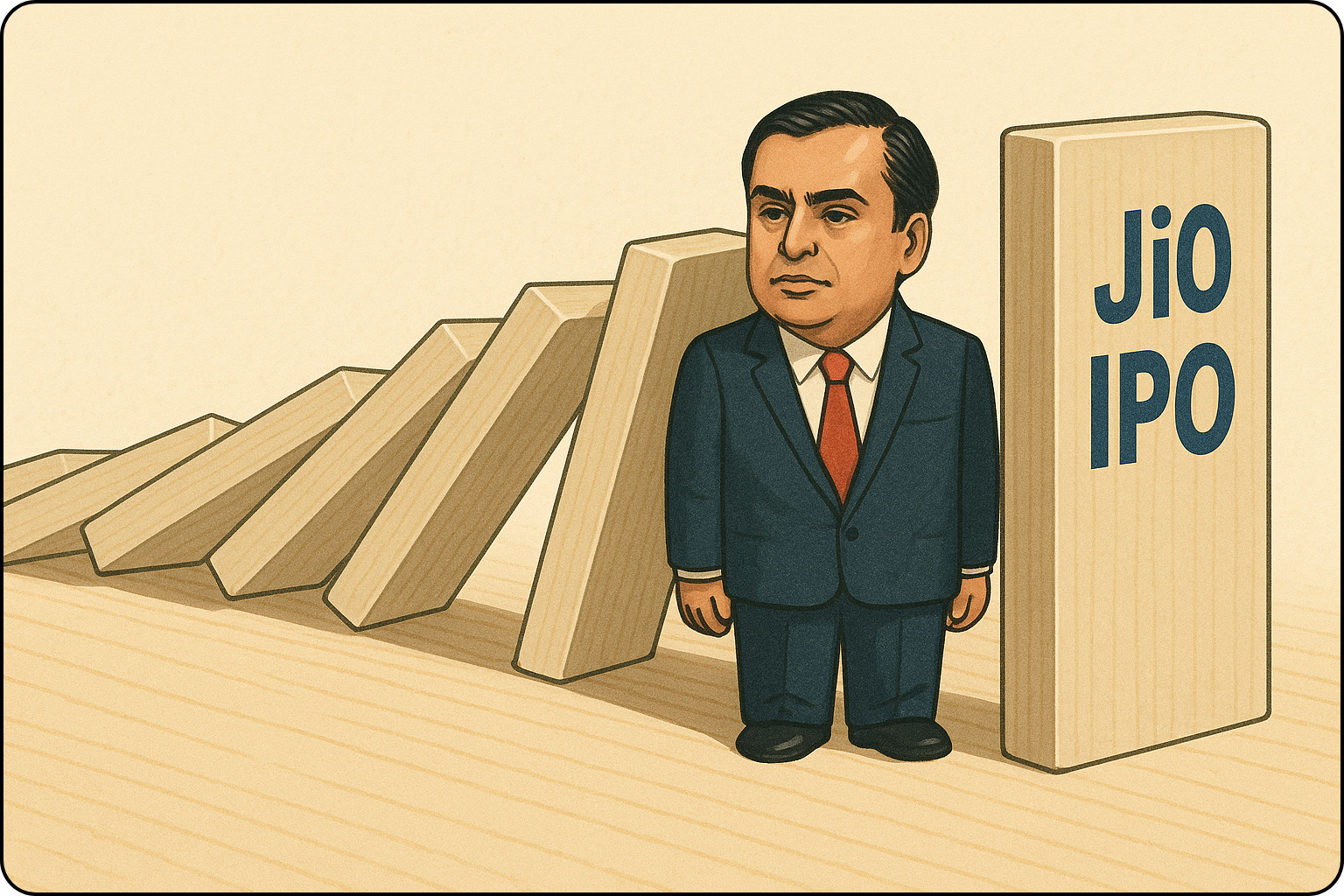
These are not modest numbers. By any comparison in global telecom — against T-Mobile, Deutsche Telekom, SoftBank's Japanese operations — Jio's scale and margin profile would command serious investor attention. And it's about to get that attention formally: Mukesh Ambani used the Q4 earnings call to confirm that Jio's IPO is advancing, calling it "a defining milestone" without specifying a date, which is itself a signal. Draft papers are reportedly targeting SEBI by May 2026.
Here's the thing nobody saying "strong quarter" wants to address: Jio's current ARPU of ₹214 trails Bharti Airtel's ₹259 significantly, raising questions about the sustainability of a projected IPO valuation of $120–170 billion. The Federal When a company targets one of the largest public listings in Indian history, the gap between what it earns per user and what a premium competitor earns per user becomes the most important number in the room. Right now, that gap is ₹45 per month. Annualised across 524 million users, closing half that gap would add roughly ₹1.4 lakh crore in annual revenue. It's the single biggest organic growth lever Jio hasn't pulled yet.
The ARPU gap is a strategic choice, not a failure
It'd be easy to read Jio's ARPU position as weakness. That reading misses the architecture of what Ambani actually built. When Jio launched in 2016 with free voice calls and near-zero data pricing, it wasn't making a tactical pricing decision — it was executing a market restructuring play. Thirteen telcos competed for Indian subscribers before Jio arrived. By the time the dust settled, India's telecom market became effectively a duopoly, with Jio and Airtel controlling the majority of revenue and subscriber share between them.
Jio maximises reach; Airtel maximises yield. The 5G rollout shifted competition from price wars to platform ownership — both players invested billions upfront, and the real story is no longer about who offers cheaper data but about who has built a network and business model better suited to a data-intensive, platform-driven economy. Inc42 Media
Jio's bet was always sequence. Build the subscriber base first, at virtually any cost. Once competitors are structurally weakened or eliminated, raise prices and extract value. That playbook is now entering its monetisation phase. ARPU increased 3.8% YoY to ₹214 Asianet Newsable — modest, but directionally consistent with a company gradually pushing pricing upward while the competition can't meaningfully undercut. The entire sector is now entering a tariff hike cycle, with expectations of 10–20% price increases in 2026, expected to benefit both players but especially Airtel given its premium positioning. Republic World Jio benefits too — it just starts from a lower base and has more room to run.
The 5G number that should interest every operator globally
268 million. That's Jio's 5G subscriber base as of March 2026 — with 5G now accounting for 55% of total wireless traffic. SuperOps To put that in context: the US had roughly 200 million 5G subscribers across all carriers as of late 2025. Japan, South Korea, and Germany combined don't reach 268 million.
India's 5G rollout trajectory has no real global precedent for speed. Jio's standalone 5G architecture — built on a clean-slate, all-IP network rather than retrofitted infrastructure — allowed it to push nationwide coverage at a pace that Nokia, Ericsson, and every Western operator have been studying closely. Jio AirFiber, its fixed wireless access product, reached 13 million subscribers and drove more than 75% of industry-wide fixed broadband additions during FY26. Business Standard AirFiber is the piece of the Jio story that most global observers underweight. Fixed wireless access — using 5G towers to deliver home broadband without laying fibre — is being watched by operators from Southeast Asia to sub-Saharan Africa as a potentially viable alternative to fibre rollout. Jio is the largest live case study in the world.
"Jio's fixed wireless play is arguably more instructive for emerging market operators than its mobile story. The economics of laying fibre in dense, high-rise urban India versus sprawling rural markets don't work for most operators. Fixed wireless at Jio's cost structure is a different proposition — and 13 million subscribers in a single year is a proof point that the market exists."
— Rohan Verma, telecom infrastructure analyst, Kotak Institutional Equities
The AI claim deserves scrutiny
Akash Ambani's statement that Jio is "positioned as the digital gateway to the intelligence era" landed in every earnings recap without challenge. It shouldn't.
Jio's AI Cloud offering is reportedly serving around 40 million customers, with plans to scale from storage into AI-enabled data and application services. Goodreturns That's a real product with real users. But "AI gateway for 524 million subscribers" is a significant ambition, and the gap between infrastructure ownership and actual AI service monetisation is where a lot of telco strategies have quietly dissolved in recent years. AT&T tried this. Deutsche Telekom has been trying variations of it for a decade. The pattern of large telecoms announcing AI platform strategies and then delivering AI platform revenues on a timeline that investors find credible is not a pattern with many success stories.
This doesn't mean Jio will fail at it. Jio's structural position — owning the last-mile connection into homes and businesses across the world's most populous democracy, with government backing that no Western operator enjoys — is genuinely different from the telcos that tried and stumbled. The Telecom Regulatory Authority of India (TRAI) and the Department of Telecommunications have consistently aligned policy to support Jio's expansion ambitions in ways that give it regulatory tailwinds its global peers don't get. But founders and operators reading this should treat "AI gateway" claims from telecoms with the same scepticism they'd apply to any platform company claiming adjacency to AI revenue.
The data traffic numbers, though, are worth paying attention to. Data traffic rose 35% year-on-year to 66 billion GB in Q4 FY26. SuperOps Someone is generating that traffic. If Jio can convert even a fraction of those 524 million data users into paying subscribers for AI-powered services — cloud storage, enterprise tools, SMB productivity software — the revenue geometry changes materially.
Skeptic's corner
The projected IPO valuation range of $120–170 billion The Federal requires a significant suspension of disbelief about near-term ARPU growth. A ₹214 ARPU with 524 million subscribers generates roughly $1.28 per user per month. That's the monetisation baseline Jio is bringing to public markets. For context, T-Mobile's average revenue per account in the US runs north of $50 per month. The comparison isn't entirely fair — purchasing power and market structure differ enormously — but anyone underwriting Jio at $120 billion is making a bet on Indian telecom premiumisation happening faster and more completely than it has anywhere else in Asia. That bet might be right. It's still a bet.
Three things to watch in FY27
Whether Jio files its DRHP with SEBI by the end of Q1 FY27 as reportedly planned — the filing will force disclosure of detailed segment financials that aren't currently public, particularly around digital services revenue versus pure telecom.
ARPU trajectory through the IPL 2026 season and the broader tariff hike cycle. A sequential jump from ₹214 toward ₹230+ would meaningfully shift the valuation conversation.
Enterprise and B2B traction. Internal IT teams already comprising 20% of some enterprise SaaS companies' customer bases Global Prime News signals demand for managed connectivity in India's growing enterprise segment — a segment Jio has been quietly moving into and which carries fundamentally different margin profiles than consumer mobile.
The numbers Jio reported for Q4 FY26 are, in isolation, impressive. Thirteen percent profit growth on a base of 524 million subscribers, 52% EBITDA margins, 268 million 5G users — these are numbers that would generate serious analyst attention anywhere in the world. What makes Jio's story genuinely interesting heading into its IPO isn't the profit growth. It's whether the company can make the case — in a DRHP, in roadshow pitches, in actual quarterly results — that the distance between ₹214 per user today and where it needs to be to justify a nine-figure valuation is a journey with a credible map.
Ambani's been right about Jio more often than his critics have been. But the public markets will want specifics, not vision statements, and the clock on that is now running.