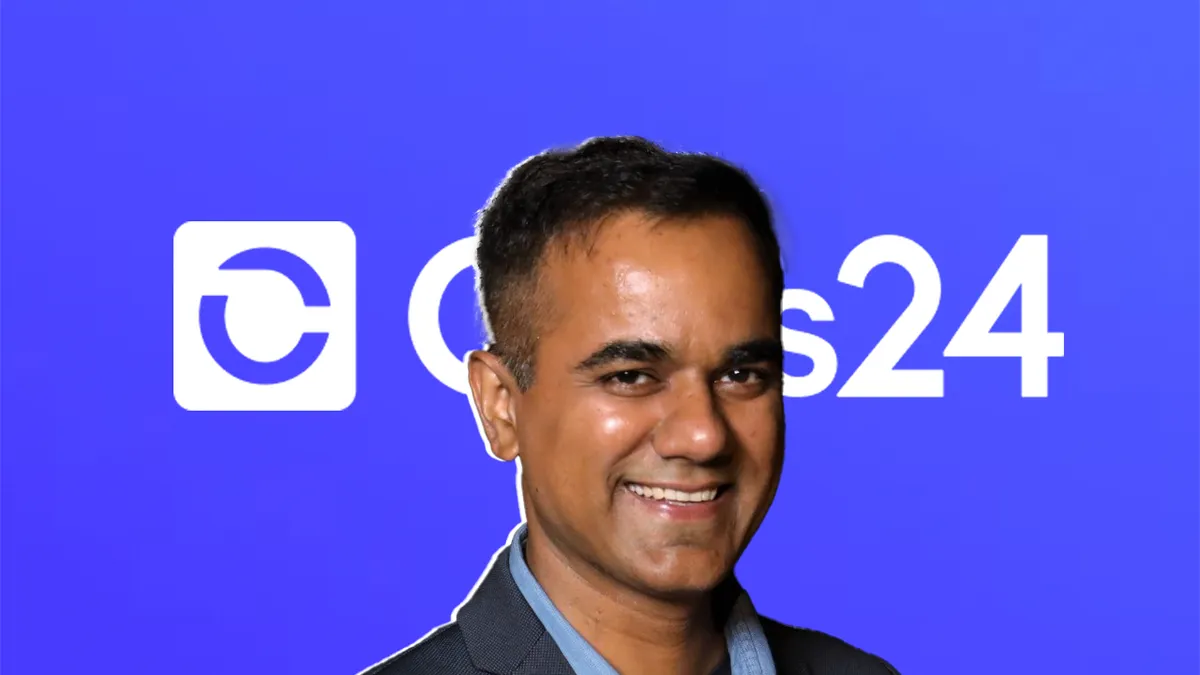
Gajendra Jangid, co-founder and chief marketing officer of used-car marketplace Cars24, has stepped down from his executive role after eleven years, moving instead to an advisory position. The announcement came alongside confirmation from group CEO and co-founder Vikram Chopra that Jangid would stay connected to the brand, marketing, and the road safety initiative Crashfree India. But the careful wording shouldn't obscure what this is: a founding team reshaping itself for an audience it hasn't met yet — public market investors. Inc42 Media
Jangid himself put it plainly in a LinkedIn post, writing that stepping down from a title isn't the same as stepping away from what you built. He added that the executive role changes and responsibility shifts, but some things you've put your whole self into, you don't just leave behind. It's a graceful exit note, the kind that reads well in a prospectus. Whether that's cynical or strategic depends on your prior beliefs about founders. Storyboard18
This marks the second major departure for Cars24 within weeks. In March, Himanshu Ratnoo, CEO of the India used-car business, announced he was stepping away. Ankit Bhalla also exited, indicating movement across several critical roles simultaneously. Three departures, different functions, same short window. Pattern recognition isn't conspiracy. Something is being deliberately unwound here. Inc42 Media
The question worth asking isn't "why are people leaving?" It's "why now, and who's leaving?"
Jangid wasn't peripheral. He'd been associated with Cars24 since its 2015 founding, playing a central role in building the brand. Before his entrepreneurial journey, he spent over nine years at Schlumberger in operational roles across India and international markets. He was the public face of Cars24's consumer identity — the marketing mind behind campaigns that made a B2B dealer platform feel like a consumer brand. Losing that institutional memory, even temporarily, carries real risk. Best Media Info
CEO Vikram Chopra has been clear about what comes next. He said earlier this year that Cars24 is aiming to go public within the next six to twelve months, pointing to improving financial metrics as the basis for confidence. The numbers have genuinely moved. TechStory
For the six months ended September 2025, Cars24 reported adjusted net revenue of INR 6.5 billion ($72 million), up 18% year-on-year. More significantly, the company cut its adjusted EBITDA loss by 36%, citing disciplined cost management and increased automation. Those aren't vanity metrics. They're the kind of trajectory that Dalal Street — and eventually institutional investors in London, Singapore, and New York — needs to see. AIM Group
85,000 cars were transacted in H1 FY26, generating a GMV of over INR 3,700 crore. Loans disbursed through the company's NBFC arm, Loans24, grew 38% to INR 1,600 crore in the same period. Profitable? Not yet. Moving in the right direction? Clearly.
Here's where it gets interesting for anyone who's been through an IPO process, or watched one closely. Public market investors don't like founder-led companies the way venture investors used to. They like founder-founded companies that are now professionally managed. The distinction matters enormously to underwriters pricing an issue.
India's 2025 startup wave confirmed this pattern bluntly: leadership changes were not random exits — they were strategic resets. Companies brought in leaders with experience in large organizations, regulated environments, and public companies. Cars24 has been doing exactly this, in its own way. Chopra remains. The others rotate out. The story being told to investors is: here's a founder-led vision, now executed by a professional team. It's a cleaner pitch than "our CMO also founded the company in his living room ten years ago." KTPL
"Stepping back from a designation does not mean disengaging from the company's journey." — Gajendra Jangid, in his exit note to Cars24 employees
Whether that framing holds up under scrutiny is another matter. Advisory roles after founder exits have a mixed record at scaling Indian startups — sometimes they're genuine mentorship arrangements, often they're dignified offboarding.
The contrarian case: maybe the exits aren't strategically coordinated at all. Maybe they're a consequence of something less flattering — cultural friction as Cars24 pivots from high-growth startup to IPO-ready institution. Founders who built something scrappy often struggle when governance frameworks, audit committees, and investor relations professionals move in. Not every exit is a hand-off; some are just a handshake goodbye.
According to data compiled by TheKredible, Indian startups saw 35 leadership exits in 2025 alone, compared to 16 in 2024. That's a sharp acceleration. Cars24 is not an outlier — it's riding a wave of pre-IPO professionalization that's sweeping through the entire Indian startup cohort. Knowing that doesn't resolve the question of whether Cars24's version of this transition is managed or messy. Entrackr
Beyond the balance sheet, Cars24's global footprint adds a dimension that's easy to miss if you're only reading Indian business press.
Cars24's UAE business has become its first international venture to deliver positive adjusted EBITDA — INR 90 million in H1 FY26. That's not a number that makes headlines. It should. Breaking into profitability in the UAE's hyper-competitive, expat-heavy used-car market — where buyers have options ranging from local dealers to global platforms — is genuinely difficult. It validates the thesis that Cars24's model travels. AIM Group
Co-founder Mehul Agrawal, writing about the international expansion rationale, noted that the Indian used-car market stands at $25-30 billion, but the combined market size of the UAE and Australia targets scaled over $100 billion — making expansion a core bet, not a side one. That calculation is why Cars24's Australian and UAE operations matter for any IPO story. Investors in a public offering aren't just buying exposure to India's $200 billion used-car opportunity — they're buying a multi-market platform thesis. A CMO departing doesn't dilute that story. A CMO departing right as international profitability becomes real might even help it, if the argument is that the company's brand is now self-sustaining. Cars24
India itself is experiencing something remarkable in used car adoption. In 2024, India's used car market surpassed new car sales, with 5.4 million pre-owned vehicles sold against 4.16 million new ones — a trend projected to reach 10.8 million units by 2030. This is the domestic runway Cars24 is standing on. No leadership restructuring changes that tailwind. Orange Owl
Cars24's IPO ambitions put it on a similar path to rival CarTrade, which has already expanded aggressively through acquisitions. While CarTrade previously explored a merger with CarDekho, valuation differences stalled the deal, leaving room for continued competition in the sector. Cars24 has meanwhile been doing its own deal-making. In 2025, the company acquired Team-BHP, followed by the car information platform CarInfo, to deepen user engagement and data capabilities. These aren't vanity acquisitions. They're content and data moats that strengthen pricing algorithms and reduce customer acquisition costs — the kind of thing that shows up as margin improvement two or three quarters after the deal closes. TechStoryTechStory
Three things to watch as Cars24 moves toward a public listing:
Whether Vikram Chopra names a permanent India CEO. Ratnoo's departure left Chopra holding that role directly. He's capable, but a sole founder running both group and India operations is not the governance structure public market investors prefer. Expect an appointment, and expect it to be someone with a listed-company background.
The UAE EBITDA trajectory. One profitable international market is a proof of concept. Two consecutive profitable halves would be a pattern. The H2 FY26 numbers, which should be disclosed as part of any DRHP filing, will tell you whether the margin story is structural or seasonal.
Jangid's actual involvement post-exit. If he stays engaged with the brand and Crashfree India, that's a genuine advisory role. If he disappears from the narrative within six months, it was offboarding with extra steps.
For founders watching this from elsewhere in the world — whether you're in Southeast Asia, Latin America, or building somewhere in the Middle East — Cars24's restructuring carries a lesson that's uncomfortable to hear: the IPO process often asks you to diminish yourself before it rewards you. The people who built something from nothing frequently have to become advisors so that the institution they built can become legible to investors who never met them.
Jangid poured eleven years into Cars24. He's now an advisor. That's not a failure of the company or of him. It might be the most honest signal that Cars24 is actually serious about going public — more honest, anyway, than any press release about market readiness and improving unit economics.
The market will decide if that's worth something.