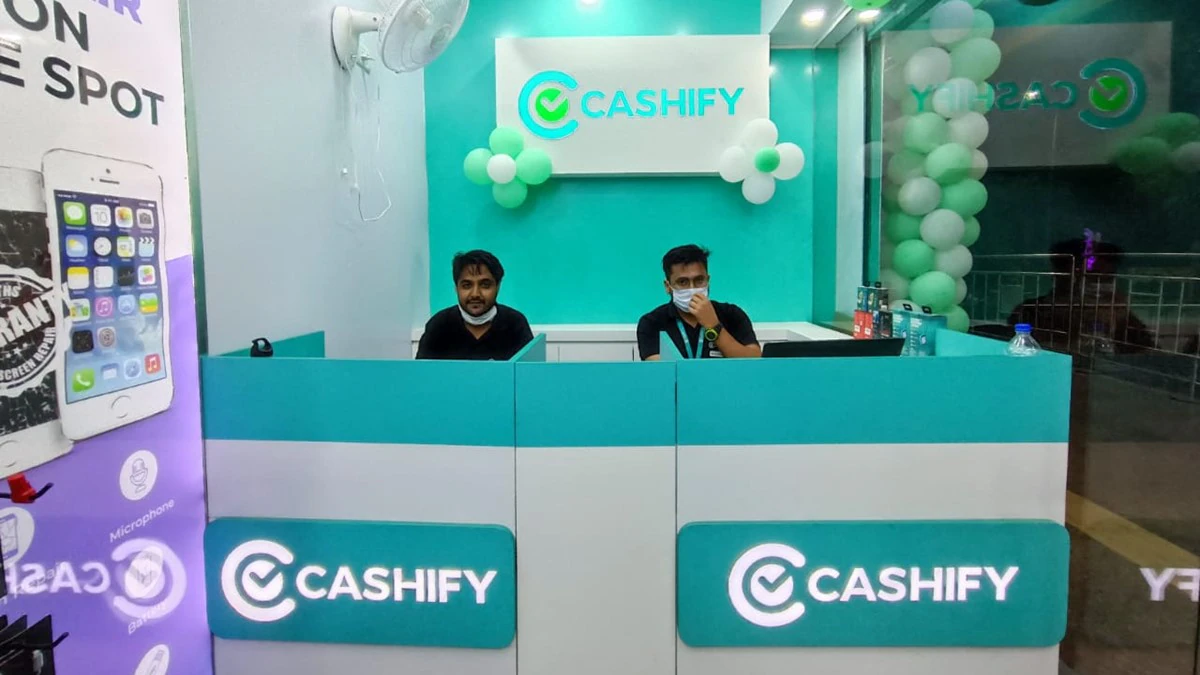
Walk through Nehru Place on any weekday and you'll still find them — the narrow stalls, the laminated price sheets, the handshakes that seal deals no invoice will ever record. India's grey market for used electronics has always been vast, informal, and nearly impossible to kill. For most of the last decade, that market looked like a wall Cashify would never breach.
Then, quietly, something shifted.
In the financial year ending March 2025, Cashify posted operating revenue of ₹1,096 crore — up 17% year-on-year — and slashed its net loss by 80% to just ₹10.6 crore. For a company that was bleeding ₹148 crore in losses as recently as FY23, this is not a pivot. It's a different company wearing the same logo.
The transformation didn't come from a product overhaul or a last-minute pivot. It came from a decade of grinding at a market that everyone knew was enormous and nobody could figure out how to make respectable.
The Problem Was Never the Market. It Was the Trust.
India produces roughly 1.75 million metric tonnes of e-waste annually, ranking it third globally in that dubious category. Hundreds of millions of Indians upgrade phones every year — but the secondary market through which those devices circulate had, for most of its existence, the cultural prestige of a flea market. Buyers got cheated. Sellers got underpaid. Warranties were fiction.
Cashify CEO and co-founder Mandeep Manocha has described the core challenge bluntly: moving from a world where people don't know what to do with their old phones, to one where resale feels as natural as the upgrade itself.
That sounds like a marketing tagline. It was actually an engineering problem.
The company, founded in 2013 in Gurugram by Manocha, Nakul Kumar, Amit Sethi, and Siddhant Dhingra, spent its early years building what the grey market conspicuously lacked: a price-discovery engine. Feed a phone's model, age, condition, and remaining warranty into their system, get an instant quote, schedule a doorstep pickup. Simple on the surface. Operationally, it required mastering reverse logistics across a country with 28 states, inconsistent road infrastructure, and wildly variable consumer behavior between, say, a Tier-1 buyer in Bengaluru and a first-time seller in Patna.
They also made a bet that most marketplace operators avoid: going full-stack. Rather than remaining a pure intermediary, Cashify shifted to buying, refurbishing, and selling devices directly to consumers — absorbing inventory risk, quality control, and last-mile delivery in one move. It's the kind of decision that kills unit economics in the short run and builds defensibility in the long run. A decade in, the defensibility is showing.
The Numbers That Actually Matter
Metric | FY23 | FY24 | FY25 |
|---|---|---|---|
Operating Revenue | ₹817 Cr | ₹935 Cr | ₹1,096 Cr |
Net Loss | ₹148 Cr | ₹53 Cr | ₹10.6 Cr |
YoY Revenue Growth | — | 14.4% | 17% |
5G Refurb Phone Share | — | 55% | 73% |
The average selling price of a refurbished smartphone on Cashify has more than doubled in recent years — from roughly ₹10,000 to ₹23,000. That's not inflation. That's premiumization: Indian consumers are increasingly buying refurbished iPhones and OnePlus flagships instead of entry-level new devices. Apple alone commands a 64.5% share of Cashify's refurbished sales, followed by OnePlus at 10.9% and Xiaomi at 9.9%.
Here's the counterintuitive part: Cashify's business is not being built on budget buyers. It's being built on aspiration. The buyer who wants an iPhone 14 but can't justify ₹70,000 for a new one is Cashify's most valuable customer — and that customer is multiplying fast as India's middle class expands and UPI-driven fintech infrastructure makes digital transactions frictionless even in smaller cities.
The Payment Layer: Invisible but Load-Bearing
This is where the fintech layer matters in ways that rarely get discussed in coverage of recommerce platforms. Cashify's entire consumer-facing flow — price quote, instant payout to sellers, UPI-based disbursement, EMI options for buyers — runs on India's payment gateway and digital payments infrastructure. In markets like Southeast Asia, Latin America, or even Sub-Saharan Africa, where analogous recommerce opportunities exist, this layer is either missing or fragmented. India got lucky: the government-backed UPI stack gave startups like Cashify an instant-payout backbone that took a decade to build in the U.S. and Europe.
"The reason recommerce can work at scale in India before it works in most other emerging markets is not the supply of used phones — that's everywhere. It's the payment infrastructure. You can settle a transaction with a seller in rural Rajasthan in under two minutes. That changes everything."
— A fintech operator with experience across India and Southeast Asia markets
The fintech angle extends beyond payments. Cashify's integration with exchange programs run by OEMs like Xiaomi, Samsung, and OnePlus, as well as with e-commerce giants Amazon and Flipkart, means that when you trade in an old device on any of those platforms, there's a reasonable chance Cashify is the entity actually processing it on the back end. The company built a B2B2C flywheel that the grey market never could.
India's Regulatory Tailwind (and Its Double Edge)
India's e-waste management rules — strengthened through CPCB guidelines and updated Extended Producer Responsibility (EPR) mandates — increasingly require OEMs to account for end-of-life device management. That's formally good news for Cashify. Brands need certified refurbishers and recyclers in their supply chains. Cashify, with its physical network and audit trail, is positioned to be that partner.
The double edge: regulation that legitimizes the organized sector also attracts better-capitalized competitors. Apple's own certified refurbished program, Samsung's pre-owned device push, and the slow but visible entry of global players into India's secondary market mean Cashify's moat needs to be operational — not just positional.
The unorganized sector still handles roughly 85% of India's secondary device market. That statistic cuts both ways: it means Cashify's total addressable market remains enormously underpenetrated, but it also means the structural shift from grey-market haggling to platform-mediated recommerce is still early innings. The company has 30 million app users and has paid out over ₹1,400 crore to sellers over its lifetime — impressive scale by any regional benchmark, fragile-looking against the full market size.
What the IPO Clock Is Really Saying
Cashify has raised $140 million in total funding and has publicly targeted an IPO by FY28. The investors behind that timeline — NewQuest Capital, Prosus, Bessemer Venture Partners, Amazon, Blume Ventures — are a who's-who of patient, late-stage capital. None of them invested in a company that was planning to stay private forever.
The FY25 numbers are clearly being managed with that exit in mind. An 80% reduction in net losses in a single year, on revenue growth of 17%, is not organic operating leverage alone. It's a company actively demonstrating to public market investors that the unit economics work. In 2024, 63% of Cashify users sold their old device within six months of their last upgrade — a cohort retention metric that would look compelling in any IPO prospectus.
The skeptic case is worth hearing. A company doing ₹1,096 crore in revenue with procurement costs of ₹1,037 crore — up 45% year-on-year — is running on thin air margins. The business only works at scale, and scale requires continual offline expansion (stores, kiosks, pickup networks) that is capital-intensive in ways that software businesses are not. If the IPO window narrows — as it did for much of India's startup ecosystem through 2023-2024 — Cashify would need another funding round at a moment when its losses are almost gone but its free cash flow story isn't fully written.
Key Takeaways
Cashify's FY25 results mark a genuine inflection point for India's recommerce sector. The path from ₹148 crore in annual losses to near-breakeven in two years was built on three structural shifts: a move to full-stack inventory ownership that gave quality control; deep OEM and e-commerce platform partnerships that created a B2B2C supply flywheel; and the rising aspirational demand for premium refurbished devices at a price point the new market can't touch. The payment infrastructure — India's UPI network and the fintech rails that Cashify plugs into for instant seller payouts — is the invisible scaffolding that made the consumer trust story possible.
What founders in analogous markets — Southeast Asia, MENA, Nigeria — should note is this: the recommerce model doesn't travel on product alone. It travels on payment infrastructure and regulatory environment. Countries that have solved instant digital payouts and have some form of EPR mandate are the next Cashify markets. Those that haven't aren't ready yet.
What to Watch Next
Three things will determine whether Cashify's FY28 IPO narrative holds. First, whether procurement cost growth — that alarming 45% year-on-year jump in FY25 — decelerates as the company's buying scale compounds. Second, whether the extended product categories (cameras, smartwatches, gaming consoles) gain enough traction to reduce the 95% smartphone revenue concentration that makes the business vulnerable to any single-category demand shock. Third, and most telling: whether Apple's own refurbished push in India — the company has been expanding its direct retail footprint in Mumbai and Delhi aggressively since 2023 — chips away at the category where Cashify makes most of its margin.
India's circular economy story is real. The question has always been whether any single platform could be the ledger for it. Cashify, after twelve years and $140 million, is closer to that answer than anyone else in the room.
Filed April 30, 2026 | StartupNews.fyi covers India's startup ecosystem with an editorial focus on the operators and market dynamics behind the headlines.