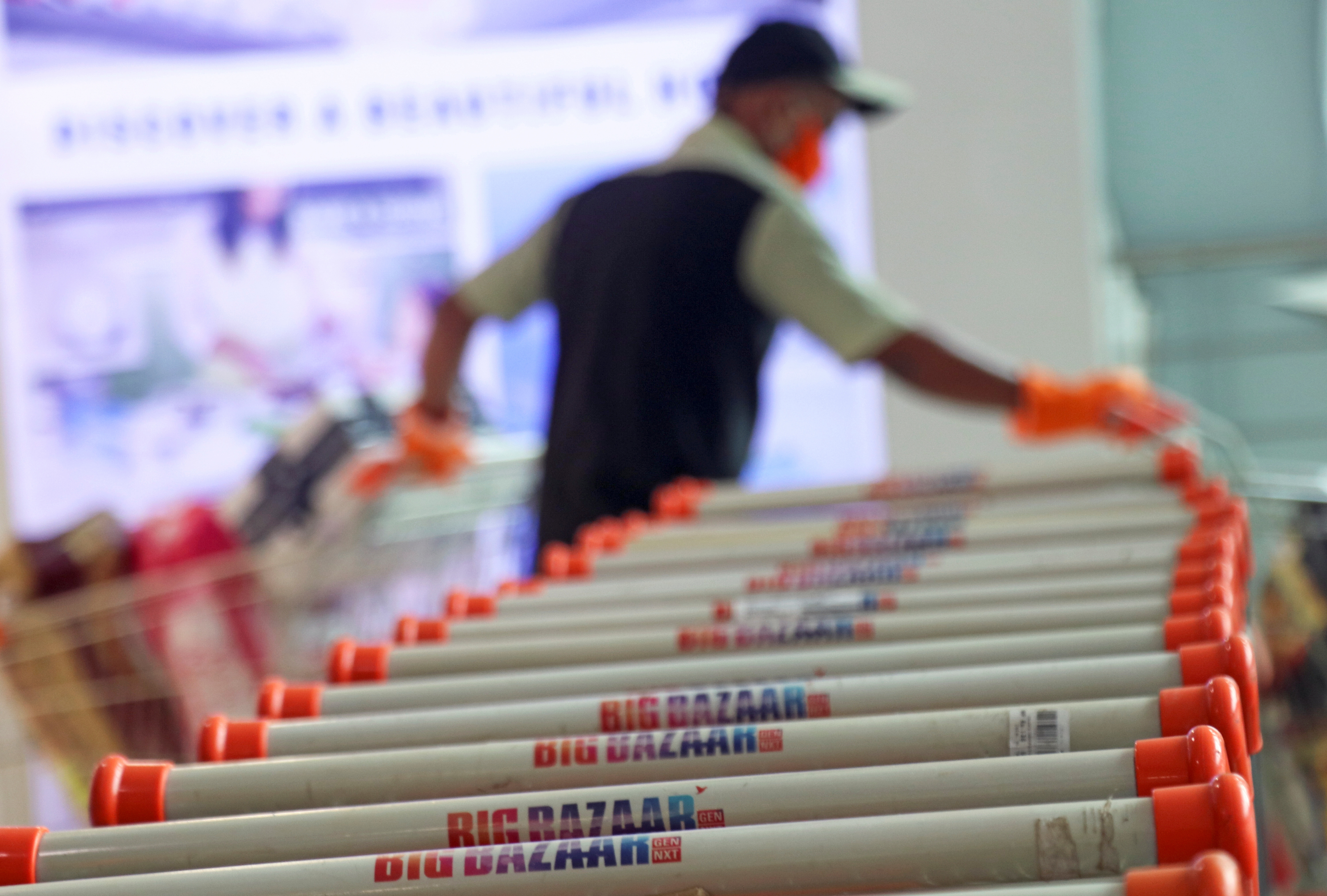
The legal theatre that once threatened to rewrite the rules of global commerce ended this week not in the Supreme Court, but in a modest ledger entry. Amazon and the promoters of Future Coupons have reached a settlement of approximately ₹11 crore, effectively putting a price tag on the funeral of a multi-billion dollar ambition. To call this a victory for any party would be a stretch. It’s an autopsy of a deal that went so spectacularly wrong it managed to incinerate one of the most iconic brands in Modern Retail.
For years, the battle for Future Retail and its flagship Big Bazaar stores was the most watched cage match in the tech and retail world. It pitted Jeff Bezos’s global machine against Mukesh Ambani’s Reliance Retail, with Kishore Biyani’s empire caught in the middle. Today, the ₹11 crore settlement feels like pennies found in the couch cushions of a house that’s already burnt down. The stores are rebranded, the inventory is liquidated, and the legal teams have moved on to newer, more lucrative disputes.
The 2019 Hook: A Strategic Miscalculation
The roots of this fallout date back to a 2019 agreement where Amazon invested ₹1,431 crore in Future Coupons. At the time, it looked like a masterstroke of regulatory navigation. Since India’s FDI rules restricted direct foreign investment in multi-brand retail, Amazon used a back-door entry to gain a 4.5% stake in the listed Future Retail. The contract included a "non-compete" list—effectively a "No-Reliance" clause.
The Financial Fallout
Original Deal Value: Reliance’s 2020 bid for Future assets was pegged at ₹24,713 crore.
Settlement Amount: The final truce between Amazon and Future promoters sits at ₹11 crore.
Asset Leakage: Reliance eventually took over approximately 800+ Future Group stores after the company failed to pay rent.
Market Valuation: Future Retail’s market cap has effectively vanished from its 2017 peak.
When Biyani, facing a liquidity crunch during the 2020 lockdowns, attempted to sell the retail assets to Reliance, Amazon pulled the emergency brake. They headed to the Singapore International Arbitration Centre (SIAC), claiming the Reliance deal breached their contract. What followed was a four-year stalemate that saw the assets of Big Bazaar rot in real-time while lawyers argued over the definition of "promoter."
“In the theatre of Indian corporate law, the process is often the punishment. Amazon didn’t need to win the assets to win the war; they simply needed to ensure their primary global rival, Reliance, didn't get a clean handover. By the time the courts were done, the prize had disintegrated.”
— Siddharth M., Senior Corporate Litigator and Retail Analyst
The Global Dimension: Regulatory Chess
The Amazon-Future battle wasn't just about grocery stores in Mumbai or Delhi; it was a stress test for international arbitration in India. Global investors watched closely to see if a Singapore-seated arbitration order would hold weight in Indian courts. While the Supreme Court eventually upheld the validity of the Emergency Arbitrator’s award, the victory was pyrrhic.
In the United States or Europe, a breach of contract of this magnitude might have led to a forced divestiture or massive damages. In the Indian retail environment, the "physical" reality often moves faster than the legal one. While Amazon was winning in court, Reliance was quietly signing new leases with the landlords of Big Bazaar properties. When Future Retail couldn't pay the rent, Reliance stepped in, rebranded the stores, and essentially executed an acquisition without ever having to close the formal deal.
Strategic Takeaways for Decision Makers
Corporate leaders looking at this settlement should see it as a cautionary tale rather than a resolution. The fallout has fundamentally changed how foreign entities approach the Indian market.
Arbitration is not Execution: Winning a legal stay doesn't protect the physical health of a business. If the underlying asset requires constant capital and operations, legal delays can be a death sentence.
Contractual Vetoes have Limits: Amazon’s "negative control" rights were powerful on paper but failed to provide a positive path forward when the partner faced bankruptcy.
The "Reliance Factor": In the Indian theatre, domestic incumbents possess a geographical and "landlord-level" advantage that global tech giants struggle to match with just a legal department.
The Biyani Perspective: The Ambition Trap
Kishore Biyani sat in his office, watching the ticker of a company he no longer controlled. He had built Big Bazaar to be the Walmart of India, a place where the burgeoning middle class could find everything under one roof. He’d pioneered the "Great Indian Shopping Sale," turning public holidays into consumption festivals.
But he’d built that empire on a mountain of debt. When the Amazon investment came in 2019, he saw it as a lifeline—a bridge to a digital future. He hadn't counted on a global pandemic that would shutter his stores for months. When the Reliance deal emerged, he saw it as the only way to save thousands of jobs and pay off lenders. He felt trapped between a global giant that wouldn't let him go and a domestic giant that was his only exit. By the time he reached the settlement this week, the man once called the "Sam Walton of India" was settling for a fraction of a percent of what he’d once built.
Skeptic’s Corner: Did Amazon Actually Win?
There’s a cynical, but likely accurate, interpretation of this entire saga. Amazon’s ₹1,431 crore investment was a relatively small price to pay to tie up Reliance Retail in litigation for four years. While Reliance eventually got the stores, they didn't get the clean, integrated transition they wanted. They got a mess of legal liabilities and a fragmented rollout. If Amazon’s goal was to slow down the 0-to-1 expansion of its biggest competitor in the world’s most important growth market, the ₹11 crore settlement is a bargain-basement price for a successful mission of attrition.
What to Watch Next
Insolvency Proceedings: Future Retail is still navigating the National Company Law Tribunal (NCLT). With the Amazon dispute settled, the liquidation process may finally see a grim conclusion.
FDI Policy Evolution: The government is expected to tighten "back-door" investment norms further to prevent similar litigation-heavy stalemates in the retail sector.
Reliance’s Consolidation: Watch how Reliance integrates the former Future assets into its "JioMart" strategy, as the physical rebranding is now legally unencumbered.
The saga of Modern Retail in India will remember this battle as the moment the market matured. Ambition is no longer enough; you need a balance sheet that can survive a four-year court battle. As for Big Bazaar, it survives now only as a memory of a time when Indian retail felt like a wide-open frontier, before the giants moved in and started digging trenches.
The ₹11 crore settlement isn't a headline; it’s a footnote. But for anyone trying to navigate the intersection of global tech and Indian retail, it’s the most important footnote in the book.