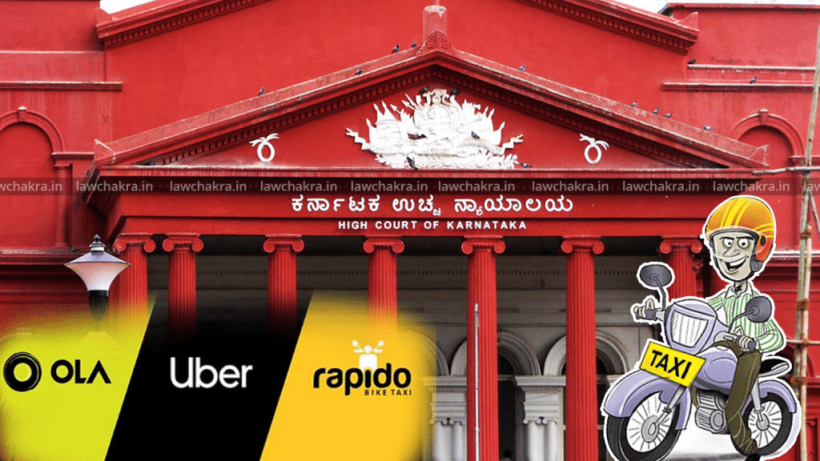
There's a detail buried in Karnataka's Supreme Court filing that should make any founder pause. Even as the state government challenges the High Court ruling that permitted bike taxis, it's reportedly considering a separate policy to legalise bike taxi services altogether. A senior state official has said the special leave petition addresses only technical flaws in the judgment and doesn't prevent the government from eventually framing a policy. In other words: Karnataka is fighting in India's highest court to reverse a ruling it doesn't entirely disagree with. Inc42 Media
That's not a legal strategy. That's a government in conversation with itself while 600,000 riders wait for the outcome.
The Karnataka government filed its special leave petition on April 22, naming Ola parent ANI Technologies, Uber India, Rapido, and the Bike Taxi Welfare Association as respondents. The petition targets the January 23 High Court order from a division bench comprising Chief Justice Vibhu Bakhru and Justice C.M. Joshi, which had done something straightforward: it told the state that it couldn't deny permits to motorcycles simply because they were motorcycles. Inc42 Media
The constitutional reasoning was blunt. The bench held that bike taxi services were neither inherently dangerous nor illegal, and that operating taxis constitutes a legitimate business protected under Article 19(1)(g) of the Constitution—the fundamental right to trade. The court directed operators to apply for registration as transport vehicles or contract carriages with yellow number plates. It also clarified that while the state is free to regulate bike taxis and impose conditions under Section 74(2) of the Motor Vehicles Act, 1988, it cannot reject applications solely on the ground that the vehicle is a motorcycle. Inc42 MediaBar and Bench
For the aggregators—Ola, Uber, and Rapido—this was a genuine win. For the riders who'd been off the road since June 2025, it was oxygen.
Seven Years of Circles
The appeal arrived nearly three months after that High Court ruling, and the dispute itself stretches back to 2019, when aggregators began facing regulatory hurdles as Karnataka either rejected licence requests or refused to process them. The story since then has been one of judicial ping-pong. A single-judge bench in April 2025 ordered all bike taxi services to halt until the state framed specific rules. Services run by Ola, Uber, and Rapido were suspended from June 2025 after the court declined to stay that ban. Then the Division Bench reversed it in January 2026. Now Karnataka's at the Supreme Court. Bar and BenchDriveSpark
This is a cycle that should feel familiar to founders building in regulated verticals anywhere: you get a favourable ruling, you invest in supply-side growth, and then the government appeals. Operational certainty never quite arrives.
"We have 5 million captains earning their livelihoods on Rapido. Bike taxis are the future of affordable urban mobility in India. The regulations will catch up to the reality on the ground." — Aravind Sanka, Co-founder & CEO, Rapido
The problem is that "the regulations will catch up" has been the operative theory for the better part of a decade—and in Karnataka, they haven't.
What's Actually at Stake
The January High Court order had brought relief to nearly 6 lakh bike taxi riders and aggregators, whose services had remained paused due to legal turmoil since April 2025. The Bike Taxi Welfare Association wrote to Chief Minister Siddaramaiah on April 21, expressing concerns over policy delays and stating that the uncertainty had pushed riders into "a state of despair." Inc42 MediaInc42 Media
The numbers behind that despair are significant. By mid-2025, Rapido was completing 3.3 million rides every day across bikes, autos, and cabs, with more than half of those on motorcycles. Rapido held a 56% share of the bike taxi market by 2024, with 31.8 million monthly active users—closing in on Uber's 33.6 million and surpassing Ola's 28.6 million. This is not a niche product. It's a mainstream mobility platform whose core category—the one that built its user base and made it a unicorn—remains legally contested in its home state of Karnataka, which includes Bengaluru, the city where Rapido was founded. SubstackMotilal Oswal
India's taxi market is projected at $23.98 billion in 2026, growing toward $34.87 billion by 2031, according to Mordor Intelligence. Two-wheeler mobility sits at the cheap, high-frequency end of that market—exactly the segment that serves gig workers, students, and anyone who can't afford or doesn't want a ₹250 cab ride when a ₹50 bike ride does the job twice a day.
The Global Comparison Is Uncomfortable
Internationally, the trajectory for motorcycle taxi regulation has generally moved toward formalisation, not back toward prohibition—and India's fragmented state-by-state approach looks increasingly unusual against that backdrop.
Indonesia requires platforms like Gojek and GrabBike to operate under Ministry of Transportation rules covering driver licensing, annual vehicle inspections, and trip data sharing with the government. The Philippines has integrated services like Angkas into national public transport policy. Thailand enforces strict licensing with uniform codes for bike taxi drivers. Vietnam integrates GrabBike into its urban transport plans. These aren't perfect frameworks—safety records remain inconsistent, and as anyone who's watched Vietnam's Hanoi petrol-motorbike ban drama knows, governments in the region still make abrupt, politically charged transport decisions. But the underlying direction is toward rules that allow the business, not rules that treat a vehicle type as inherently suspect. Livelaw India
According to a 2022 NITI Aayog report, 76% of vehicles in India are two-wheelers—which means the country's most common vehicle is the one its regulatory system hasn't figured out how to accommodate as commercial transport. Meanwhile, bike taxis emit 60% less CO₂ than diesel autos, according to environmental studies by KPMG India. If you're building a climate policy alongside a mobility policy, that's not an incidental detail. Livelaw IndiaLivelaw India
The Contrarian Read
Here's what most coverage of this case misses: Karnataka's government might not be entirely wrong, even if its tactics are counterproductive.
Karnataka's SLP argues the Division Bench's order undermines the state's discretion to refuse contract carriage permits under Section 74(1) of the Motor Vehicles Act, 1988. That's a technical legal argument, but there's something substantively reasonable underneath it. India's two-wheeler road safety problem is real. In 2022, 44.5% of road fatalities in India involved two-wheelers. In Karnataka alone, dangerous infractions like wheelies more than doubled from 341 in 2023 to 775 in early 2025. A state government that wants insurance frameworks, fare regulation, and safety standards before it issues mass commercial permits isn't acting in bad faith—it's asking the same questions regulators in Bangkok and Manila had to answer before legalising the same business model. DriveSparkLivelaw India
The difference is that Karnataka has had seven years to write those rules and hasn't. The issue isn't the destination. It's the perpetual refusal to move.
The cynical reading—one that's hard to fully dismiss—is that auto-rickshaw unions, which have historically opposed bike taxi legalisation in Karnataka, are a political constituency that no state government particularly wants to antagonise. Regulatory paralysis can be a feature, not a bug, when the incumbent transport operators have organised political leverage.
The Supreme Court Hearing Hasn't Been Listed Yet
The appeal has been filed and is yet to be listed for hearing before the apex court. That means the January High Court order technically stands—operators can apply for permits and operate. But given the state's active challenge, the practical reality is more ambiguous. Thousands of bike taxi operators across Karnataka were affected during the June-January suspension period, with multiple challans issued to riders operating through Ola, Uber, and Rapido during that time. Riders who've been on and off the road for years are unlikely to make major capital investments in their operations until there's something more durable than a High Court ruling that the state is actively fighting. Bar and BenchDriveSpark
For Rapido in particular, the Bengaluru situation is more than symbolically awkward. It's the company's home market, and its most technically advanced urban environment—exactly where platform density and last-mile metro integration should be easiest to build.
What to Watch
Whether the Supreme Court stays the High Court order when it lists the petition. A stay would immediately suspend bike taxi operations again; no stay allows the January ruling to remain in effect while the appeal is heard. That single procedural decision has more near-term impact on 600,000 riders than any policy announcement.
Karnataka's parallel policy process. Officials have indicated the SLP focuses only on technical legal flaws and doesn't foreclose future regulation. If the state tables a draft bike taxi policy in the next few months, it could render the Supreme Court petition moot—or it could become the regulatory framework that finally resolves seven years of legal ambiguity. Watch for any state cabinet-level movement on Motor Vehicles Act Section 93 compliance as a leading indicator. Inc42 Media
Whether the Centre intervenes. The Union government updated its Motor Vehicles Aggregator Guidelines in 2020 to permit bike taxis, but left implementation to individual states. If the Supreme Court hearing prompts any federal-level clarification on state versus central jurisdiction over two-wheeler permits, it could set a precedent that affects Maharashtra, Tamil Nadu, and every other state still running its own version of this fight.
The Karnataka case is ultimately a question that every founder building in a regulated market eventually has to answer: how do you operate at scale when the legal basis for your core product is actively contested? Rapido's answer has been to build anyway, fight every ban in court, and bet that 5 million captains earning livelihoods create enough political gravity to eventually force legalisation. It's not a comfortable strategy. But looking at the alternatives, it's hard to argue it was the wrong one.