There’s a version of the Ather Energy story that writes itself: a plucky Bengaluru startup founded by IIT graduates.. Hardware that rivals actually feared. A Hero MotoCorp-backed IPO that listed on BSE and NSE in May 2025 and gave early believers their moment. That story is real, and it's not wrong. But it's also not what's driving the numbers that landed on Monday, May 4.
Ather Energy's quarterly revenue went past Rs 1,000 crore in Q4 FY26 — revenue from operations hit Rs 1,174.66 crore, up 74% from Rs 676.8 crore in the same quarter a year earlier. The company delivered 83,418 units in the quarter, up 76% year-on-year, while EBITDA losses shrank to just Rs 30 crore — a 2,080 basis point improvement year-on-year. The net loss narrowed 57% to Rs 100 crore. These aren't incremental gains on a good quarter. This is a company that looks structurally different from what it was twelve months ago.
The question worth asking — the one the press releases don't answer — is why. And the answer is uncomfortable for anyone who spent years celebrating Ather as India's answer to a premium, design-led EV brand.
The Rizta happened.
The Product That Ate the Company
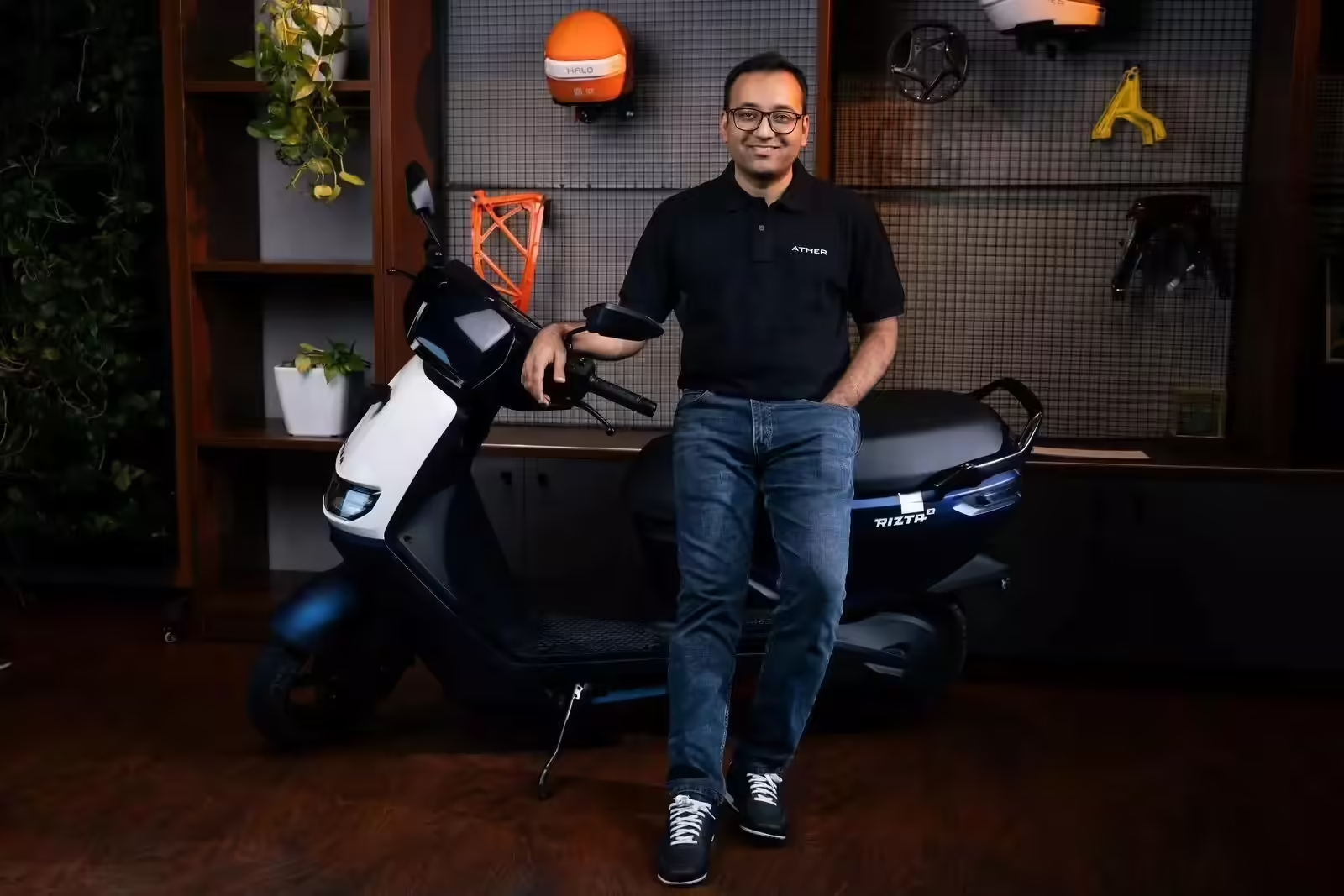
Launched in April 2024, the Ather Rizta family scooter now accounts for over 70% of the company's total sales. Seventy percent. One product, introduced less than two years ago, generating more than two-thirds of volumes at a company that had spent six years building its identity around the 450 series. That's not a product addition. That's a strategic pivot that succeeded so thoroughly it reshaped what Ather actually is. Thrust Zone
The Rizta is not a performance machine. It doesn't have the 450X's sporty geometry or its 0-40 kmph sprint time. What it has is 56 litres of total storage space, the largest seat in its segment, a frunk, SkidControl, and an IDC range of up to 159 km. It has a Battery-as-a-Service option that drops the Rizta S's effective upfront cost to Rs 76,000 — making a premium-brand scooter accessible to buyers who'd never have wandered into an Ather Experience Centre before.
It has, in short, everything a family in Lucknow or Indore actually needs from a scooter, and nothing they don't.
The geographic data tells the real story. Between Q1 FY26 and Q3 FY26, Ather's market share in Madhya Pradesh and Chhattisgarh grew from 7% to 14%, Punjab from 8% to 15%, and Uttar Pradesh from 4% to 10%. These aren't Ather's historical strongholds. South India — Bengaluru, Chennai, Hyderabad — was where Ather was born and bred. By Q4 FY26, Middle India's market share had risen to 17.3%, up from 9.5% a year earlier, while Rest of India grew to 12.1% from 6.5%. The company didn't just grow. It moved, geographically and demographically, into markets that legacy ICE players had considered their permanent territory. India.comElectrical Mirror
"Rizta helped us unlock a much larger addressable market, and with that, we expanded our retail network. That demand translated into strong volume growth and better unit economics."
— Tarun Mehta, Co-founder & CEO, Ather Energy
Mehta's been saying some version of this since the Rizta launched, and you could be forgiven for treating it as founder optimism at the time. It wasn't. Ather doubled its retail network during FY26, ending the year with 700 Experience Centres, up from 351 at the end of FY25. The service network nearly doubled in parallel. You can't scale distribution like that without a product that actually pulls people into new markets — and the Rizta was that product.
The numbers that matter most from Q4 FY26 and the full year:
Q4 revenue from operations: Rs 1,174.66 crore (+74% YoY)
Q4 units delivered: 83,418 (+76% YoY)
Q4 net loss: Rs 100.23 crore (vs Rs 234.36 crore a year ago)
Q4 adjusted gross margin: 25% (vs 18% in Q4 FY25)
FY26 full-year revenue from operations: Rs 3,671.76 crore (vs Rs 2,255.01 crore in FY25)
FY26 full-year net loss: Rs 517.17 crore (vs Rs 812.28 crore)
FY26 EBITDA loss: Rs 257 crore (vs Rs 531 crore in FY25)
National market share, Q4 FY26: 18.6%
One figure that doesn't get enough attention: 93% of customers in Q4 opted for AtherStack Pro, Ather's software subscription layer. That's the embedded thesis of the whole business — that hardware volume is a distribution mechanism for recurring software revenue — playing out in real-time. A mass-market family scooter customer opting into a premium software pack is not a trivial result. That's a business model working as designed.
Why This Matters Beyond India
India's electric two-wheeler market is one of the largest and fastest-growing in the world, and it operates by its own logic. Total electric two-wheeler sales reached 1.4 million units in FY2026 — a 21.8% year-on-year increase, according to industry data — with penetration now around 6.5% of the overall two-wheeler market. That sounds modest until you realize the total two-wheeler market in India runs at tens of millions of units annually, and ICE-to-EV conversion at scale is still early days.
The competitive context is brutal. TVS Motor led the segment in FY26 with 341,513 units and a 24.36% market share, followed by Bajaj Auto with 289,349 units. Ola Electric, once the volume leader, saw registrations fall to approximately 164,000 units in FY26 and revenue drop 55% year-on-year in Q3 FY26. Ather, at 18.6% national share in Q4, is now clearly the number-three player — and closing on number two in a way that TVS and Bajaj's legacy distribution advantages can't fully offset, because Ather's software attach rates and margin profile are categorically different from anything the legacy OEMs have built. Whalesbook
The broader lesson for founders building hardware companies in emerging markets isn't complicated: your premium brand is valuable precisely because of what it lets you do next. Ather's 450 series built the credibility and the engineering foundation. The Rizta is the product that monetises the addressable market those earlier products never reached. This is a playbook that maps onto electric motorcycles in Southeast Asia, affordable EVs in Latin America, or any market where a niche player needs to graduate into volume without destroying its brand.
The Skeptic's Corner
None of this means Ather's problems are solved. The company needs to sell roughly 50,000 units monthly to approach breakeven — a target it hasn't yet consistently met. Q4's 83,418 units over three months averages out to about 27,800 per month. That's real progress, but it's also a reminder that the path to profitability still requires another significant step-change in volume. Factory 3.0 at AURIC — Ather's new Maharashtra facility targeting 1 million units per annual capacity — is the structural bet on getting there, but it's not fully operational yet. Whalesbook
There's also a single-product concentration risk that the filing's buoyant tone somewhat obscures. The Rizta carrying 70%+ of volumes is a sign of product-market fit, not a sign of a diversified business. If the forthcoming EL platform stumbles at launch, or if TVS or Bajaj mount an aggressive pricing response in the family segment, Ather's momentum is more exposed than the headline numbers suggest.
And the sequential numbers — losses actually widened from Rs 84.6 crore in Q3 to Rs 100.2 crore in Q4 — are a quiet reminder that scaling costs money, and Ather's cost structure isn't done compressing.
Three things to watch from here:
EL platform execution. Mehta explicitly flagged the new EL scooter platform as the vehicle for Ather's next growth phase — "the biggest total addressable market in the Indian E2W segment." When it launches, watch the price point and the BaaS adoption rate. If it pulls the same software attach numbers as Rizta, the unit economics story gets materially better.
AURIC factory ramp. The AURIC plant is expected to be fully operational before the end of FY27, with a monthly capacity of 42,000 units. That's the production lever that closes the gap between current volumes and breakeven. Delays here would be the most consequential risk to the FY27 narrative.
Non-vehicle revenue disclosure. Software subscriptions and charging already contribute 14% of total income. If Ather begins reporting this segment separately with margin data attached, analysts will reprice the stock. Watch for that disclosure to become a deliberate investor communication choice — because when it happens, it signals the company thinks the numbers are ready to be seen.
Ather Energy quarterly revenue going past Rs 1,000 crore in Q4 is a milestone, but milestones are just coordinates. What's more interesting is the strategic logic underneath: a company that built its brand on performance and technology used those assets to credentialise a mass-market product that could never have launched without them — and is now running faster in Middle India than anyone in Bengaluru expected. The Rizta didn't save Ather. It proved that the first eight years actually worked.