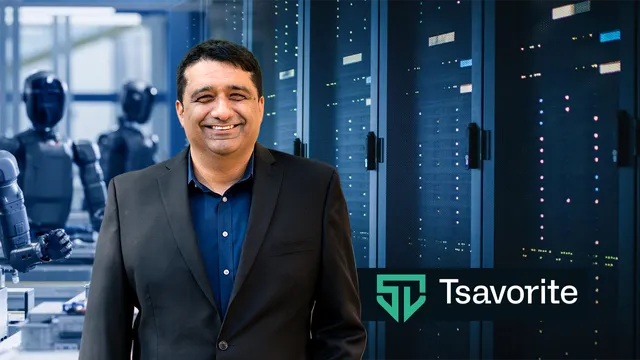
Here's a number that stops you mid-scroll: $100 million. That's how much Tsavorite Scalable Intelligence claims in pre-orders for a chip that hasn't gone into mass production yet. The Milpitas, California-headquartered startup — with a design centre anchoring its engineering work in Bengaluru — disclosed those orders when it unveiled its Omni Processing Unit last November. On May 4, 2026, it added another data point: a fresh $5 million from Hyderabad-based Pavestone VC, bringing renewed attention to what Tsavorite raises funds to do next.
This isn't a massive round. In a sector where Rebellions just raised $200 million and Axelera AI crossed $200 million in cumulative funding, $5 million looks like a footnote. But dismiss it too quickly and you'll miss what it actually signals — both about Tsavorite's momentum and about where Indian deep-tech capital is placing its bets.
What Tsavorite Is Actually Building
Start with the hardware. Tsavorite's core offering is an Omni Processing Unit (OPU), a chip architecture that integrates CPU, GPU, memory, and connectivity into a single system to improve performance and reduce data movement. That architectural decision — integration over disaggregation — is the central wager the company is making against the incumbent approach of stacking separate compute and memory components together, then drowning in the latency and power costs of moving data between them. Dailyhunt
The OPU is built on ARM Neoverse and Tsavorite's proprietary MultiPlexus fabric — an interconnect that spans from die to rack, offering petabyte-scale bandwidth and gigabyte-scale caches with ultra-low latency. The chiplet architecture is composable, meaning the same underlying design can be configured differently for edge deployments, on-premises enterprise use, or large-scale data centre workloads. Think of it as LEGO blocks for AI compute: modular, recombinable, and theoretically future-proof in a way that monolithic chip designs simply aren't. Tsavorite
The software layer matters as much as the silicon. Tsavorite also offers an integrated software layer — its Agentic Operating Stack (TAOS) — that enables developers to deploy AI models without rewriting code or relying on proprietary dependencies. TAOS natively supports PyTorch, vLLM, Triton, HuggingFace, Ray, and Kubernetes. In plain terms: if your team has CUDA-optimised workflows running on Nvidia hardware today, Tsavorite is promising a migration path without a code rewrite. That's not a trivial offer. CUDA lock-in is one of Nvidia's most durable competitive moats, and any credible challenger has to solve for it. Dailyhunt
Early performance data claims gains of 90% lower power and cost, though the company hasn't provided detailed benchmarks to validate these results against specific competitors. That caveat matters. Pre-production performance claims in the semiconductor industry need to be treated with appropriate scepticism — the gap between architectural promises and silicon reality has ended more than a few ambitious chip startups. Data Center Dynamics
The Case Pavestone Is Making
Pavestone VC invests through its Rs 816-crore technology fund, with a deliberate focus on early growth-stage B2B startups that have demonstrated meaningful product-market fit and early enterprise adoption. This isn't a fund chasing hype. Their portfolio is concentrated in foundational B2B technology, and backing a semiconductor startup at this stage represents a calculated read on where AI infrastructure capital is heading.
"Tsavorite is developing a differentiated, full-stack AI compute platform designed to address the growing need for power-efficient, scalable, and enterprise-ready systems. The company has already demonstrated meaningful market validation through strategic customers, ecosystem partnerships, and pre-orders that collectively exceed $100 million in value."
— Sridhar Rampalli, Managing Partner, Pavestone VC
Rampalli's framing is worth unpacking. He's not just backing a chip. He's backing a validated commercial position: customers — reportedly including Fortune Global 500 companies, sovereign cloud providers, and systems integrators across the US, Asia, and Europe — have placed advance commitments before production silicon exists. That's either extraordinary market conviction in Tsavorite's architecture, or a sign that enterprises are so desperate to diversify away from Nvidia dependency that they'll pre-order alternatives at scale. Probably both.
The Global Context Tsavorite Is Navigating
The AI chip market's structural shift is real and accelerating. India's AI chip ecosystem saw an injection of $410 million from venture and strategic capital sources in 2025 — a number that would have been inconceivable three years ago, when the country's semiconductor ambitions were more policy document than funded reality. The India Semiconductor Mission, launched in 2021, has since catalysed both domestic investment and foreign interest, and the Bengaluru design centre model — where companies like Tsavorite run high-value engineering work at a cost structure impossible to replicate in Silicon Valley — is now a well-worn playbook. SQ Magazine
Globally, the pressure on Nvidia's dominance is intensifying from multiple directions simultaneously. AMD's MI300 series is genuinely competitive for certain training workloads. AWS Trainium and Google TPUs are pulling hyperscaler spend away from third-party GPU providers. Tenstorrent, led by chip legend Jim Keller, is attacking the inference market from a clean-sheet architectural perspective. And in Asia, Korean startups like Rebellions have raised hundreds of millions and are moving toward volume production on Samsung's foundry nodes.
Tsavorite's position within this crowd is specific: it's targeting the gap between edge efficiency and data centre scale with a unified architecture that doesn't force customers to buy separate hardware for different deployment environments. Whether enabling Physical AI at the edge, Agentic AI in enterprise systems, or foundation model training in the cloud, the OPU is designed to deliver one consistent architecture across all three. That's a larger addressable market claim than most chip startups make — and a proportionally larger execution challenge.
One early adopter in the ecosystem has already raised its hand: Eviden SAS, a subsidiary of server maker Atos SE, has committed to leveraging Tsavorite's OPU to enhance performance across AI training, inference, and agentic workflows. Sumitomo Corporation is also in the partner mix, citing Tsavorite's architecture as a building block for sustainable AI infrastructure. Samsung Electronics is manufacturing the OPU on its advanced SF4X platform. These aren't random names. They're strategic validators, and in deep-tech hardware, strategic validators are worth more than press releases.
The Funding Math and What It Reveals
Here's what the capital stack tells you about where Tsavorite actually is.
Tsavorite secured $17.9 million in a Series B round on February 14, 2025. The new $5 million from Pavestone follows that round, making total disclosed capital somewhere in the range of $23 million. That's lean for a full-stack semiconductor company targeting hyperscale data centres and edge deployments simultaneously. Building a chip from architecture to production silicon to packaged appliance is brutally capital-intensive — Intel burned through billions developing Gaudi, and even well-funded startups like Groq needed nine-figure rounds to get to market. Indian Startup Times
The $5 million raise from Pavestone reads less like a growth round and more like a strategic milestone — a bridge to production silicon, potentially structured to preserve runway while the company converts pre-orders to signed contracts and moves toward tape-out. Tsavorite plans to use the funds to step up product development and expand its footprint as it taps rising demand for AI infrastructure. The Bengaluru design centre, specifically, is where Tsavorite is building the hardware and software stack in parallel — a structural advantage over pure-play US chip companies that can't replicate that cost profile. Inc42 Media
Where the Scepticism Lives
There's an honest version of the Tsavorite story that includes harder questions. The $100 million in pre-orders is self-reported and unverified by any third party — and in the semiconductor industry, pre-orders can dissolve as quickly as they materialise if production timelines slip or competitive alternatives improve. Tsavorite hasn't named a single customer publicly.
The CUDA software moat that TAOS promises to address is real, but it's also been the graveyard of multiple would-be Nvidia challengers. Promising zero-code-change migration is easy to say. Delivering it across the full complexity of real production AI workloads — with all their edge cases, custom kernels, and performance-tuned code — is another matter entirely.
And $23 million in total raised capital is a tight budget for what Tsavorite is attempting. Either a much larger round is coming, or the company has structured its architecture to reach a revenue-generating milestone before it needs to raise again. Shalesh Thusoo and his team — veterans of Intel and the broader semiconductor industry — understand this constraint better than any outside observer does. The question is whether the $100 million in pre-orders converts to cash before the runway demands a decision.
What Founders and Operators Should Watch For
The indicators that will tell you whether Tsavorite's bet is paying off:
First silicon delivery. Tsavorite has flagged production silicon and Helix AI appliances as 2026 milestones. Slippage here — even a quarter — will be a meaningful signal in an industry that punishes schedule misses hard.
Named customer disclosure. When Fortune Global 500 companies and sovereign cloud providers go from "strategic customers" to named references, the pre-order pipeline's credibility transforms. Watch for that shift in any subsequent funding announcement or conference appearance.
A Series C or strategic investment from a major OEM. Sumitomo and Samsung are already in the partner ecosystem. A capital relationship with either, or with a hyperscaler, would confirm that Tsavorite has passed the architectural credibility threshold that separates viable challengers from ambitious also-rans.
The global AI compute infrastructure market is large enough to support more than one winner, and the energy efficiency imperative is real — data centres are running into power constraints that Nvidia's current GPU architectures only partially address. Tsavorite raises funds with a specific answer to that problem: a composable, integrated architecture that reduces data movement, slashes power draw, and runs existing AI code without modification.
Whether the OPU delivers on those claims in production is the only question that matters now. The pre-orders, the partnerships, and the Pavestone capital are all table stakes. Silicon is the proof.