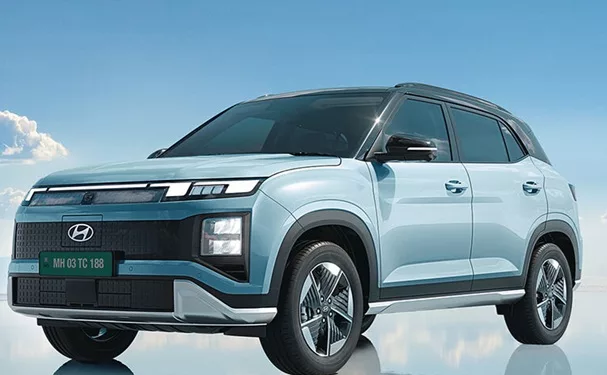
The IONIQ V looks like the future. But Beijing Hyundai sold just 125,726 vehicles in all of 2025. Twenty new models won't fix a distribution problem — or a trust deficit.
When Hyundai CEO José Muñoz took the stage at Auto China 2026 in Beijing last Thursday and declared this "the most committed, the most ambitious, and the most exciting chapter we have ever written in this market," he wasn't wrong about the ambition. The question is whether ambition is what China's EV buyers are currently shopping for.
The plan is real, the money is committed, and the car is genuinely striking. But the math underneath is brutal.
What Hyundai and BAIC Are Actually Announcing
Strip the press release language, and the deal is this: Hyundai and its joint venture partner BAIC Group (Beijing Automotive Group) have committed a combined 8 billion yuan — roughly $1.1 billion — to Beijing Hyundai under an agreement signed in December 2024. The money funds a five-year roadmap of 20 new models spanning battery electric vehicles (BEVs) and extended-range electric vehicles (EREVs), targeting 500,000 annual sales by 2030.
The first physical product of that plan is the IONIQ V, unveiled at Auto China 2026 on April 24. It's a liftback EV built specifically for China — not adapted from a global model, but designed from the ground up for Chinese buyers. The specs are credible: 800V platform, CATL battery pack, over 600 km of range on the CLTC standard, and a 27-inch 4K display running on a Qualcomm Snapdragon 8295 chipset. The ADAS stack is powered by Momenta, the Chinese autonomous driving startup backed by Toyota, Bosch, and Mercedes-Benz. Hyundai is calling it the first dedicated IONIQ production model for China, and introducing a new design language — "The Origin" — that deliberately distances it from the angular aesthetic of the global IONIQ 5 and IONIQ 6.
It's a considered product. That part isn't in dispute.
Why 500,000 Units by 2030 Deserves Scrutiny
Beijing Hyundai sold 125,726 vehicles across all of China in 2025. The 500,000-unit target by 2030 requires multiplying that figure by almost four in five years, inside a market where Chinese brands now account for 68.8% of domestic passenger vehicle sales — up from 36% in 2020. That's not a headwind. That's a structural realignment.
The competitive context for any foreign brand entering China's EV segment today is grim in a way that quarterly data understates. NEVs surpassed ICE passenger vehicle sales in China for the first time in 2025. Through August, NEVs accounted for 51% of passenger vehicle sales and rising. BYD commands roughly 29% of the NEV market alone. Geely, SAIC, and Chang'an collectively hold another 26%. Tesla — the only foreign brand with a real foothold — has been losing share consistently, dropping from over 7% in 2024 to closer to 5–6% in 2025.
Foreign OEMs as a category have lost one-third of their market share since 2020. German brands fell 6–8% year-on-year through mid-2025. Japanese brands dropped 5–7%. Not individual companies — entire national fleets. The industry research firm Automobility describes China's NEV market as a place "where China's auto market is no longer the friendly exchange-student program it once was."
Hyundai is walking into this.
"China is where the future of mobility is being defined, and Hyundai intends to help define it — In China, For China, and ultimately, for the world." — José Muñoz, President and CEO, Hyundai Motor Company
That last clause is the tell. "For the world" suggests Hyundai's China strategy isn't purely about China. It's about using China as a development pressure cooker — a market so competitive that anything built to succeed there becomes globally hardened. That's a legitimate strategic frame. It's also a convenient one if the domestic China numbers disappoint.
The EREV Pivot Is Smart. The Timing Is Late.
One of the more strategically interesting elements of Hyundai's 20-model roadmap is the inclusion of EREVs alongside BEVs. This isn't Hyundai adapting to Chinese consumer preferences — it's Hyundai catching up to them.
EREVs — vehicles where a small combustion engine acts only as a generator, never directly driving the wheels — have become the fastest-growing propulsion format in China's NEV market. They appeal to buyers with genuine range anxiety about pure BEVs in a country where charging infrastructure, despite rapid expansion, remains uneven outside Tier-1 cities. Li Auto and Huawei's AITO/Seres brand have built entire brand identities around the format. Li Auto's L-series SUVs have exceeded 1 million cumulative sales. The EREV global market is projected to grow at a 20%+ CAGR through 2034.
Hyundai seeing EREVs is correct. But Li Auto commercialized the format in China at scale in 2019. Huawei's automotive division weaponized it into a premium positioning tool by 2022. Hyundai's EREV products, if the timeline holds, start arriving in meaningful numbers by 2027. In a market where Chinese OEMs release new models at something close to smartphone refresh cycles — often updating software, range, and price within 12 months of launch — a 2027 EREV from Hyundai will be entering a category that its competitors have already iterated three generations into.
The EREV move is right. The question is whether "right" in 2026 is the same as "competitive" in 2027.
What Hyundai Actually Has That BYD Doesn't
Here's the contrarian read: Hyundai's biggest asset in China isn't its cars. It's its passport.
Chinese EV brands are hitting walls abroad. The EU imposed tariffs of up to 35.3% on Chinese EVs. The US effectively closed its market with tariffs exceeding 100%. Even Southeast Asian nations are introducing local content requirements and recycling fees that complicate pure export strategies. BYD, Geely, NIO, and Xpeng are scrambling to build local manufacturing in Thailand, Hungary, Brazil — precisely because their China-made vehicles face escalating friction at borders.
Hyundai, as a South Korean multinational with manufacturing in the US (Georgia), Europe, India, and Southeast Asia, moves across trade zones that Chinese OEMs can't. The "In China, For China, To Global" framing isn't just corporate rhetoric — it's a genuine supply chain advantage. If Hyundai can develop competitive EV and EREV technology in China's brutal pressure-test environment, then produce those vehicles in Korean or US facilities for non-restricted markets, it captures the innovation velocity of the Chinese market without the tariff exposure of a Chinese brand.
That's a plausible strategy. Volkswagen has been attempting a version of it through its Xpeng partnership and its Hefei R&D center, which the German automaker says can now complete the full vehicle development and approval cycle locally. The logic isn't flawed. Execution at volume, in a market with this competitive density, is where strategies go to die.
The Software Problem Nobody in the Press Release Mentioned
The IONIQ V ships with an LLM-based Smart AI Assistant running on a Qualcomm Snapdragon 8295 — the same chipset used in several Chinese EVs including vehicles from XPeng and the Huawei AITO lineup. That's table stakes in China in 2026, not a differentiator.
The deeper question is whether Hyundai's software stack can iterate fast enough to match the update cadence that Chinese consumers have been trained to expect. BYD and Xpeng push over-the-air updates that meaningfully change range, charging behavior, and ADAS performance — sometimes monthly. NIO's battery swap network is an ongoing service improvement, not a static feature. Xiaomi, which sold 48,654 EVs in October 2025 alone in its first full year of production, treats its EV as a mobile software platform with four wheels.
Hyundai's partnership with Momenta for ADAS is smart — Momenta is one of China's most credible autonomous driving companies, backed by Toyota, Bosch, and Mercedes, and it understands the localization challenge. But software supply chain relationships aren't the same as owned software velocity. Volkswagen's painful lesson in China over the past five years has been precisely that: you can partner with the right local tech firms and still move too slowly because the integration, QA, and deployment cycles of a traditional OEM don't match the pace of a tech company building cars.
Whether Hyundai has solved this internally is unknown. The press release didn't address it.
Who Wins, Who Loses, What to Watch
The winners in the short term are CATL, Momenta, and Qualcomm. CATL supplies the batteries for the IONIQ V and will presumably supply much of the 20-model roadmap — locking in revenue from a committed foreign OEM buyer during a period when Chinese brands are increasingly exploring in-house battery development. Momenta gets a global OEM validation client that enhances its credibility beyond China. Qualcomm continues its vehicle SoC penetration strategy.
The losers in the near term are foreign component suppliers that previously relied on legacy Hyundai architecture without localized alternatives. The "In China, For China" supply chain means Hyundai is localizing procurement, which will consolidate spend toward Chinese Tier-1 suppliers.
For Indian and Southeast Asian markets specifically: if Hyundai succeeds in developing cost-competitive EREV platforms in China, those products become strong candidates for markets where Hyundai already has manufacturing infrastructure — India's Talegaon plant, the Indonesian operation — and where range anxiety is even more pronounced than in China due to patchy charging networks.
Three things to watch over the next 18 months:
Pricing of the IONIQ V at launch. Hyundai has range and design. China has price wars. The IONIQ V enters a segment where BYD, NIO, and Li Auto are all competing on price. If Hyundai prices the IONIQ V above 250,000 yuan without a substantially differentiated service proposition, the 500,000-unit target is fiction.
The BAIC side of this equation. BAIC Group isn't a passive partner — it's a state-affiliated automaker with its own EV ambitions through BJEV (Beijing Electric Vehicle Co.), which doubled October 2025 sales year-on-year. The joint venture structure means Hyundai's success is partially contingent on BAIC's willingness to prioritize it over its own expanding NEV lines. That alignment isn't guaranteed.
Software update velocity post-launch. The first OTA update schedule for the IONIQ V will tell you more about Hyundai's real software ambitions in China than any press release. Monthly updates mean they're building a tech company. Quarterly updates mean they're still an automaker.