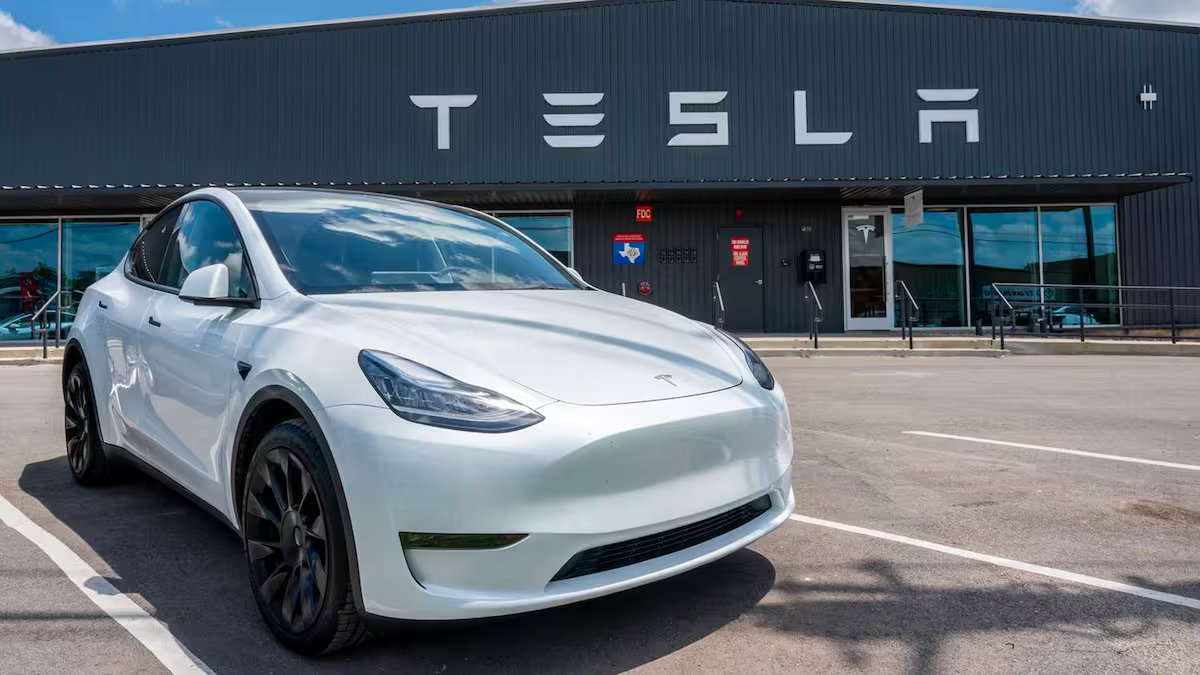
Tesla sold over 20,000 units in South Korea between January and March 2026, a surge of more than 335% year-over-year, surpassing both BMW and Mercedes-Benz to become the country's top-selling imported car brand for the first time in a quarterly measure. TechStory In March alone, Tesla sold 11,130 vehicles — becoming the first single imported brand to break the 10,000-unit monthly sales barrier in the country's history. TechStory
The word "American" is doing a lot of work in that sentence, and it's the work worth questioning.
The Shanghai factory is the story
The biggest driver of growth for China-made EVs in South Korea is not a Chinese brand but Tesla, whose Shanghai-built models have become increasingly popular. INDmoney Every Tesla sold in South Korea this quarter came off the Giga Shanghai production line. The Model Y Juniper — the refreshed version of Tesla's bestselling crossover — is built in China with LFP (lithium iron phosphate) battery cells, shipped to Korea, and sold at prices engineered specifically to land just under South Korea's subsidy eligibility caps.
The 2026 Model 3 RWD was priced at 49.9 million won — just under the 53 million won national EV subsidy cap for full eligibility. With local government top-ups, buyers could bring their out-of-pocket cost down to between 37 and 39 million won. Tracxn That's the price of a well-specced Hyundai Sonata, for a car that a year ago cost 20 million won more. Tesla didn't stumble into this pricing. Someone at Fremont or Austin ran the Korean subsidy tables and reverse-engineered the retail price from the desired post-subsidy number. That's disciplined market entry, not lucky timing.
From 2023, Tesla largely shifted to importing Model Y vehicles manufactured in China instead of the US and lowered prices by about 4 million won from the previous year's starting price of 56.99 million won. IPO Scanner The price cut and the manufacturing shift happened simultaneously and are inseparable. Giga Shanghai's cost structure — lower labour, integrated supply chain, proximity to Korean ports — is what made the price cut possible. Tesla sells an American brand powered by Chinese manufacturing economics. In South Korea, that combination is currently unbeatable.
What the market data actually shows — and why it matters beyond Korea
New electric vehicle registrations in South Korea surpassed 220,000 units in 2025, a surge of over 50% compared to the previous year. The EV penetration rate reached 13.1% — crossing the double-digit threshold for the first time. The market share of imported EVs rose to 42.8%, while the share of Korean-made EVs fell from 75% in 2022 to 57.2%. Chittorgarh
Those four numbers together tell a coherent story. South Korea's EV market grew 50% in a year. Nearly half of all EVs sold were imports. Chinese-manufactured vehicles — overwhelmingly Tesla, with BYD and Polestar as secondary players — drove most of that import growth. And Hyundai and Kia, the domestic giants that built South Korea's auto reputation, are losing ground in their home market.
33.9% — the market share of EVs manufactured in China in South Korea's total EV market in 2025, up from 4.7% in 2022. That's not a trend. That's a restructuring.
The global dimension here is specific and uncomfortable for Western automakers. South Korea is one of the most technically sophisticated auto markets in the world, with consumers who understand EVs, a mature charging infrastructure, and domestic manufacturers capable of world-class products. If Hyundai and Kia are losing EV share at home to Chinese-manufactured vehicles, the argument that Chinese EV competitiveness is a developing-market story falls apart completely. It's not. This is happening in Seoul.
"Most Chinese firms have identified overseas expansion as a growth pillar of 2026, in light of slowing EV demand at home. South Korea is certainly one of the target markets."
— Xu Tianchen, Senior Economist, Economist Intelligence Unit
BYD is still small in Korea — 3,968 units in Q1 2026 TechStory versus Tesla's 20,964. But BYD's trajectory matters more than its current volume. It entered South Korea's passenger car market only in January 2025, established its dealer network during the year, and is already ranking fourth among imported brands on a monthly basis. The first year is always about awareness and infrastructure. The second year is where Chinese brands in new markets typically accelerate hard.
Xpeng and Zeekr have both signed initial dealer agreements in South Korea. They're still rounding errors in the sales data. In three years, neither may be.
The subsidy architecture that made Q1 2026 possible
The South Korean government confirmed EV purchase subsidies in January 2026 — earlier than the typical schedule. That early clarity eliminated buyer hesitation that usually suppresses Q1 EV sales while consumers wait to see if subsidies will be renewed. Tracxn Tesla, with inventory staged and prices already optimised for subsidy eligibility, captured that pent-up demand almost entirely.
Passenger EV subsidies in South Korea are set to rise from 780 billion won in 2025 to 936 billion won in 2026, aiming to boost local demand. Inc42 Media More subsidy money, earlier confirmation, and a Tesla price point engineered to maximum subsidy capture. That's not market magic. That's execution.
The Korea Automobile and Mobility Association — KAMA, the body that represents domestic manufacturers — was notably cautious in its assessment of the 2025 surge. It characterised the rebound as "more a result of the combination of specific model popularity and policy support, rather than the full-scale popularisation of EVs or a structural change in demand." Read that as institutional anxiety. When a domestic industry group hedges its interpretation of a market surge by calling it temporary, it's usually because the people inside the industry see something concerning that the data hasn't yet fully captured.
Skeptic's corner
Tesla's Q1 2026 performance was, to a meaningful degree, a timing play. Subsidies confirmed early, oil prices elevated due to Middle East tensions (which pushed consumers toward lower running cost vehicles), and the Juniper model refresh creating a concentrated demand wave. Sustain those three conditions simultaneously throughout 2026 and Tesla holds its position. Remove any one of them and the quarter looks more like a spike than a trend. The Korea Herald quoted an industry official warning exactly this: Tesla's strong performance "heavily relies on price cuts and specific temporal conditions." That's worth taking seriously, not dismissing.
The Hyundai and Kia problem is real
In 2025, Kia led South Korea's EV market with 60,609 units, followed closely by Tesla at 59,893 units and Hyundai at 55,461 units. Inc42 Media Kia is still number one. But Tesla and Kia are essentially tied on sales volume in a market where Kia has every conceivable home advantage — brand recognition, dealer network, service infrastructure, national loyalty. Tesla's brand recognition in Korea is now equal to Kia's in EVs, built entirely on one model made in China, with limited local service infrastructure, in a country that has historically run on domestic brand loyalty.
Hyundai Group's response is coming. Analysts expect 2026 to be a year of counter-offensive measures from domestic brands, with refreshed lineups from Hyundai's Ioniq series and Kia's EV range, likely accompanied by aggressive marketing emphasising national industry support and service network superiority. INDmoney But counter-offensives against an opponent with Chinese cost structure and American brand cachet are difficult to price. Hyundai can't undercut Tesla's post-subsidy pricing without compressing its own margins to levels that don't work for a Korean manufacturer without Giga Shanghai's economics.
Three things to watch
Whether South Korea follows the EU's lead and introduces country-of-manufacture provisions in its EV subsidy framework — specifically designed to make Chinese-built vehicles subsidy-ineligible. This is the policy mechanism that would most directly threaten Tesla Korea's current model, and domestic industry pressure makes it increasingly likely.
BYD's second-year inflection. The Chinese automaker sold under 5,000 units in its first year. If it replicates what Tesla's trajectory looked like in year two — roughly doubling volume — it becomes a credible third competitor in a market currently structured as a Hyundai/Tesla duopoly in EVs.
The Model Y L launch. The six-seat, extended wheelbase Model Y L is priced at 64.99 million won and is generating significant showroom interest in South Korea. IPO Watch If Tesla can hold volume while trading up in price per unit, its Korean revenue growth will outpace unit growth — which is the sign of a brand that's done competing purely on price and started competing on aspiration.
Tesla's South Korea moment is real, significant, and instructive. But founders and operators reading this should be precise about what it actually proves. It doesn't prove that an American EV brand has cracked Asia. It proves that a Chinese manufacturing operation with American brand equity, subsidy-optimised pricing, and disciplined market timing can displace European luxury incumbents in a sophisticated economy.
The Shanghai factory won South Korea. Tesla just put its logo on the win.