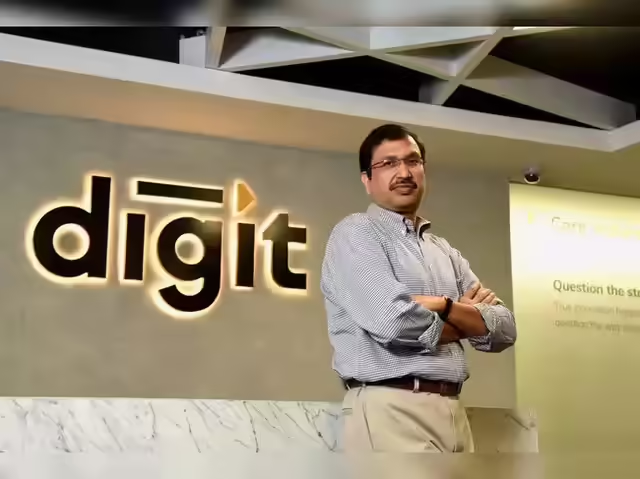
The company’s latest push suggests it is positioning itself not merely as a trading terminal but as a long-term financial services brand.
The Changing Retail Investor Landscape
India’s retail investor base has expanded dramatically over the past five years. Millions of first-time investors entered equity markets during pandemic-era liquidity surges and subsequent bull cycles.
However, user acquisition alone does not guarantee durable revenue. Active trading volumes fluctuate with market conditions. During volatile or bearish periods, transaction-based revenue models can weaken sharply.
This dynamic has pushed brokerage platforms to diversify into products such as wealth management, derivatives tools, portfolio analytics, margin financing, and educational services.
Dhan’s broader play appears aligned with this industry shift.
Competing in a Crowded Market
India’s online brokerage space has become intensely competitive, led by players such as Zerodha and Groww, alongside traditional brokers modernizing their digital offerings.
In such an environment, differentiation increasingly depends on product depth, technology integration, and ecosystem stickiness rather than simple pricing advantages.
Platforms that successfully layer additional services — from advisory to structured investment products — are better positioned to retain users through market cycles.
Dhan’s expansion strategy may be aimed at increasing lifetime customer value rather than short-term trading frequency.
Technology as a Competitive Lever
Modern retail investors expect real-time analytics, API-based integrations, algorithmic trading support, and advanced charting capabilities. Brokerage platforms must invest heavily in infrastructure to support high-frequency activity and derivatives trading.
Beyond execution capabilities, there is growing demand for portfolio intelligence — tools that provide actionable insights rather than raw data.
If Dhan’s expansion includes technology-led features or proprietary analytics, it could strengthen positioning among serious traders and semi-professional investors.
Revenue Diversification and Stability
Moving beyond brokerage can also stabilize revenue. Asset-based products, subscription services, and margin lending generate recurring income that is less dependent on daily market turnover.
As Indian markets mature, investors are likely to demand more sophisticated wealth management solutions, including goal-based investing and diversified asset allocation strategies.
Platforms that capture this shift early may build more resilient business models.
Regulatory Backdrop
India’s financial regulators have tightened oversight on derivatives exposure, margin requirements, and trading practices in recent years. Compliance costs have risen across the industry.
Diversifying revenue streams reduces reliance on segments that may face regulatory constraints.
For digital brokerages, aligning with evolving regulatory frameworks while innovating product offerings is a delicate balance.
The Broader Fintech Evolution
Globally, brokerage apps have evolved into financial super-apps. In the United States and Europe, retail platforms now integrate savings products, retirement accounts, crypto exposure, and credit tools.
India’s fintech sector is gradually following a similar trajectory, albeit within a distinct regulatory and consumer environment.
Dhan’s move suggests it recognizes that the future of brokerage lies not in execution alone, but in integrated financial engagement.
What It Signals
Dhan betting beyond brokerage is less about abandoning its core and more about reinforcing it with complementary layers.
The online trading market is no longer defined by transaction volume alone. It is increasingly shaped by ecosystem design, user retention, and diversified monetization.
If executed effectively, the strategy could elevate Dhan from a trading app to a broader financial platform.
In India’s rapidly evolving capital markets, staying a pure broker may no longer be enough.