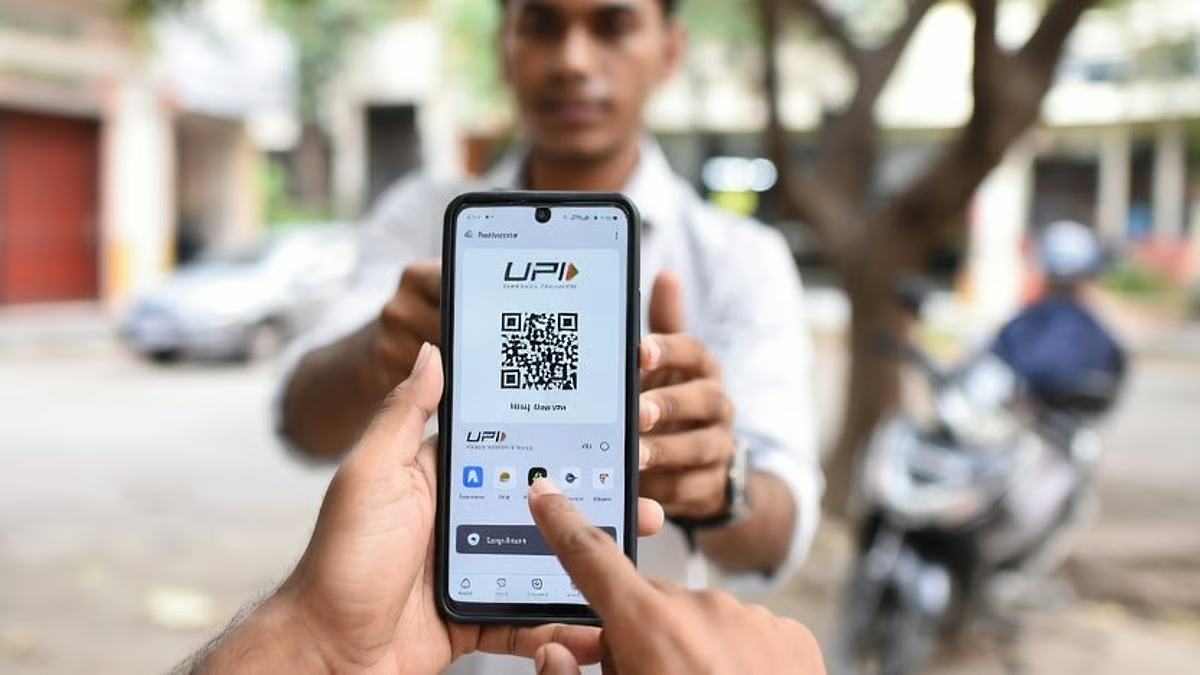
UPI at the Core of Daily Commerce
Launched by the National Payments Corporation of India (NPCI), Unified Payments Interface has transformed how individuals and businesses exchange money.
From street vendors and grocery stores to utility payments and peer-to-peer transfers, UPI now supports billions of low-value, high-frequency transactions.
Unlike traditional card-based systems, UPI enables:
• Instant bank-to-bank transfers
• QR-code-based merchant payments
• Interoperability across apps
• Minimal transaction friction
The result is a payments infrastructure built around micro-payments rather than large-ticket transfers.
The Rise of a Micro-Payments Economy
The scale of 22.8 billion transactions illustrates a broader behavioral shift. Indian consumers increasingly rely on digital payments for everyday purchases — often for amounts that would previously have been handled in cash.
This transformation is driven by:
• Smartphone penetration
• Low-cost mobile data
• Government-led digitization initiatives
• Merchant onboarding at scale
The micro-payments model has expanded financial inclusion while reducing dependence on physical currency.
For small merchants, digital payments have lowered entry barriers into formal financial systems.
Global Context: India’s Payments Edge
India’s UPI volumes significantly outpace many developed markets’ real-time payment systems.
While countries in Europe and North America are expanding instant payment rails, adoption levels remain lower in comparison. India’s success stems from a unified national infrastructure that integrates banks, fintech apps and merchants seamlessly.
Major fintech platforms such as PhonePe and Google Pay have scaled atop UPI rails, contributing to mass-market accessibility.
This public-private integration model has become a reference point for policymakers worldwide.
Implications for Fintech Startups
The growth of UPI presents both opportunity and constraint for fintech companies.
On one hand, open payment rails lower infrastructure costs and enable rapid product deployment. On the other, monetization remains challenging due to low transaction margins.
Startups are increasingly building value-added layers on top of UPI, including:
• Credit underwriting
• Buy-now-pay-later services
• Wealth management products
• Merchant analytics tools
In this ecosystem, the competitive advantage lies not in payments processing itself but in adjacent financial services.
From Volume to Value
While transaction volume is surging, average ticket sizes remain modest — reinforcing the “micro-payments economy” label.
The next phase of growth may center on:
• Cross-border UPI expansion
• Integration with digital lending
• International QR interoperability
• Offline payment capabilities
India has already begun exploring cross-border linkages with other payment systems, signaling ambitions beyond domestic dominance.
A Structural Shift in Commerce
UPI’s 22.8 billion transaction milestone is more than a headline figure. It reflects a fundamental reordering of commerce where digital payments are the default — not the alternative.
For global fintech observers, India offers a case study in how public digital infrastructure can catalyze mass-scale financial transformation.
As other economies debate digital payment frameworks, India’s micro-payments engine is already operating at planetary scale.
The country is no longer just digitizing transactions.