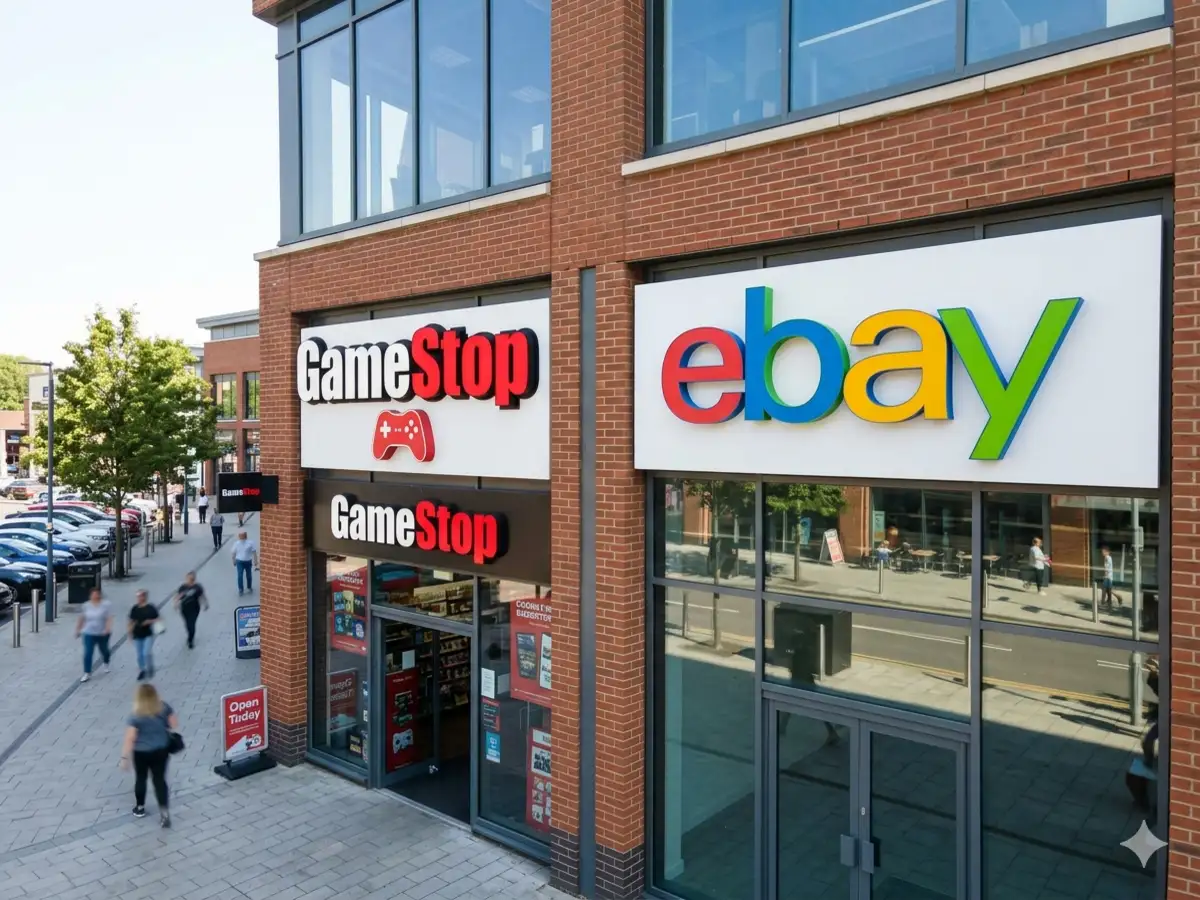
Sunday, May 3, 2026. GameStop — the chain that shouldn't exist, run by the CEO who shouldn't have been able to save it — submitted a non-binding proposal to acquire eBay for $55.5 billion. A company with a $12 billion market cap trying to buy one worth $46 billion. On paper it reads like a prank. In practice, Ryan Cohen had already spent three months quietly accumulating a 5% stake in eBay, secured a commitment letter from TD Bank for $20 billion in debt financing, and published a 12-month cost-cutting plan before the public even knew the bid existed.
This isn't a stunt. But whether it's a serious acquisition attempt or an extraordinarily sophisticated forcing function is a much harder question.
GameStop Announces Shocking Buyout — Here's What's Actually in the Offer
The proposed offer is $125.00 per share, comprising 50% cash and 50% GameStop common stock, with full shareholder election rights as to consideration type and pro-rata allocation. The aggregate undiluted equity value is approximately $55.5 billion, representing a 27% premium to the 30-day VWAP and a 36% premium to the 90-day VWAP. Gamestop
Cohen said he will deliver $2 billion in annualized cost reductions within the first 12 months of buying eBay, should the deal go through. This would include $1.2 billion in cost-cutting from sales and marketing at eBay, along with $300 million from product development, and $500 million from general and administrative costs. GameSpot
That $2 billion number deserves scrutiny. eBay's total operating expenses ran roughly $7.5 billion in 2025. Cutting 27% of that in year one while running an integration of two fundamentally different businesses — a brick-and-mortar gaming retailer and a global e-commerce marketplace — isn't conservative. It's aggressive enough to raise real questions about whether the resulting business would be functional or merely lean.
Cohen told the Wall Street Journal that putting eBay and GameStop under one roof would create huge opportunities to improve earnings and cut costs. "It could be a legit competitor to Amazon," he said. He also confirmed he was prepared to pursue a proxy fight and take the offer directly to shareholders should eBay's board be unreceptive. Investing.com Canada
He envisions GameStop's 1,600 US locations as a national network for authentication, intake, fulfilment, and live commerce. That's the physical retail thesis reframed: stores aren't liabilities for a dying business model, they're authentication hubs and last-mile fulfilment infrastructure for a resale marketplace. It's actually not a bad idea. eBay's perennial problem with counterfeits and buyer trust in high-value categories like sneakers, trading cards, and electronics is precisely the kind of problem that physical verification solves. Investing.com Canada
The financial structure of the bid: $9.4B in GameStop cash + $20B in TD Bank debt financing + GameStop stock comprising 50% of the offer price = a $55.5B deal that GameStop technically can't afford without the stock component valuing it at a significant premium to current levels.
The Compensation Package Nobody's Talking About Enough
Before you can understand the eBay bid, you need to understand what Ryan Cohen personally needs to happen.
In January, GameStop outlined a compensation package for Cohen comprising stock options tied to performance targets, including market capitalization and earnings thresholds. Based on the structure, the options could be worth more than $35 billion if the company reaches a $100 billion valuation and meets profit targets. CNBC
The total award consists of stock options to purchase 171,537,327 shares at $20.66 per share. The award is divided into nine tranches that vest only if GameStop achieves both a Market Capitalization Hurdle and a corresponding Cumulative Performance EBITDA Hurdle — starting at $20 billion market cap and $2 billion EBITDA, scaling to $100 billion market cap and $10 billion cumulative EBITDA. sec
The performance hurdles in this proposed package will be adjusted "equitably and proportionately" as determined by the Compensation Committee in the event that GameStop shares are used to complete an acquisition. As of the filing of GameStop's annual report in late March, Cohen's proposed pay package remains subject to shareholder approval. Sherwood News
Here's the thing that makes this messy: Cohen's compensation is directly tied to GameStop reaching a $100 billion valuation. GameStop's current market cap is $12 billion. eBay's is $46 billion. A combined entity — even if valued conservatively — immediately gets closer to that $100 billion threshold simply by existing. The acquisition isn't just a business strategy. It's also the fastest path to Cohen's compensation milestones.
That's not necessarily bad — alignment between CEO incentives and shareholder value creation is often exactly what you want. But it does mean the board and eBay's shareholders should read every line of this proposal knowing that the man making it has $35 billion of personal upside riding on the combined entity's valuation, not just its operational health.
"Cohen's structure here resembles what he did at Chewy more than what he did at GameStop in 2021. He's not playing to retail sentiment — he's running a calculated acquirer's playbook. The question isn't whether the logic is sound. It's whether a company with $9 billion in cash and a $12 billion market cap can credibly control a $55 billion negotiation. The answer depends entirely on whether eBay's board thinks its shareholders want the premium more than they want independence." — M&A analyst tracking activist acquisitions, speaking to regional financial press, May 2026
eBay's Slow Slide Makes Cohen's Timing Look Sharp
eBay's not a failing business. It's a plateauing one — which is arguably a worse position to be in.
After peaking at $100 billion in gross merchandise volume in 2020, eBay's GMV slid to $79.6 billion in 2025, as the platform struggled to retain buyers. That's a 20% contraction in transaction volume over five years, in a market where Amazon, Mercari, Depop, Whatnot, and StockX have all been eating different slices of eBay's historical market. February brought the announcement of a $1.2 billion transaction to acquire Depop from Etsy — a move that signals eBay knows its secondhand positioning is under pressure from younger, more social commerce-native platforms.
Cohen's thesis is that eBay has the infrastructure and the GMV but lacks the operational discipline and physical presence to compete. GameStop provides the physical. Cohen provides the operational aggression — his track record at Chewy, which he took from zero to $3.5 billion in revenue before selling to PetSmart, is the actual credibility backstop here, not the GME meme stock moment.
But the collectibles overlap is real and worth noting. GameStop has already been pivoting toward trading cards, Funko Pops, and collectible toys as video game software migrates to digital. eBay's single strongest verticals include trading cards, vintage electronics, sneakers, and gaming hardware. These aren't adjacent businesses. They're the same customer with slightly different transaction sizes.
The Global Dimension — and Why Regulators Will Have Views
A GameStop-eBay combination creates a US-anchored secondhand commerce platform with genuine global reach. eBay operates across more than 190 markets, with particularly strong presence in Germany, the UK, and Australia. Germany's secondhand market is one of the most active in Europe — eBay's German operation is a significant revenue contributor — and the UK Competition and Markets Authority has been increasingly aggressive on e-commerce consolidation after blocking several deals in recent years.
The FTC under its current posture has already shown willingness to scrutinise large e-commerce mergers. A $55.5 billion deal combining the world's second-largest general marketplace with a retailer that operates 1,600 physical locations in the US would almost certainly trigger a second request, an extended review, and possibly a challenge on vertical integration grounds — particularly if the combined entity starts preferencing GameStop product categories in eBay search rankings.
Cohen's timeline of closing and implementing $2 billion in cost cuts within 12 months looks especially optimistic in that regulatory context. Deals at this complexity rarely close in under 18 months even without regulatory complications.
Skeptic's corner: The most cynical read here is that Cohen has no expectation of closing this deal. He's built a 5% stake in eBay — if the proposal forces eBay to engage, raises the stock price, and he sells his position at a premium, he's made a significant return on a months-long information advantage. The proxy fight threat is negotiating leverage, not necessarily a genuine plan. It would be wrong to say this is definitely what's happening. It's not wrong to say that Cohen didn't get rich by being naive, and that the gap between a $12 billion bidder and a $46 billion target creates structural incentives for an outcome other than a completed merger.
What to watch:
eBay's board response, expected within days — if they reject outright and close off the proxy window (which their June annual meeting schedule may allow), Cohen's leverage shrinks substantially and the deal timeline collapses
Whether any of the Middle Eastern sovereign wealth funds Cohen referenced as potential co-investors materialise publicly — their participation would transform this from a leveraged buyout into a geopolitically significant commerce infrastructure play
GameStop shareholder vote on Cohen's compensation package, still pending as of late March 2026 — if shareholders reject it, the structural logic of the acquisition attempt shifts materially
The operating principle for founders and operators: Ryan Cohen is doing something rare in corporate dealmaking. He's attempting to use retail investor sentiment, activist tactics, and a meme-stock-era cash pile to execute a genuine M&A strategy for a business transformation that would have seemed impossible three years ago. Whether it works or not, it's a masterclass in using capital structure creatively — $9.4 billion in cash, $20 billion in committed debt, a 5% stake built pre-announcement, and a compensation package that makes the personal and corporate incentives identical.
GameStop Announces Shocking Buyout isn't the headline you expect from a company that was a meme in 2021. That's exactly why you should be paying attention.