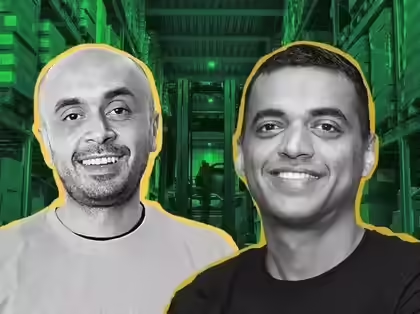
Deepinder Goyal spent 18 years building a food delivery app into something that processes $10 billion in annual transactions. Then, in February 2026, he handed it to someone else and stepped back. That transition — from Zomato's founder-CEO to Albinder Dhindsa, who co-founded Blinkit — was either a bold signal that quick commerce is now the real business, or an acknowledgment that what comes next requires a different kind of operator. Probably both.
Dhindsa's first quarterly results as group CEO showed Eternal's consolidated net profit surging 4.5X year-on-year to ₹174 crore in Q4 FY26, up from ₹39 crore a year ago. Operating revenue jumped 196% YoY to ₹17,292 crore. On the surface, those are numbers that silence critics. Beneath the surface, things get more complicated.
Excluding other income of ₹342 crore, the company would have reported a loss for the quarter, highlighting the gap between headline growth and underlying profitability.
That single sentence, buried in the earnings analysis, is the most important sentence in this story.
Eternal's Triple Bet Faces Its First Real Scrutiny
Eternal — the parent of Zomato, Blinkit, and District — rebranded from Zomato roughly a year ago to signal it was more than a food delivery company. The new name was meant to reflect a portfolio company running three distinct consumer verticals: eating out and food delivery (Zomato), 10-minute grocery and goods delivery (Blinkit), and a going-out experience platform covering events, movies, sports, and dining reservations (District). The thesis was that these three would share infrastructure, cross-pollinate users, and build a consumer OS for urban India.
In FY26, 109 million Indians transacted across these three platforms for a combined $10 billion in net order value — numbers that make Eternal one of India's most significant consumer internet companies by any standard.
But transaction value and profitability are different problems. And right now, Eternal is three businesses in three different financial conditions.
The strong one: Blinkit. Blinkit reported its first-ever adjusted EBITDA profit in Q3 FY26, posting ₹4 crore. In Q4, that rose to ₹37 crore. Between FY23 and FY26, Blinkit's net order value grew at a 104% CAGR. It now operates 2,243 dark stores, added 216 net new stores in the quarter, and is targeting 3,000 stores by March 2027. Dhindsa, who built Blinkit before the acquisition, is now running the whole group. Nobody missed what that signalled about where leadership thinks the growth is. Business Standard
The stable one: Zomato food delivery. Food delivery NOV stood at ₹9,757 crore in Q4 FY26, up 18.8% YoY. Adjusted revenue from food delivery rose 29.7% to ₹3,125 crore. Founder Deepinder Goyal noted in his shareholder letter that the earlier concern about quick commerce cannibalising food delivery appears to have stabilised. Monthly transacting users reached 24.1 million by Q2 FY26, up from 20.5 million in Q3 FY25. The food delivery business is not flashy, but it generates consistent adjusted EBITDA. It's the business that funds the bets.
The uncertain one: District. In August 2024, Eternal acquired Paytm Insider for ₹2,048 crore — roughly 6–7 times the target's FY24 revenue — to expand into movies and events ticketing, where it competes with Reliance-backed BookMyShow and Swiggy Scenes. Eternal's going-out vertical saw NOV grow 46.5% YoY to ₹2,736 crore. The CFO is right that it's a lumpy business — Q1 is IPL-heavy, Q3 is events-heavy — and that annual numbers are more diagnostic than quarterly. He said FY26 should be seen as a more meaningful baseline year because it was the first full year with the District app in its current form. That's a reasonable ask. But it doesn't change the fact that District is still loss-making, still trying to find its core, and still competing with an incumbent that's had two decades to build relationships with promoters.
Who Wins, Who Loses — and Who Gets Nervous
The honest winner here is Blinkit. Dhindsa said quick commerce is still concentrated in the top 15–20 cities and in a relatively narrow set of categories, with substantial headroom for growth on geography, assortment, and frequency. He expects Blinkit's NOV growth CAGR to be north of 60% over the next three years, translating to more than 4X its current scale. If that trajectory holds, Blinkit alone justifies Eternal's current market capitalisation — which reached ₹2.87 lakh crore ($31.8 billion) by end-2025 — and then some. Upstox
The honest loser is everyone competing with Blinkit in India's quick commerce market. Zepto and Swiggy Instamart are both fighting for the same dark store density, the same delivery partners, the same consumer mindshare. Dhindsa noted that aggressive discounting by competitors is currently leading to poor-quality growth centred around low-margin SKUs, but argued that in a nascent category, competition ultimately expands the market faster than any single player could alone. That's a thoughtful read — and also strategically convenient for a market leader to believe. Upstox
BookMyShow is the company that should be most unsettled right now. District has taken IPL ticketing partnerships from it — exclusive rights to five of ten IPL teams — and is building a subscription product (District Pass) to lock in repeat purchase behaviour in movie ticketing. District isn't even 2% of Eternal's business. But it's enough to rattle BookMyShow, which now has to defend against a competitor with essentially unlimited cross-subsidy from the Zomato and Blinkit cash flows.
"District doesn't need to win on margin to hurt BookMyShow. It just needs to stay in the game long enough to shift consumer habit. Eternal can absorb losses in District that would kill a standalone ticketing company. That's the structural asymmetry in this fight — and it's a very uncomfortable one for the incumbent." — Consumer internet analyst, India market practice, speaking to regional press, 2026
The Global Frame: Platform Consolidation, Indian Edition
What Eternal is building isn't unique in ambition, but it may be unique in timing. Globally, super-app consolidation happened earlier — Grab in Southeast Asia tried eating, rides, and payments simultaneously; Gojek in Indonesia ran a similar multi-vertical playbook; Meituan in China became the closest reference point for Eternal's thesis, combining food delivery, hotel bookings, and entertainment ticketing into a single consumer platform that now processes hundreds of billions of dollars annually.
India's consumer internet market is a decade behind China's in penetration but accelerating fast. India's live events economy is valued at ₹20,800 crore and expected to double by 2030. Quick commerce is, by most estimates, still in the first 15% of its addressable market. And food delivery's monthly transacting user base is growing even as average order frequency plateaus — which means new users are still discovering the category even if existing ones aren't ordering more. The demographic wave hasn't crested yet.
But the regulatory and competitive context is different from China's in one important way: India has well-resourced domestic incumbents and conglomerates that won't cede ground easily. Eternal doesn't have China's market consolidation tailwind. It has to fight for every vertical.
Skeptic's corner: The 196% revenue jump deserves more scrutiny than it's getting. Blinkit's shift to an inventory-led model means it now reports gross merchandise value as revenue, not just commission. That's an accounting change, not an operational one. Strip that out, and the like-for-like revenue growth is considerably more modest. Annual profit actually fell in FY26 — ₹366 crore versus ₹527 crore in FY25. The direction of travel is right, but the absolute numbers are not yet telling the story the headlines suggest.
What to watch:
Whether District reaches adjusted EBITDA breakeven within the 4–6 quarters the company has guided for — if it misses, the ₹2,048 crore acquisition price will face fresh scrutiny from institutional investors who already have questions about it
Blinkit's dark store unit economics as it pushes into tier-2 cities; the business case is strong in Mumbai and Bengaluru but depends heavily on demand density that thins out rapidly outside the top urban centres
How Swiggy Instamart responds to Blinkit's 60% NOV growth target — if Swiggy matches the pace, margin pressure across quick commerce intensifies, and Eternal's financial cushion for District shrinks proportionally
The read across Q4 FY26 is this:
Eternal's profitability test is really three separate tests running concurrently. Blinkit is passing. Zomato food delivery is passing more quietly. District is still sitting the exam. The company's leadership has been transparent about the sequencing — District is a long-term bet, not a near-term revenue contributor — but that transparency only buys so much patience from markets that are watching annual profit decline even as revenue triples.
Goyal noted in his shareholder letter that it took 18 years to reach $10 billion in annual NOV. The implicit question in that framing is whether the next phase — becoming a genuinely multi-vertical, consistently profitable platform — will take another 18 years, or whether the flywheel he's built can compress that timeline. Eternal's Triple Bet Faces that question every quarter now, and the answers are coming from three very different places within the same company.