SAN FRANCISCO — The ground shifts under the feet of the robotics industry. Genesis AI, the formidable Khosla-backed powerhouse, today announces a strategic pivot, going full-stack in its ambitious robotics push. This move, long rumored in venture circles, signals a profound re-evaluation of the vertical integration model within a sector increasingly defined by software but bottlenecked by hardware. It promises to reshape competitive dynamics, forcing incumbents and new entrants alike to re-examine their positions.
For years, Genesis AI has been the quiet architect behind the scenes. Its name became synonymous with advanced generative AI models for robotic task planning and simulation. Their proprietary platform, "Orchestrator," offered a tantalizing glimpse into a future where robots learn and adapt with unprecedented agility. Khosla Ventures, recognizing the deep tech potential, led their Series B and C rounds, pouring over $180 million into their software-centric vision. The company’s valuation soared past $1.5 billion based on the strength of its AI, not its hardware.
Now, Genesis AI is no longer content to merely provide the brain. It seeks to own the body, the nervous system, and the entire operational pipeline. This transition from pure-play AI provider to a vertically integrated robotics company is a monumental undertaking. It means designing, manufacturing, deploying, and servicing its own robots, from the ground up.
The Full-Stack Offensive
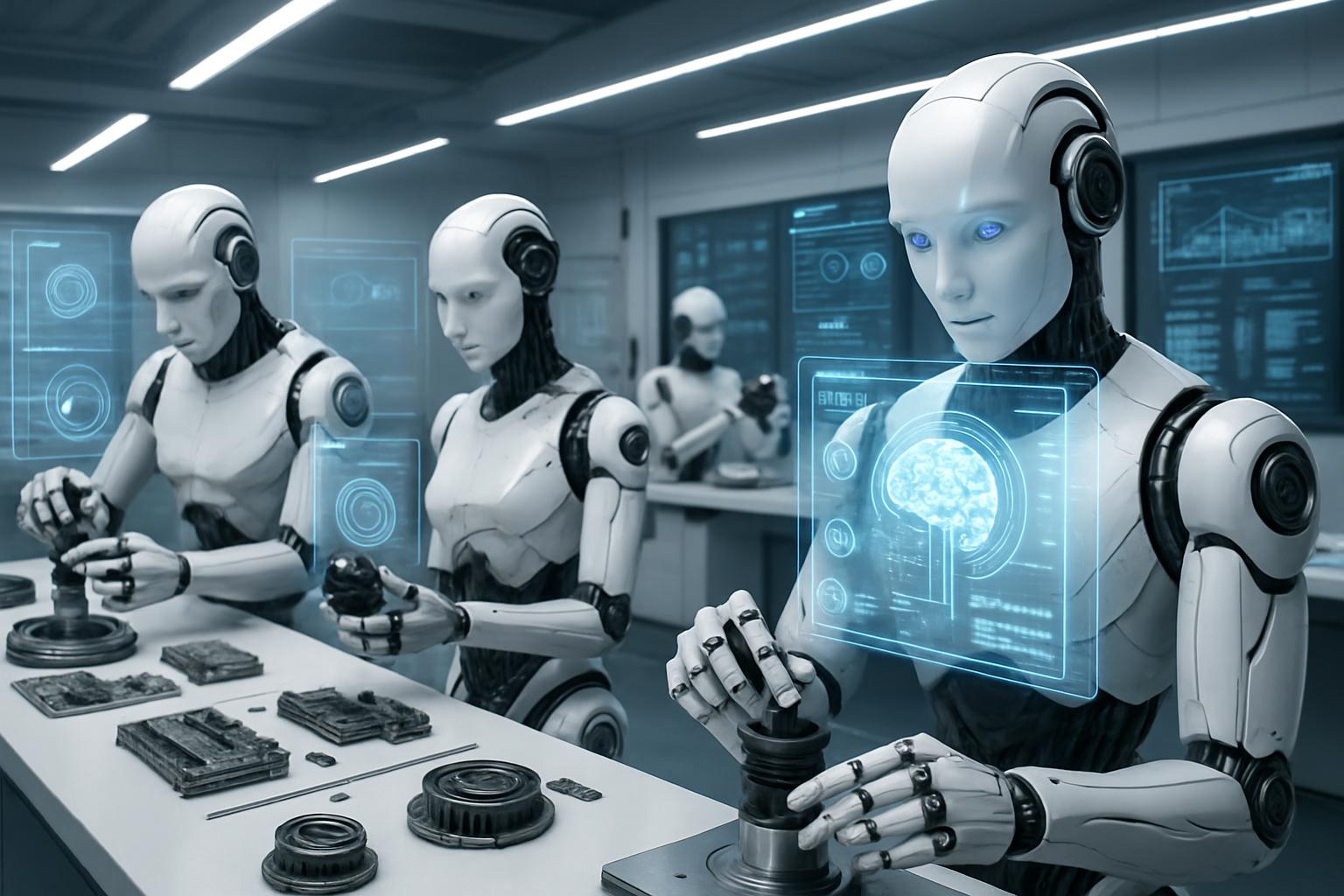
The company unveils its first proprietary robot line today: the "Aether" series. These modular, multi-purpose autonomous mobile manipulation robots (AMMRs) are designed for environments ranging from advanced manufacturing floors to complex logistics hubs. Genesis AI claims the Aether series will offer unparalleled integration with its Orchestrator AI, leading to a 40% improvement in task completion rates and a 25% reduction in operational errors compared to existing third-party hardware.
This is not merely about slapping their software onto generic chassis. Genesis AI has established dedicated hardware R&D labs in Boston and Shenzhen. They are investing heavily in advanced materials, robust sensor arrays, and energy-efficient locomotion systems. The manufacturing strategy involves a hybrid approach: critical components designed in-house, assembled by contract manufacturers in Southeast Asia, with final integration and testing facilities in key regional markets.
The shift is driven by a clear rationale: performance and control. Genesis AI leadership has consistently vocalized frustrations with the fragmentation of the robotics ecosystem. "Our AI models achieve peak performance only when tightly coupled with hardware designed specifically for our algorithms," states Dr. Lena Chen, CEO of Genesis AI. "The latency, sensor data discrepancies, and architectural limitations of off-the-shelf robotics were simply too great a bottleneck for the sophisticated tasks our AI is capable of handling."
Why Vertical Integration Now?
The move comes at a critical juncture for robotics. The promise of widespread automation has often been hampered by integration complexities. Companies adopting robotics face a labyrinth of incompatible software, disparate hardware platforms, and significant upfront customization costs. Genesis AI’s full-stack approach aims to cut through this Gordian knot, offering a unified, optimized solution from perception to actuation.
Consider the market dynamics. Logistics automation, projected to reach $68 billion by 2027, is rife with point solutions. A typical warehouse deployment might involve an AMR vendor, a separate robotic arm provider, an AI vision company, and a system integrator. Each layer adds complexity, cost, and potential points of failure. Genesis AI’s strategy positions them as the single vendor responsible for the entire stack, simplifying procurement, deployment, and ongoing maintenance.
This also allows Genesis AI to capture a larger share of the value chain. Rather than earning licensing fees on software, they now sell complete systems, including recurring revenue streams from maintenance, upgrades, and AI-as-a-service subscriptions. This dramatically alters their revenue model and market capitalization potential, aligning with Khosla’s big-bet philosophy.
Genesis AI's Full-Stack Push: Key Investments
R&D:$75M allocated for hardware development, materials science, and modular design.
Manufacturing:Partnerships with tier-1 contract manufacturers in Vietnam and Malaysia; establishing regional integration hubs.
Deployment:Launching a global field engineering and support network across 12 major industrial centers.
Initial Rollout:Targeting 50 beta deployments of the Aether series in Q4 across North America, Europe, and Asia.
Implications for the Robotics Landscape
The ripple effects will be immediate and profound. Established hardware manufacturers like Boston Dynamics or KUKA, which often rely on open software ecosystems or offer their own limited AI solutions, will face a direct challenger that controls both brain and brawn. Software providers focused solely on specific robotic functions will find their addressable market shrinking, as Genesis AI internalizes these capabilities.
For founders and operators in the robotics space, this presents a dual challenge and opportunity. Niche hardware component manufacturers, specializing in areas like advanced haptics or novel battery tech, might find a new, demanding customer in Genesis AI. System integrators, however, may see their core business eroded, forced to either specialize in complex, custom projects or partner closely with full-stack providers.
The move also validates a growing trend: the convergence of software and hardware. Apple, Tesla, and now Genesis AI. The playbook is similar: achieve superior performance and user experience by tightly integrating every layer of the product. This vertical control allows for accelerated innovation cycles, optimized performance, and a more cohesive customer journey.
Global Deployment and Early Wins
Genesis AI is not waiting. Beta deployments of the Aether series are already underway. In Germany, a major automotive manufacturer is testing Aether AMMRs for precision assembly line tasks, aiming for a 15% throughput increase. In Singapore, a leading logistics provider is evaluating the robots for last-mile sorting and palletizing, targeting a 20% reduction in labor costs for repetitive tasks.
Agriculture in the US Midwest is another focus. Here, customized Aether units are being deployed for automated crop monitoring and selective harvesting, showcasing the platform's adaptability to unstructured outdoor environments. In UK healthcare, trials are exploring autonomous delivery of medical supplies within hospital campuses, emphasizing reliability and safety.
These initial deployments are critical. They provide real-world data, allowing Genesis AI to rapidly iterate on both hardware design and AI performance. The goal is not just to build robots, but to build a robust, scalable robotics service that can be deployed globally with minimal friction.
“Genesis AI’s pivot is a bold, high-stakes play. Building hardware is capital-intensive and fraught with supply chain complexities. However, if they can deliver on the promise of seamless AI-hardware integration, they will unlock a new tier of performance that pure-play software or hardware companies simply cannot match. This could fundamentally shift the competitive landscape, creating a new benchmark for what's possible in intelligent automation.”
— Dr. Anya Sharma, Robotics Industry Analyst, Veridian Insights
The Road Ahead: Challenges and Vision
The path is not without its hurdles. Scaling hardware manufacturing, establishing a global service network, and navigating diverse regulatory environments for autonomous systems are immense challenges. Genesis AI will need to transition from a software-first culture to one that deeply understands supply chain logistics, quality control, and rugged industrial design.
Yet, the vision is clear. Genesis AI aims to become the definitive platform for intelligent automation across industries. By owning the entire stack, they can push the boundaries of robotic capability, making previously impossible tasks automated and economically viable. Their long-term goal extends beyond individual robots; it involves creating intelligent fleets that communicate, coordinate, and continuously improve their collective performance.
This full-stack approach is more than a strategic shift; it is a declaration of intent. Genesis AI is betting that the future of robotics belongs to those who control the entire experience, from the silicon to the sensor, from the algorithm to the actuator. For founders and operators watching closely, the message is stark: adapt, specialize, or be prepared to compete with a vertically integrated giant.
KEY TAKEAWAYS
Vertical Integration is the New Frontier: Genesis AI's full-stack move signals a growing trend where tightly integrated hardware and software are seen as key to unlocking next-gen performance and market share in robotics.
Disruption to Existing Ecosystems: This strategy challenges both pure-play hardware manufacturers and niche software providers, potentially consolidating market power and forcing re-specialization.
Performance and Control as Core Drivers: The pivot is primarily driven by the need for superior performance and complete control over the user experience, eliminating bottlenecks common in fragmented systems.
Capital-Intensive but High-Reward: While building hardware is costly and complex, the potential for increased market capture, recurring revenue, and a larger share of the value chain makes it an attractive, albeit risky, proposition.
Strategic Implications for Founders: Operators must consider how to best position their companies in a landscape increasingly defined by full-stack players – either by becoming a critical component supplier or by adopting a similar integrated approach.