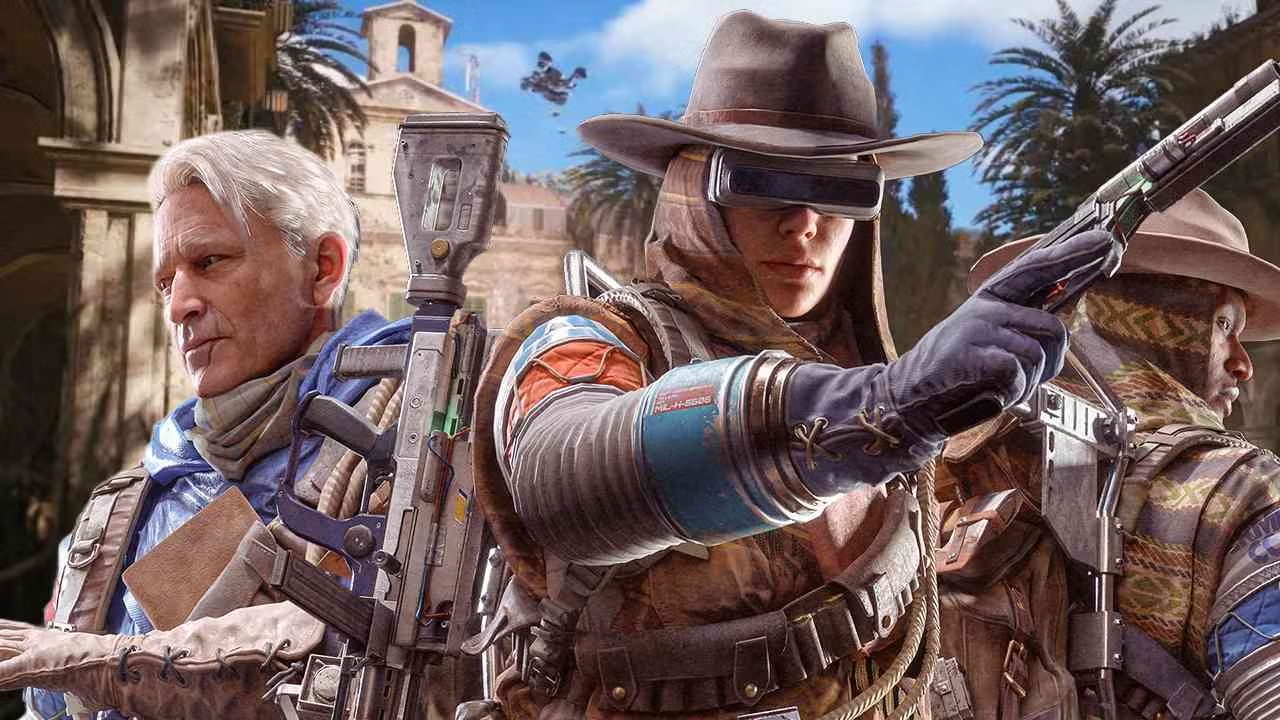
Yet months after launch, a different pattern has emerged. Many players are choosing not to shoot at all.
“It caught us a little bit by surprise,” said executive producer Aleksander Grøndal. “Many people play a more peaceful version of the game than we anticipated. Pleasantly surprised, just to be clear.”
According to the studio, roughly one in five players have never knocked out another raider. Half have knocked out fewer than 10. In a genre where aggression typically defines success, that statistic is striking.
A survival game that became a social experiment
Arc Raiders launched late last year and has sold more than 14 million copies globally, placing it among the most successful new multiplayer releases in recent memory.
The core design is intentionally tense. Players venture to the surface from underground colonies to scavenge resources while avoiding both hostile AI machines — known as Arcs — and other human players. Loot can be stolen. Encounters are unpredictable. The economic structure rewards risk-taking and opportunism.
In theory, that setup incentivizes preemptive aggression.
In practice, something else is happening.
Developers have observed players signaling non-aggression, sharing resources and even forming temporary alliances with strangers mid-mission. Instead of immediate gunfire, some encounters begin with voice chat conversations.
For a competitive extraction-style game, that dynamic challenges assumptions about player motivation.
What it reveals about online behavior
For psychologists and social scientists, the phenomenon offers a live behavioral dataset.
Competitive multiplayer games have often been framed as laboratories of hostility — environments where anonymity lowers social barriers and increases aggression. Yet Arc Raiders suggests that under certain design conditions, players may lean toward cooperation even when systems reward betrayal.
Several factors may be influencing that behavior:
• High shared threat from AI enemies
• The emotional intensity of risk-heavy missions
• Voice communication that humanizes opponents
• Emergent player norms within the community
When danger comes primarily from non-human adversaries, other players can shift from competitors to potential allies.
Game designers have long studied this tension. Titles like DayZ and Escape from Tarkov established the “trust dilemma” in survival shooters, but Arc Raiders’ scale — with over 14 million copies sold — makes the behavioral data more significant.
For startup founders building multiplayer platforms, the lesson is clear: system incentives do not fully determine user behavior. Social dynamics can override economic design.
Cooperative friction in competitive markets
Embark Studios, founded by industry veterans in Sweden, built Arc Raiders with a strong PvPvE (player-versus-player-versus-environment) foundation. The expectation was that human unpredictability would amplify tension.
Instead, unpredictability has sometimes meant mercy.
That outcome complicates the standard monetization and engagement models often associated with competitive shooters. High kill rates and intense rivalry tend to drive highlight clips, influencer visibility and esports narratives.
Cooperation, by contrast, creates quieter engagement — but potentially deeper community loyalty.
For global gaming markets, particularly in North America and Europe, the shift reflects broader player fatigue with purely adversarial systems. As multiplayer ecosystems mature, segments of players appear to be seeking connection as much as competition.
The psychology of risk and empathy
In high-stakes digital environments, empathy may paradoxically increase.
When players risk losing hard-earned loot, shared vulnerability can create moments of solidarity. Voice chat, in particular, appears to reduce hostility by replacing anonymous avatars with human presence.
Developers report instances where players negotiate safe passage, split scavenged items or team up to defeat AI enemies before parting ways.
This behavior mirrors findings in behavioral economics: under uncertainty, cooperative equilibria can emerge even without formal agreements.
For game startups, that insight carries product implications. Systems that allow for spontaneous communication may significantly alter user dynamics. The design of proximity chat, signaling tools and shared objectives can reshape what appears to be a purely competitive framework.
A signal for the broader gaming industry
The commercial success of Arc Raiders suggests that players are not abandoning high-stakes shooters. Rather, they may be redefining how they engage with them.
In a market saturated with battle royale formats and elimination-driven progression, Arc Raiders demonstrates that tension does not always require constant aggression.
For studios competing in crowded multiplayer categories, this raises strategic questions:
• Should systems explicitly reward cooperation?
• How much unpredictability strengthens engagement versus discourages new players?
• Can emergent social behavior become a core retention driver?
The answers will influence how the next generation of multiplayer games is structured.
Beyond mechanics: what players want
At a cultural level, the phenomenon speaks to something larger.
Despite the game’s dystopian setting — ruined cities, underground colonies, lethal machines — many players are choosing dialogue over dominance. In a fictional world defined by scarcity and threat, cooperation has become a recurring outcome.
That may say less about game balance and more about player psychology.
Digital spaces increasingly serve as social platforms as much as entertainment products. For some players, the opportunity to connect, negotiate and build fleeting alliances may be as compelling as winning firefights.
Embark Studios did not design Arc Raiders as a social experiment. But with millions of players reshaping its dynamics, it has become one.
In an industry that often assumes competition drives engagement, Arc Raiders is offering a counterpoint: sometimes, even in apocalyptic landscapes, players would rather talk.