Nvidia's market valuation surges towards an unprecedented $6 trillion, driven by explosive global demand for its high-performance AI chips and CUDA platform.
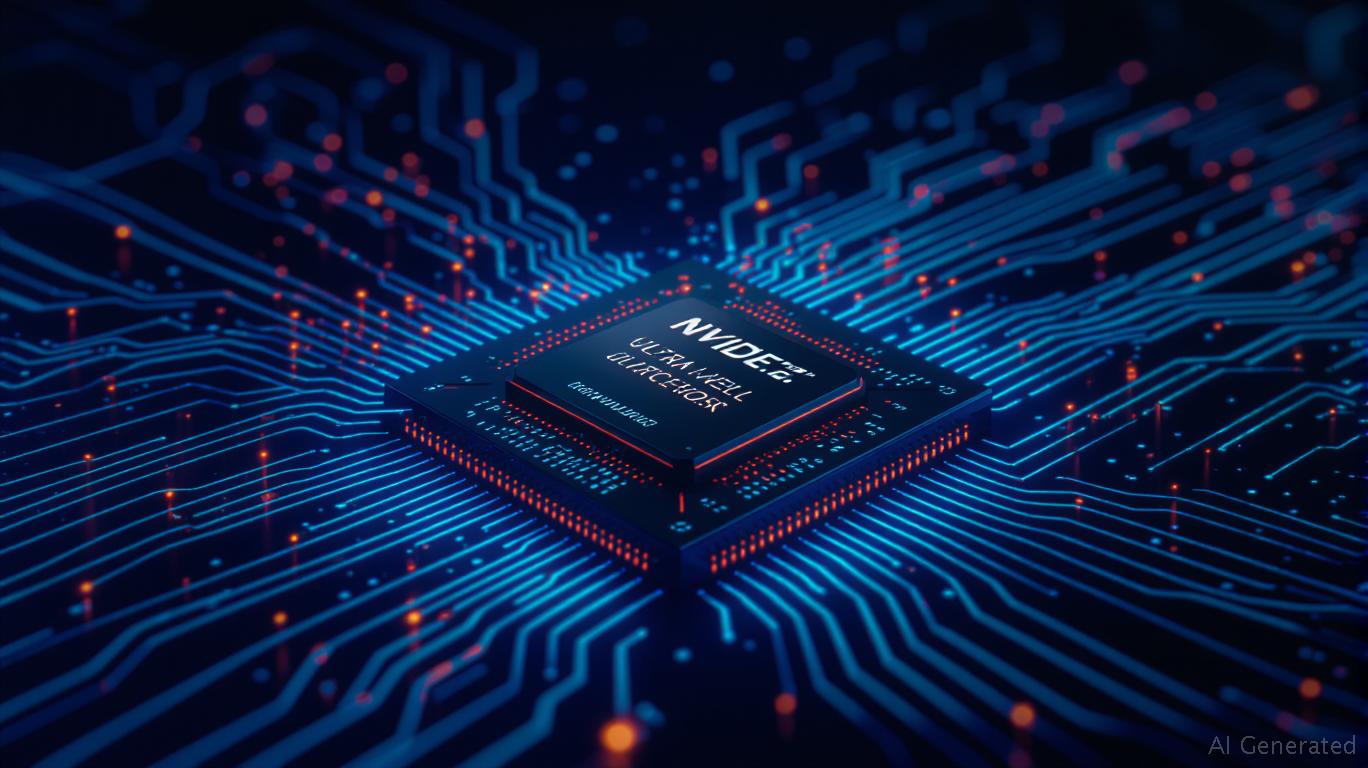
Nvidia, a leading semiconductor firm founded in 1993, is nearing a monumental $6 trillion market valuation, propelled by its dominance in the artificial intelligence (AI) chip sector.
The surge is primarily driven by insatiable global demand for its high-performance GPUs and CUDA software platform, essential for training and deploying advanced AI models.
This market milestone underscores Nvidia's pivotal role as a foundational technology provider for the generative AI revolution, impacting hyperscalers and enterprises worldwide.
Nvidia's success highlights the critical infrastructure required for AI development, influencing investment trends and technological capabilities across diverse sectors including data centres, automotive, and healthcare.
Looking ahead, Nvidia is focused on expanding its AI ecosystem, introducing next-generation architectures, and navigating challenges from intensifying competition and supply chain complexities.
Nvidia, the Santa Clara, California-headquartered pioneer in graphics processing units (GPUs) and a foundational force in artificial intelligence, founded in 1993, is rapidly approaching a staggering $6 trillion market capitalization, equating to approximately INR 498 Lakh Crore. This unprecedented ascent is squarely attributed to the relentless global demand for its high-performance AI chips and the robust CUDA software platform, which have become indispensable for developing and deploying the most advanced AI models across industries. The company's journey from a niche gaming hardware manufacturer to a linchpin of the global AI infrastructure underscores its strategic foresight and technological innovation. The spectacular rally in Nvidia's valuation reflects its near-monopoly in the burgeoning AI hardware market, particularly in chips optimized for large language models (LLMs) and other generative AI applications. Companies like Microsoft, Google, Amazon, and Meta are investing billions in AI infrastructure, with Nvidia's GPUs at the core of these massive data centres. This foundational role has transformed Nvidia into the pick-and-shovel provider for the ongoing AI gold rush, consistently exceeding market expectations with its quarterly earnings and revenue projections. CEO Jensen Huang has repeatedly emphasized that the company is not just selling chips but an entire platform, including networking, software, and services, creating a formidable ecosystem moat. Nvidia's success story is deeply intertwined with the evolution of parallel computing and the subsequent explosion of deep learning. Its proprietary CUDA computing platform, launched in 2006, enabled developers to harness the parallel processing power of GPUs for general-purpose computing, laying the groundwork for AI breakthroughs years later. This early investment in a unified software and hardware architecture provided Nvidia with an insurmountable lead, as AI researchers and developers built their entire ecosystems around CUDA, making it incredibly challenging for competitors to replicate. The current AI boom, therefore, is not merely a hardware cycle but a testament to Nvidia's long-term strategic vision in building a comprehensive AI ecosystem.
Nvidia's market capitalization nearing $6 trillion USD (approximately INR 498 Lakh Crore) represents an astonishing surge, with its stock price growing over 3,000% in the last five years, driven almost entirely by the escalating demand for its AI accelerators.
The company's strategic expansion beyond gaming GPUs into professional visualization, data centers, and automotive sectors further diversified its revenue streams, but it is AI that has truly catapulted it into the exclusive club of trillion-dollar companies. Its H100 and upcoming Blackwell series GPUs are not just chips; they are highly integrated systems designed for specific AI workloads, offering unparalleled performance and efficiency. This holistic approach, combining cutting-edge silicon with a comprehensive software stack, positions Nvidia as an indispensable partner for anyone serious about AI development, from nascent startups in Bengaluru to global tech giants.
Why Nvidia's Ascent Matters for the Global Tech Ecosystem
Nvidia's rapid ascent to a near $6 trillion valuation carries profound implications for the global technology ecosystem, extending far beyond the semiconductor industry. Its dominance in AI hardware is not merely about market share; it signifies a foundational shift in how computing power is perceived and utilized, particularly for next-generation applications like generative AI, autonomous systems, and advanced scientific research. The company's technology has become the de facto standard for training large language models, enabling breakthroughs that were once considered science fiction. This means that access to Nvidia's technology is increasingly synonymous with access to cutting-edge AI capabilities, influencing national strategies and corporate competitiveness worldwide. For the Indian startup ecosystem, Nvidia's technological leadership is particularly significant. Indian AI startups, from those building vernacular LLMs to those developing AI solutions for healthcare, agriculture, and finance, heavily rely on Nvidia's GPUs and CUDA platform. The availability of high-performance computing infrastructure, powered by Nvidia, is crucial for these companies to innovate and scale. As India pushes its digital transformation agenda and aims to become a global AI hub, the foundational technologies provided by Nvidia directly impact the pace and potential of this ambition. Local data centres and cloud providers are increasingly investing in Nvidia's architectures to cater to the burgeoning demand from Indian enterprises and startups looking to leverage AI. Furthermore, Nvidia's valuation reflects a broader recognition of the strategic importance of AI infrastructure in the current geopolitical landscape. Nations are increasingly viewing AI capabilities as a matter of national security and economic competitiveness, leading to massive investments in supercomputing facilities that are almost universally built around Nvidia's hardware. This creates a virtuous cycle where more investment in AI infrastructure translates to greater demand for Nvidia's products, solidifying its position as a critical enabler of future technological progress. The company's innovation in chip design and its foresight in cultivating an extensive developer ecosystem through CUDA has allowed it to capitalize on this megatrend like no other.
In its latest reported quarter, Nvidia's data center revenue soared by over 400% year-over-year, reaching approximately $22.1 billion USD (around INR 1.83 Lakh Crore), primarily driven by the robust demand for its Hopper architecture GPUs like the H100.
The ripple effect of Nvidia's success is also evident in the venture capital landscape. Investments in AI startups, particularly those focused on model development and AI infrastructure, are at an all-time high, often with the implicit understanding that their solutions will run on Nvidia hardware. This creates a strong incentive for startups to align with Nvidia's ecosystem, further cementing its position as an industry standard. Market analysts told Inc42 that Nvidia's technological moat is not just in its hardware but in the deeply ingrained software ecosystem that makes switching to alternatives a costly and complex proposition for developers and enterprises.
What's Next: Sustaining the AI Momentum and New Frontiers
Looking ahead, Nvidia faces the dual challenge and opportunity of sustaining its explosive growth while navigating an increasingly competitive and complex landscape. The company's strategy involves continuous innovation in its core AI chip architectures, as demonstrated by the upcoming Blackwell and Rubin platforms, which promise even greater performance and efficiency. These next-generation systems are designed to push the boundaries of what's possible in AI, enabling the training of even larger and more sophisticated models, and accelerating inference at an unprecedented scale. Nvidia's commitment to a rapid two-year product cycle ensures it remains at the forefront of hardware innovation. Beyond silicon, Nvidia is significantly expanding its software and services offerings, recognizing that the future of AI is not just about raw compute power but also about accessible, optimized software. The company is investing heavily in its AI Enterprise software suite, the Omniverse platform for 3D simulation and collaboration, and its robotics initiatives. These efforts aim to move Nvidia beyond being solely a hardware vendor to becoming a comprehensive AI platform provider, capturing more value across the entire AI stack. Jensen Huang has often articulated this vision, emphasizing that the company is building "the AI factory" for the world. However, challenges loom large. The competitive landscape is intensifying, with rivals like AMD making strides with their MI300X GPUs and Intel pushing its Gaudi accelerators. Moreover, major hyperscalers are increasingly developing their custom AI chips, such as Google's TPUs and Amazon's Trainium and Inferentia, to reduce reliance on external vendors and optimize costs. This trend could potentially erode Nvidia's market share in the long run, although the performance gap remains significant for many workloads. Supply chain constraints, especially for advanced packaging technologies, also pose a persistent challenge in meeting the soaring demand. Despite these hurdles, Nvidia's long-term vision appears robust. The company is actively exploring new growth vectors, including the industrial metaverse, autonomous vehicles, and drug discovery, all of which require massive AI compute. Its strategy of creating highly specialized processors and integrated platforms for these specific domains positions it for continued expansion. The sheer scale and complexity of future AI applications suggest that the demand for advanced computing power will only continue to grow, with Nvidia well-positioned to remain at the forefront of this technological revolution. The journey to $6 trillion is a testament to its past achievements, and its future trajectory will define a significant portion of the global AI landscape.
Frequently asked questions
How close is Nvidia to a $6 trillion market cap?
Nvidia is nearing a monumental $6 trillion market valuation, driven by its leading role in the artificial intelligence chip sector. This places it among the most valuable companies globally.
What is driving Nvidia's market surge?
The surge is primarily driven by insatiable global demand for its high-performance GPUs (Graphics Processing Units) and the proprietary CUDA software platform. These are essential for training and deploying advanced AI models.
When was Nvidia founded?
Nvidia, a leading semiconductor firm, was founded in 1993.
What makes Nvidia's chips crucial for AI?
Nvidia's GPUs are specifically designed for parallel processing, which is highly efficient for the complex calculations required in AI model training and deployment. Their CUDA platform further optimizes this process.
What is CUDA?
CUDA (Compute Unified Device Architecture) is Nvidia's proprietary parallel computing platform and application programming interface (API) that allows software developers to use a CUDA-enabled graphics processing unit for general purpose processing.
Why is a $6 trillion market cap significant for Nvidia?
Reaching a $6 trillion market cap would solidify Nvidia's position as one of the world's most valuable companies, highlighting the immense economic impact and future growth potential of the AI industry and Nvidia's dominance within it.