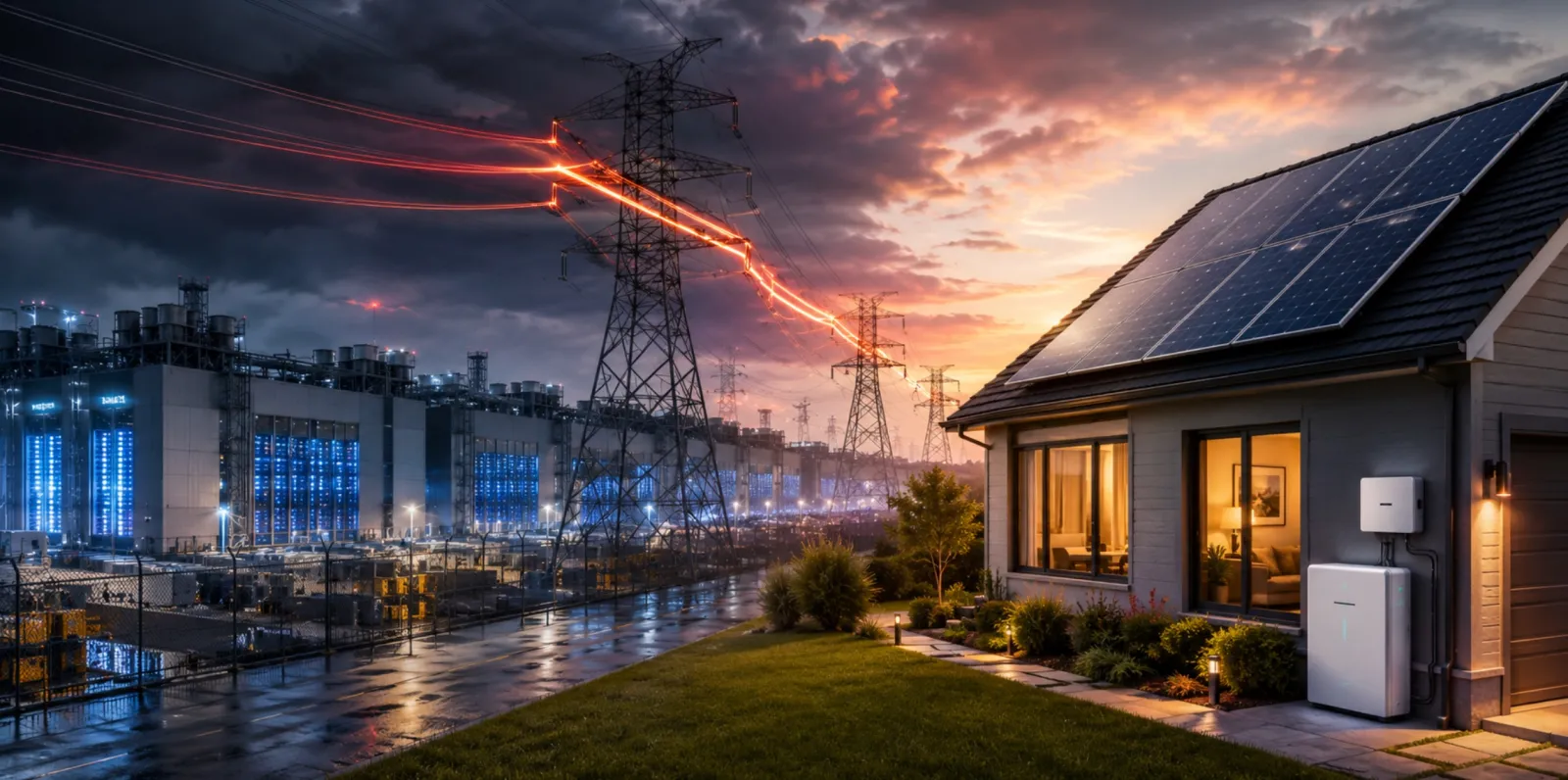
Hyperscale data centers push grids to breaking point, forcing blackouts and accelerating a mass exodus of homeowners to solar and battery storage solutions.
The relentless expansion of hyperscale data centers across North America is pushing local power grids to their absolute breaking point, forcing utilities to implement rolling blackouts that disproportionately impact residential consumers. This escalating energy crisis is now directly accelerating a mass exodus of homeowners towards solar panels and battery storage, transforming grid reliance from a given into a luxury.
For years, the tech industry has built its digital empires on the promise of infinite compute, but the physical infrastructure underpinning that promise is now visibly cracking. These massive digital fortresses, housing the servers that power everything from AI models to streaming services, demand staggering amounts of electricity, often equivalent to small cities, straining grids that were never designed for such concentrated, relentless load growth.
In states like Virginia, which boasts the largest data center cluster globally, local utilities such as Dominion Energy have openly acknowledged the unprecedented power demands, citing new data center hookups as a primary driver of grid congestion and the need for new, costly infrastructure upgrades. Reports from the PJM Interconnection, the regional transmission organization covering 13 states, routinely flag significant generation and transmission capacity deficits, directly attributing a substantial portion to the data center boom.
Tech giants often tout their commitments to 100% renewable energy procurement, a narrative that sounds good in press releases. Yet, on the ground, these facilities are still drawing massive, instantaneous power loads from the existing grid, which largely remains a mix of fossil fuels, particularly during peak demand when renewables might not be fully available. The problem isn't just about total energy; it's about reliable, instantaneous capacity.
This is the harsh reality of the AI gold rush and the continued explosion of cloud computing. Every generative AI query, every streaming movie, every complex data analysis now translates into more servers, more racks, and critically, more megawatts. The demand curve for computational power is exponential, and the energy infrastructure is simply linear, struggling to keep pace, creating a fundamental imbalance.
The immediate implication for suburban communities surrounding these data center hubs is a palpable decline in grid reliability. Homeowners in areas like Loudoun County, Virginia, or parts of Arizona, are increasingly experiencing unpredictable power interruptions, not due to storms, but due to load management. Utilities are faced with impossible choices: cut power to homes or risk a cascading grid failure impacting vital services.
This stark reality is catalyzing a profound shift in consumer behavior. What was once a lifestyle choice or an environmental statement—installing solar panels and home batteries—is rapidly becoming a defensive necessity. Homeowners, weary of blackouts and rising electricity bills, are now actively seeking energy independence, viewing a resilient microgrid solution as essential home infrastructure.
Residential solar and battery installers report surging demand, particularly in regions impacted by data center expansion. Companies like Sunrun and Enphase Energy are seeing their value proposition shift from "save money, save the planet" to "maintain critical power during grid instability." This is a market driven by resilience, not just economics, a powerful new incentive layer.
The investment landscape is responding in kind. VCs are pouring capital into distributed energy resource management systems (DERMS), smart inverters, and sophisticated home energy management platforms that can aggregate residential batteries into virtual power plants. The vision is no longer just selling power back to the grid; it's about forming robust, localized grids capable of islanding during utility outages.
This decentralized energy movement challenges the century-old utility model of centralized generation and distribution. Utilities, once monopolistic providers, now face a future where their most valuable customers can, and increasingly will, opt out of grid reliance, at least partially. This creates a complex regulatory dilemma, as utilities still need to maintain the grid for everyone, even as their revenue base erodes.
Local governments are caught in the crossfire. Data centers bring substantial tax revenue and high-paying jobs, making them attractive for economic development. Yet, the environmental and infrastructure costs, especially grid strain, are becoming undeniable. Communities are beginning to push back, demanding moratoriums or stricter energy efficiency requirements for new data center builds, recognizing the hidden costs to their constituents.
The energy efficiency claims of modern data centers, while improved, are often relative. A facility might be "more efficient" per unit of compute, but the sheer scale of compute growth often outpaces these gains. The industry is effectively running faster just to stay in the same place concerning its overall environmental and grid impact.
This scramble for reliable power is also driving innovation in other areas. Companies are exploring modular nuclear reactors, advanced geothermal, and even direct power generation at data center sites to bypass the grid entirely. The idea of energy self-sufficiency for these digital factories is gaining serious traction, moving from fringe concept to strategic imperative.
For founders and engineers, this represents a massive opportunity. The entire energy stack, from generation to storage to intelligent consumption, is ripe for disruption. Building the software and hardware that enables seamless transitions between grid power and stored energy, optimizes energy usage, and allows homes to participate actively in grid stabilization efforts is a multi-trillion dollar market in the making.
The financial incentives for homeowners are also shifting. Beyond just avoiding blackouts, utilities are starting to offer demand response programs where homeowners with batteries can sell stored energy back to the grid during peak times, turning their homes into active participants in grid balancing. This creates a new revenue stream, further accelerating battery adoption.
This is not a temporary blip; it is a fundamental re-architecture of how power is delivered and consumed in the digital age. The friction between an old, centralized energy grid and the relentless demands of a hyper-connected, AI-driven world is forcing an accelerated transition to a more distributed, resilient, and ultimately, smarter energy future. The data center boom is inadvertently paving the way for a truly decentralized energy revolution.
The immediate future will see further grid stress and more localized power cuts, but it will also solidify solar and battery storage as non-negotiable home utilities, fundamentally reshaping the energy landscape for decades to come.
Frequently asked questions
Why are data centers causing power outages for homes?
Hyperscale data centers demand immense amounts of electricity, often overwhelming local grid infrastructure not designed for such loads. This strain forces utilities to implement rolling blackouts, disproportionately affecting residential consumers to prevent total system failure.
What is the primary reason homeowners are adopting solar and batteries?
Homeowners are increasingly turning to solar panels and battery storage to gain energy independence and mitigate the impact of unreliable grid power and frequent blackouts caused by data center energy demands.
How do data centers impact local power grids?
Data centers place significant strain on local power grids by drawing massive amounts of electricity, often exceeding existing infrastructure capacity and leading to instability and the need for load shedding.
Are solar panels and home batteries a long-term solution to power cuts?
Yes, solar panels paired with home battery storage offer a robust long-term solution, providing reliable power during grid outages and reducing reliance on an increasingly unstable centralized utility infrastructure.
What is 'grid reliance' in this context?
'Grid reliance' refers to how much a household depends on the public utility electrical grid for its power supply. The article suggests homeowners are reducing this reliance by generating and storing their own power.
Where are these power cuts from data centers most common?
These power cuts are most common in areas across North America experiencing rapid expansion of hyperscale data centers, where local power grids struggle to keep up with the escalating energy demands.