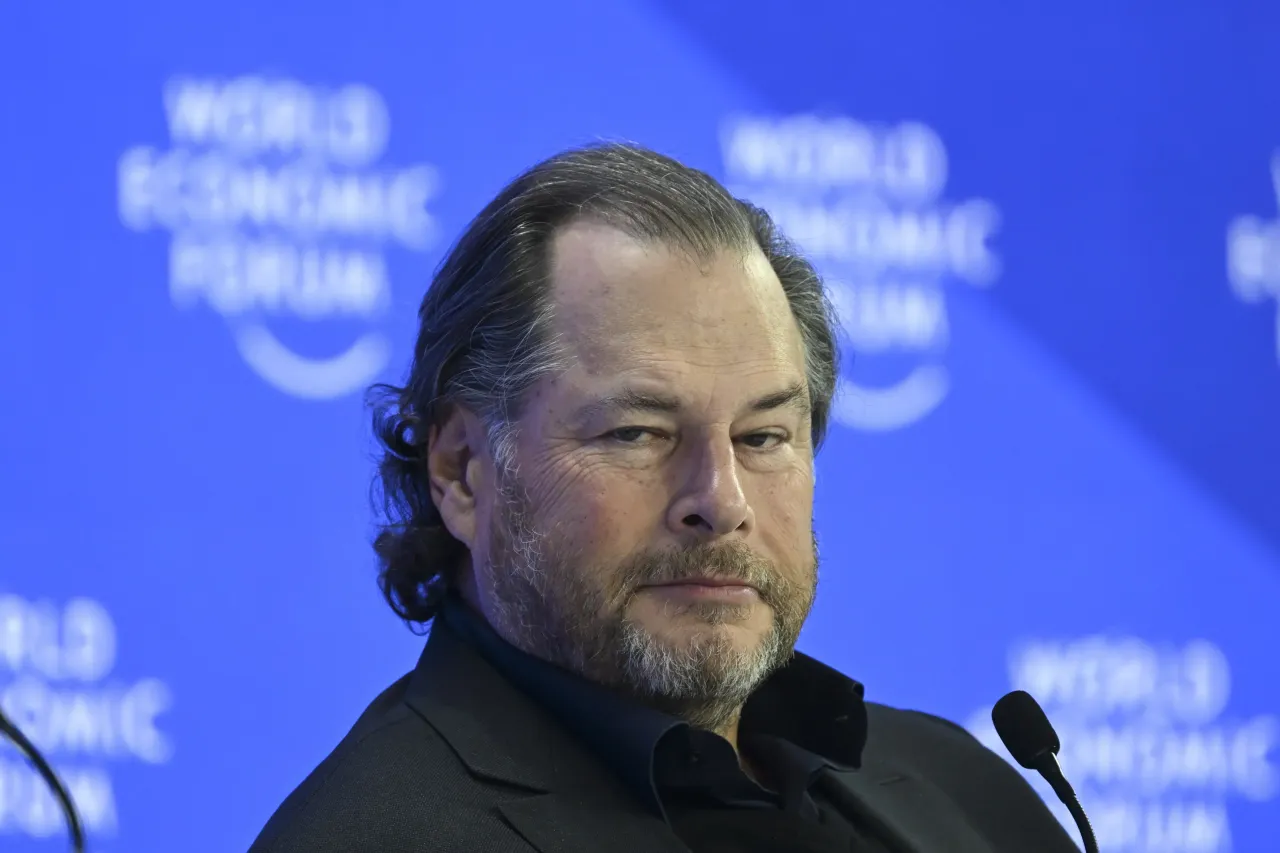
Marc Benioff is pushing back against a growing wave of skepticism surrounding enterprise software.
The CEO of Salesforce has dismissed bearish narratives that question the company’s growth trajectory, arguing that critics are misreading both its financial discipline and its AI strategy.
In a software market marked by slower growth and heightened investor scrutiny, Benioff’s message is direct: Salesforce is not in decline — it is recalibrating.
The Bear Case
Skeptics of Salesforce point to several headwinds. Enterprise IT budgets have tightened after years of aggressive digital spending. Growth rates across SaaS have normalized. Competition in customer relationship management (CRM) and enterprise automation remains intense.
Salesforce has also undergone internal restructuring, workforce reductions and margin-focused cost controls — signals that some investors interpret as signs of slowing momentum.
In public markets, software multiples have compressed compared to pandemic-era highs, intensifying scrutiny on revenue expansion and operating efficiency.
Benioff’s Counterargument
Benioff argues that the narrative misses the bigger picture.
Salesforce has shifted from prioritizing rapid expansion to emphasizing profitability and disciplined growth. Operating margins have improved, and the company has leaned into shareholder returns alongside product development.
Central to his defense is Salesforce’s AI integration strategy. The company has embedded generative AI capabilities across its CRM platform, positioning itself to monetize enterprise adoption rather than compete in foundational model development.
By layering AI directly into customer workflows, Salesforce aims to increase stickiness and upsell potential across its installed base.
AI as Revenue Multiplier
Enterprise software firms are racing to translate AI capabilities into measurable revenue impact.
For Salesforce, AI tools promise:
Automated customer service responses.
Predictive sales forecasting.
Marketing campaign optimization.
Workflow automation across departments.
Rather than chasing consumer AI headlines, Salesforce is focusing on embedding intelligence within business-critical systems.
Benioff’s argument rests on the idea that enterprises will pay for productivity gains — especially in cost-conscious environments.
The Competitive Landscape
Salesforce operates in a competitive ecosystem that includes Microsoft, Oracle and a growing number of vertical SaaS providers.
Microsoft’s integration of AI across productivity tools has intensified competition. Meanwhile, niche SaaS startups are targeting specific industry workflows with leaner cost structures.
Salesforce’s advantage lies in its scale and integration depth. With a vast installed base and broad product suite, the company can bundle AI enhancements into existing contracts.
That scale, however, also makes growth acceleration more difficult compared to smaller, faster-moving rivals.
Investor Sentiment and Market Cycles
The broader software sector is adjusting to a new capital environment. Investors are rewarding profitability and free cash flow more than pure top-line expansion.
In that context, Salesforce’s margin improvements may align better with current market expectations than critics acknowledge.
Still, skepticism persists over whether AI monetization can meaningfully offset slowing organic growth.
A Defining Moment for Enterprise SaaS
Benioff’s pushback reflects a deeper tension within enterprise software.
The sector is transitioning from hypergrowth to optimization. Companies must prove they can generate durable cash flow while innovating through AI disruption.
If Salesforce successfully converts AI features into incremental revenue and retention, bearish narratives may soften.
If not, skeptics will argue the recalibration masks structural slowing.
For now, Benioff is betting that disciplined execution — not market sentiment — will define Salesforce’s next chapter.