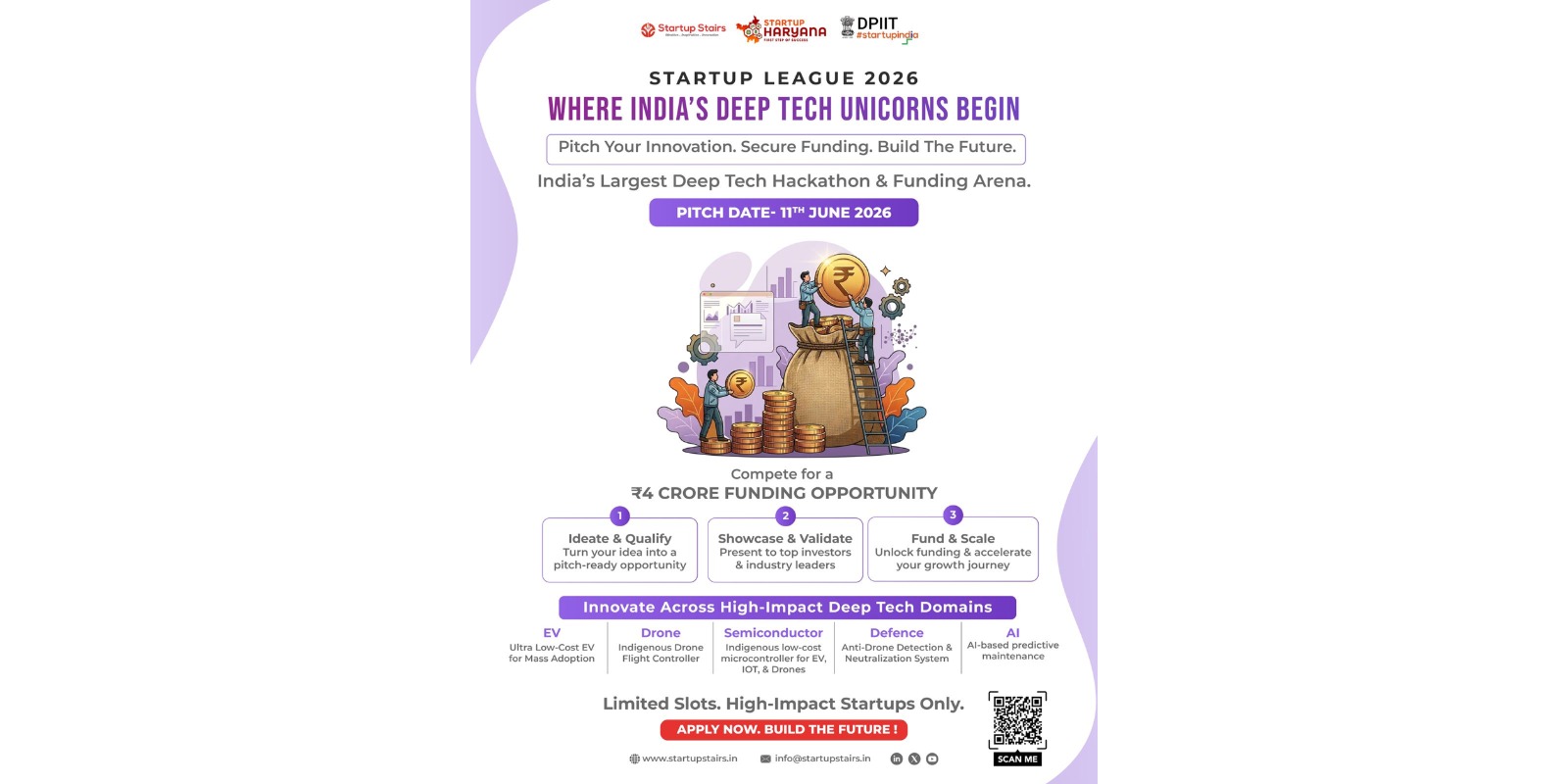
Startup Stairs, an NSDC International-backed incubator and entrepreneurship development organisation recognised by India's Department for Promotion of Industry and Internal Trade, is now moving to close that gap with the launch of Startup League 2026 — a structured national competition designed specifically to surface and support India's next generation of deep tech ventures.
The initiative targets startups working across artificial intelligence, drone technology, robotics, electric vehicles, semiconductors, and defence technologies — precisely the sectors that have lagged behind in commercialisation despite India's well-documented engineering talent advantage.
"India has a strong talent pool, but deep tech startups often struggle with access to capital, mentorship, and market linkages," said Dr. Preet Sandhu, Co-founder of AVPL International and Promoter of Startup Stairs. "This creates a gap between innovation and deployment." It's a diagnosis that anyone embedded in India's startup ecosystem will recognise immediately. The problem isn't a shortage of ideas or engineers — it's the structural distance between a working prototype and a funded, scaling company.
Startup League 2026 is designed to bridge exactly that distance. The event follows a three-stage process: idea screening and pitch refinement in the first phase, live product demonstrations before investors and domain experts in the second, and funding opportunities combined with go-to-market support in the third. It's a format that mirrors how serious accelerators and competition platforms globally — from Y Combinator Demo Day to NATO's DIANA deep tech programme — have moved beyond pitch theatrics toward structured, milestone-driven evaluation.
Participating startups stand to access a funding pool of up to ₹4 crore, along with mentorship, investor connections, and scaling support. Organisers have been appropriately transparent that actual investment outcomes will depend on investor interest and evaluation — a refreshing departure from competitions that advertise funding numbers without the corresponding disclosure of conditionality.
The platform is built to bring together not just founders and funders, but a broader stakeholder table: incubators, corporates, academic institutions, and government bodies. That cross-sector convening is increasingly important in deep tech, where the path from lab to market often runs through regulatory clearance, defence procurement frameworks, or public-private partnership structures that consumer tech founders never have to navigate.
The timing is pointed. India is accelerating its push for indigenous capability in critical technologies — driven in part by hard lessons from global supply chain disruptions during and after the COVID-19 pandemic, and by shifting geopolitical dynamics that have made technological self-sufficiency a strategic priority rather than a policy aspiration. Semiconductors, drone technology, and defence systems in particular sit at the intersection of commercial opportunity and national interest in ways that make structured support programmes like this one consequential beyond just the startups they fund.
Startup Stairs itself brings operational credibility to the initiative. The organisation has supported more than 50 startups and facilitated seed funding exceeding ₹20 crore to date. It is embedded in government-led entrepreneurship frameworks including Startup Haryana and the Uttar Pradesh CM Yuva Udyami Yojana — giving it ground-level reach into the tier-2 and tier-3 cities where a significant portion of India's next deep tech talent is quietly building.
What makes Startup League 2026 worth watching isn't the funding number — ₹4 crore is seed-stage capital, not a Series A — it's the infrastructure around it. For a deep tech founder navigating India's ecosystem alone, the combination of structured mentorship, investor access, and go-to-market scaffolding can be worth considerably more than the check itself. The most common failure mode for technically strong deep tech startups globally isn't bad technology. It's the absence of the commercial and institutional connective tissue that turns a working system into a deployed product.
Applications for Startup League 2026 are currently open for a limited number of startups, and interested founders can apply through the official Startup Stairs website.
India's deep tech moment is building. The policy environment is more supportive than it has ever been, global demand for Indian-engineered technology is growing, and the talent pipeline — from IITs, NITs, and ISRO's alumni network — is deeper than it's ever been. What's been missing is structured, sector-specific support infrastructure that meets deep tech founders where they are. Startup League 2026 is a step toward building it.