A Chinese supplier to Nvidia — reported revenue of 5.5 billion yuan ($804 million) for the three months ending in March, with net income rising 40% to 1.3 billion yuan. That quarterly profit print, arriving just seven days after the company's $2.6 billion Hong Kong IPO debut, is the latest confirmation of something that anyone tracking the hardware stack beneath AI's promise already knows: the biggest winners in this infrastructure cycle aren't always the companies whose names appear in the headlines. House of Commons Library
Every Nvidia H100. Every Blackwell GPU. Every AI server that Google, Microsoft, and Meta are deploying at a pace that is reshaping the global energy market — all of it runs on printed circuit boards. And Victory Giant makes the most sophisticated of them.
How a Former Soldier Built the AI Era's Most Important Boring Company
Chen Tao founded Victory Giant Technology in 2006 in the Xingcheng Technology Park in Huiyang, Guangdong. His background — military service, civil servant, PCB salesman at a Taiwanese factory — is not the typical origin story of a tech company worth $39 billion. But it explains the operational discipline that has made Victory Giant what it is.
In 2019, Chen made the decision to establish Victory Giant's High Density Interconnect division — a bet on the complex, high-end boards needed for gaming graphics cards. The bet paid off as Victory Giant became a core supplier of Nvidia, including supplying its H-series AI accelerator cards. UPI
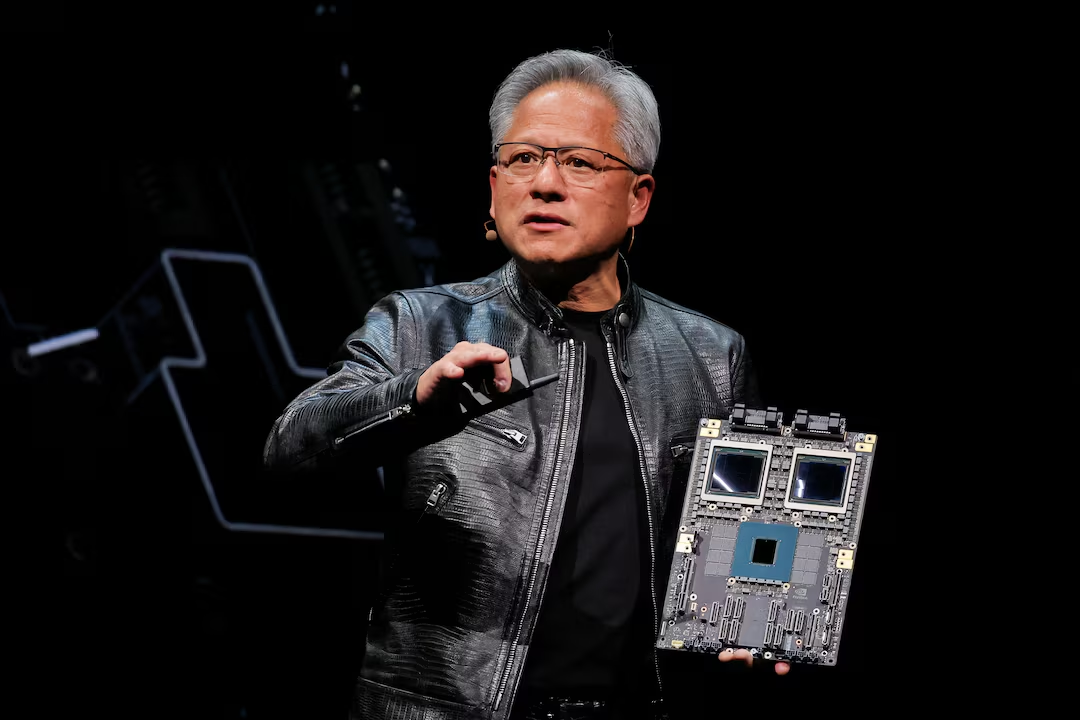
That 2019 decision — made years before the generative AI wave that Jensen Huang would ride to making Nvidia the world's most valuable company — is the strategic inflection point that separates Victory Giant from every other Chinese PCB manufacturer that watched the AI boom arrive rather than prepared for it. HDI boards require precision manufacturing tolerances, specialised materials, and process control that most commodity PCB factories cannot achieve. By investing in HDI capability when the primary application was gaming graphics cards, Chen positioned Victory Giant to be the natural supplier of choice when those same boards became the substrate for data centre AI accelerators.
"Orders are coming in extremely robust," Chen said in a Bloomberg TV interview following the Hong Kong listing. Roughly three quarters of the funds raised will be used to expand capacity in China, while the rest will fund Southeast Asian expansions to meet client requirements. North American customers account for 70% of Victory Giant's revenue. LBC
Seventy percent North American revenue. From a company headquartered in China. That figure is the tension at the heart of every analyst note written about Victory Giant — and the reason the export control risk disclosure sits prominently in every investor presentation.
"This IPO could be an attractive value growth opportunity, provided there are no further export controls from the US side. The company can use the proceeds to grow its market share in the ASICs market, though it needs to compete with existing suppliers from Taiwan and Japan."
— Gerald Gan, Chief Investment Officer, Reed Capital Partners
The PCB No One Talks About — Until It's Missing
The printed circuit board is the most overlooked component in the AI infrastructure conversation. When the discourse focuses on Nvidia's GPU supply constraints, HBM memory from SK Hynix, or TSMC's CoWoS packaging capacity, the PCB sits beneath all of it — literally. It is the substrate that routes power, signal, and data between every component on an AI accelerator. Without it, the GPU is useless.
High-density interconnect boards — the specific type Victory Giant specialises in — are meaningfully different from the commodity PCBs inside a consumer laptop. They require microscopic via drilling, laser-ablated cavities, and layer counts that can exceed 20 in the most complex AI server configurations. The yield rates at those specifications are low. The manufacturing expertise required takes years to develop. Victory Giant led PCB makers worldwide in revenue in the field of AI and high-performance computing in the first half of 2025, with 13.8% of the market. UK Parliament
That 13.8% global market share in AI/HPC PCBs — held by a company from Huizhou that most Western investors couldn't have located on a map eighteen months ago — is the counterintuitive observation buried in this story. The AI infrastructure supply chain is not primarily American. It is not primarily Taiwanese. It is distributed across a geography that the US-China technology decoupling narrative consistently underestimates, because the components that sit below the chip level — the substrates, the boards, the interconnects — are still produced in China at scale that alternatives cannot currently match.
The company's Shenzhen-listed shares increased more than 580% in 2025, leading the MSCI Asia Pacific Index. Last year, Victory Giant reported revenue of 19.3 billion yuan. Analysts project its revenue could grow by 70% in 2026. LBC
Victory Giant — Q1 FY2026 at a Glance | |
|---|---|
Revenue (Q1 2026) | 5.5 billion yuan ($804M) |
Net income growth (YoY) | +40% to 1.3 billion yuan |
Full-year 2025 revenue | 19.3 billion yuan ($2.8B) |
Analyst forecast: 2026 revenue growth | +70% |
Hong Kong IPO proceeds | $2.6 billion (April 21, 2026) |
Market capitalisation (post-IPO) | ~$39 billion |
Shenzhen share price YoY gain (2025) | +580% |
Global AI/HPC PCB market share (H1 2025) | 13.8% |
North American revenue share | ~70% |
The Hong Kong Listing as Strategic Architecture
Victory Giant's April 21 Hong Kong IPO — the city's largest listing since Zijin Gold International's $3.7 billion offering last September — was not primarily a fundraising event. It was a geopolitical positioning move.
Victory Giant plans to add $30 billion in capacity over the next three years, including an additional $10 billion worth of products to be manufactured in Thailand, Vietnam, and Malaysia. That Southeast Asian manufacturing footprint, being built simultaneously with the Hong Kong listing, answers the question that every North American customer has been asking since the Biden administration's export control escalations: what happens to our supply chain if US-China trade tensions produce new restrictions on Chinese-manufactured components? LBC
In 2024, Victory Giant acquired Taiwanese competitor APCB's business in Thailand. In March 2025, VGT started constructing a factory in the Bac Ninh province of Vietnam. The project's estimated cost is $520 million. UPI
Vietnam. Thailand. Malaysia. A $520 million factory in Bac Ninh — the same industrial province that Samsung, LG, and Foxconn have used as their primary Southeast Asian manufacturing hub. Victory Giant is building a China-plus-one supply chain architecture that mirrors what every sophisticated electronics manufacturer has been constructing since 2018, when the first round of Trump tariffs made single-country manufacturing concentration an unacceptable risk.
The Hong Kong listing provides international capital access and the investor credibility that comes with a market that North American and European institutional investors can access directly. Jack Ma's private equity firm Yunfeng Capital and Singapore-based Hillhouse Investment were reported among the 37 cornerstone investors, who collectively committed approximately $997 million — agreeing to hold the shares for at least six months. Yunfeng and Hillhouse together provide both the mainland China strategic legitimacy and the Southeast Asian institutional credibility that the investor base requires to trust a $39 billion valuation in the current geopolitical climate. LBC
The Hong Kong market's role here deserves specific attention. For Chinese technology companies with significant US revenue exposure — and Victory Giant's 70% North American revenue makes it a clear example — Hong Kong provides a listing venue that is simultaneously accessible to global capital and insulated from the delisting risks that Chinese companies face on US exchanges under the PCAOB audit inspection framework. Hong Kong's revival as a technology listing destination in 2026, after several lean years, is at least partly attributable to the structural demand from Chinese AI supply chain companies that need international capital but cannot or will not pursue US listings. Victory Giant's $2.6 billion raise — and the 57% first-day gain that validated it — is the clearest evidence yet that this market is functioning again for serious companies with serious fundamentals.
The Export Control Risk Is Real. So Is the Structural Advantage.
Citigroup analysts led by Karen Huang maintain a buy recommendation for Victory Giant, valuing the Shenzhen-listed shares at 20 times 2027 earnings with a price target of 415 yuan, citing robust growth driven by AI-related PCB demand, upside to average selling prices, and potential opportunities in data centre switches and ASICs. My Mobile India
That ASIC opportunity — mentioned almost in passing in the Citigroup note — is the strategic horizon that makes Victory Giant's valuation sustainable beyond the current GPU-driven demand cycle. Application-specific integrated circuits, custom-designed for AI inference rather than general-purpose training, are the next frontier in AI hardware. Companies like Google (with its TPUs), Amazon (Trainium), and Microsoft (Maia) are all building ASIC programmes that will require high-end PCB substrates. The supplier that already has the manufacturing relationships, process expertise, and capacity scale to serve Nvidia's GPU programme is the natural incumbent to serve the ASIC programmes that follow.
The export control risk that Reed Capital Partners' Gerald Gan flagged is not hypothetical. The Biden administration's October 2022, October 2023, and subsequent chip export control packages have progressively restricted what US companies can sell to China. What those packages have not restricted — yet — is Chinese companies selling PCBs to US customers for integration into AI servers assembled outside China. Victory Giant's Southeast Asian manufacturing expansion is a hedge against the scenario where that changes.
Key Takeaways
Victory Giant's 40% profit jump in Q1 2026 reflects structural AI infrastructure demand, not a cyclical spike. Revenue climbed to 5.5 billion yuan with net income rising to 1.3 billion yuan — the latest in a consistent trend of quarterly acceleration that predates the Q4 2025 ChatGPT-moment comparisons that analysts reach for. House of Commons Library
The 70% North American revenue concentration is the company's biggest risk and its biggest validation simultaneously. The same customers who create export control risk — Nvidia, US hyperscalers, North American AI server assemblers — are the customers whose demand is driving Victory Giant's growth. You cannot decouple that tension.
The Southeast Asian manufacturing expansion is defence, not offence. A $520 million Vietnam factory and Thailand capacity are not growth investments — they are political insurance. The growth investment is the mainland China capacity expansion that consumes three-quarters of the $2.6 billion IPO proceeds.
The Hong Kong listing is a template for how Chinese AI supply chain companies access global capital in 2026. The combination of cornerstone investors from both Chinese and Southeast Asian institutional networks, a listing venue accessible to global allocators, and a genuine fundamental story creates a structure that other companies in the AI supply chain are already studying.
PCBs are where the next supply chain panic will come from. Memory, substrates, packaging — each has had its moment of acute shortage-driven attention. High-end PCBs for AI servers are the next component that will be front-page news the first time a data centre buildout slips its schedule because of board availability.
What This Means for Founders Building on AI Infrastructure
The Victory Giant story is worth understanding not just as a financial market story but as evidence about where value actually accumulates in technology platform cycles. The companies that become dominant in technology infrastructure — the ones that compound for decades — are rarely the ones writing the software. They are the ones manufacturing the components that the software requires to run. Intel. TSMC. Samsung. The pattern is consistent.
Nvidia's supply chain, as it has scaled from a gaming GPU company to the infrastructure provider for the AI era, has created a constellation of companies whose growth is as structurally driven as Nvidia's own. Victory Giant is the most visible of them right now — but the same dynamic is playing out across PCB substrate manufacturers, advanced packaging companies, and specialised materials suppliers whose names don't appear in TechCrunch headlines.
For founders building AI-native applications — the people reading this on StartupNews.fyi — the Victory Giant story carries a specific message: the infrastructure you depend on is more fragile, more geographically concentrated, and more politically exposed than the cloud console interface that abstracts it makes it appear. A trade policy change, a factory flood in Huizhou, a Taiwan Strait incident that disrupts shipping lanes — all of these affect the hardware that your inference API calls are running on. The companies that understand their dependency chain, rather than treating compute as a utility, will be better positioned to navigate the disruptions that complex supply chains inevitably produce.
"It's not just about investors buying into China's hard tech — it all comes down to fundamentals," said Kenny Ng, strategist at China Everbright Securities International. "Thanks to the AI boom, demand and growth for PCBs are incredibly strong right now. Ultimately, it's the huge upside of the AI hardware sector that's really driving the price." Electronic Frontier Foundation
The fundamentals are correct. Chen Tao's 2019 bet on high-density interconnect boards — made when the primary application was gaming, not AI — is now worth $39 billion. The AI infrastructure buildout that Nvidia is driving has made an unglamorous factory in Huizhou one of the most consequential companies in global technology. And the 40% profit jump that Victory Giant posted on April 28, 2026 is not the end of that story. It is somewhere in the middle.