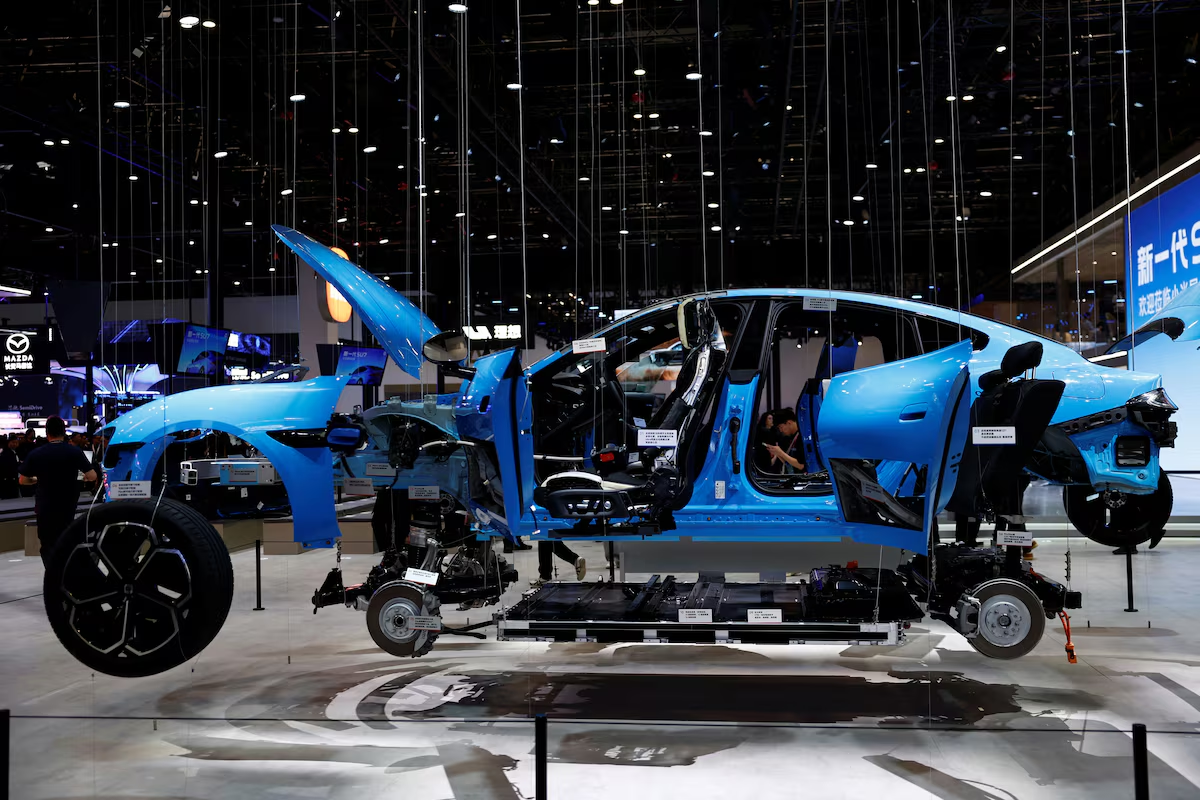
At this year’s Beijing Auto Show, hardware specifications were no longer the primary headline. Instead, software — particularly in-car artificial intelligence — dominated the narrative.
Xpeng and Xiaomi used the global stage to highlight next-generation intelligent cockpit systems and AI-driven driving capabilities, signaling how competition in China’s EV market is increasingly defined by code rather than chassis design.
As electric vehicle adoption matures, differentiation is shifting toward software ecosystems and autonomous features.
Xpeng Doubles Down on Intelligent Driving
Xpeng, long positioned as a technology-first automaker, demonstrated upgrades to its advanced driver-assistance systems and AI-powered cockpit interface.
The company emphasized improvements in real-time perception, voice interaction, and AI-assisted navigation. Its intelligent driving stack integrates high-performance chips with proprietary software designed to enhance lane recognition, obstacle avoidance, and urban driving assistance.
For Xpeng, AI is not an add-on feature. It is central to brand identity.
The company’s strategy reflects a broader industry shift in which EV makers compete on digital capabilities comparable to smartphone ecosystems.
Xiaomi Expands Its Automotive Ambitions
Xiaomi, originally known for smartphones and consumer electronics, continues to deepen its automotive presence following its formal entry into the EV sector.
At the show, Xiaomi showcased enhanced AI cockpit integration that connects vehicle systems with its broader ecosystem of devices. The seamless linking of smartphones, smart home products, and vehicle dashboards illustrates Xiaomi’s ambition to replicate its consumer electronics ecosystem inside cars.
The integration strategy positions Xiaomi vehicles as extensions of its existing technology network rather than standalone products.
This ecosystem-first model mirrors trends in the U.S., where automakers increasingly integrate proprietary software layers to control user experience and data flows.
China’s EV Software Arms Race
China’s EV market is the world’s largest and most competitive. With dozens of domestic manufacturers vying for share, price competition has intensified.
As hardware margins compress, software capabilities — including AI-assisted driving and intelligent cockpit features — have become key differentiators.
Voice assistants capable of contextual conversation, predictive maintenance alerts, personalized infotainment systems, and real-time route optimization are increasingly standard expectations.
In this environment, AI becomes both a marketing differentiator and a core engineering requirement.
Global Implications
The advancements displayed in Beijing reflect China’s growing influence in automotive AI development.
While U.S. companies focus heavily on autonomous vehicle startups and robotaxi models, Chinese automakers are embedding AI features directly into consumer EVs at scale.
For global automakers, the competitive benchmark is shifting rapidly. AI-enabled driving assistance and digital cockpit personalization are becoming minimum standards rather than premium add-ons.
The integration of over-the-air updates further allows Chinese manufacturers to iterate software rapidly, accelerating feature deployment cycles.
Regulatory and Infrastructure Considerations
China’s regulatory environment has gradually expanded pilot zones for intelligent driving technologies, supporting broader adoption.
Advanced mapping infrastructure and 5G connectivity also enable real-time vehicle-to-cloud communication — a key component of AI-powered driving systems.
However, safety validation and liability frameworks remain evolving areas globally, particularly as higher levels of automation are introduced into consumer vehicles.
The Bigger Signal
The Beijing Auto Show underscored a structural transition in the automotive industry.
Electric vehicles are no longer defined solely by battery range or acceleration.
They are becoming AI platforms on wheels.
For Xpeng and Xiaomi, leadership in in-car AI represents not just a feature advantage but a long-term strategic bet that software will define automotive value.
As EV hardware becomes increasingly commoditized, intelligence — powered by AI — may determine which brands lead the next decade of mobility.